


Plenty of Steam Games, but Can't Choose One?
Can't choose from your Steam games? Follow four fictional games through reasons to start or return, reminders, friends' plans, and your idea of finished.
Article languages
On this page
- Should Thursday night's choice also be Saturday's?
- Between giving a game more time and stopping
- Putting those decisions into collections
- Leave yourself a first action for a paused game
- A game with friends follows the plan you've made
- What "finished" means on your own list
- Keep frequently used lists up front, and update reasons when they change
You open Steam, but none of your games makes you want to click Play. These are games you once chose because you wanted them. You're pleased to see their names, and you still want to try them someday. Yet when you think about what to launch today, you spend longer and longer scrolling up and down the list.
I'm not sure that more detailed genre categories are the first thing this situation needs. If you know where a game is but struggle to choose it, separating action games from RPGs may leave you hesitating in exactly the same place. Today you might be curious about a new story while also not wanting to learn new controls. You can't quite tell whether anything on the list fits both wishes.
What I'd want to keep in the library in that situation is the reason I meant to return to a game. Information about the game, such as its genre, matters. So does what I'm hoping to get from it now.
We'll follow four fictional games you already own through some choices between a weekday evening and the weekend: a game with a new story to start, a puzzle game you paused, a game with familiar controls, and one you arranged to play with friends. These aren't real products or records from my account. They're examples for thinking about what to play from the games you own, without buying more.
Should Thursday night's choice also be Saturday's?
Suppose it's Thursday night and you have about forty minutes to yourself. Of the four games, the new story interests you most. Every time you see its cover, you think about starting it, but you haven't seen the opening scene yet. The familiar game also catches your eye. In this example, you already know what to do in it, so it's easy to return to.
My first question would be what I want from those forty minutes today. Is this a day when I want even a small look at a new world, or one when I want to do something familiar without reading any more instructions? Both are worthwhile; the games fit different purposes. If I choose the new game but expect to settle into it as easily as the familiar one, I'm choosing it for one reason and expecting a start that doesn't fit that reason.
Today I'll choose to rest. I'll launch the familiar game and leave the new story on the list as something to start for the first time on Saturday. The useful part of "Saturday" is what I expect to have changed by then. I'm putting it off because I expect to have more time and more patience for unfamiliar rules. That leaves me more to go on next time than putting it on a vague "later" list. I can check on Saturday whether the choice still makes sense. If I don't have the time then either, I may need another occasion. The problem would be turning Thursday's choice into a permanent ranking in my library. If the immediately comfortable game always stays at the front and I leave no reason to start something new, I may see the same options on the weekend even when I have more time. That's why I'd separate games to continue now from ones I'm considering starting.
On the other hand, if I opened Steam that same Thursday because I was tired of repeating something familiar, I could choose the new story. I wouldn't expect to reach a major turning point in it. Getting a feel for the opening atmosphere and controls could fit my reason for choosing something new that day. That doesn't mean I've set aside enough time to fully enjoy an unfamiliar game. It means I can decide what I'd like to find out in a short session.
Still, I can't easily decide that forty minutes is enough if I don't even know whether I can stop where I want to. If I don't know how long the first launch will take or when I can put the game down, that uncertainty belongs in the decision too. If I absolutely have to finish at a set time today, I'd leave it as a weekend option.
There's no reason a new game should always be the better choice. If I'm playing to relax and learning unfamiliar rules feels like work, the familiar game fits that day's purpose. But what if I keep wanting a new experience and always choose whichever game needs less preparation? I'd consider whether I'm asking those weekday evenings to fit something they don't leave much room for. Instead of removing the new game from the list, I could make a separate plan for when to start it.
Installation status can mean different things here too. If I'm choosing something to launch now, it's convenient to look first at games that are already prepared. If I'm choosing for the weekend, I have time to prepare, so I can consider games that aren't installed. Treating installation as the same thing as current interest could keep a game I left installed long ago on the list, while excluding one I uninstalled before wanting to play it again. Whether being installed means every condition needed to actually run it has been met is a separate question.
Now it's Saturday. Let's say I have as much time as expected and I'm still interested in the new story. The reason I put it off on Thursday is gone, so I'd choose the new game. This isn't a list automatically recommending a good game. I've looked at the reason I left myself and judged whether today's conditions fit. When I hesitate for the same reason another time, I have less need to compare all four games from the beginning.
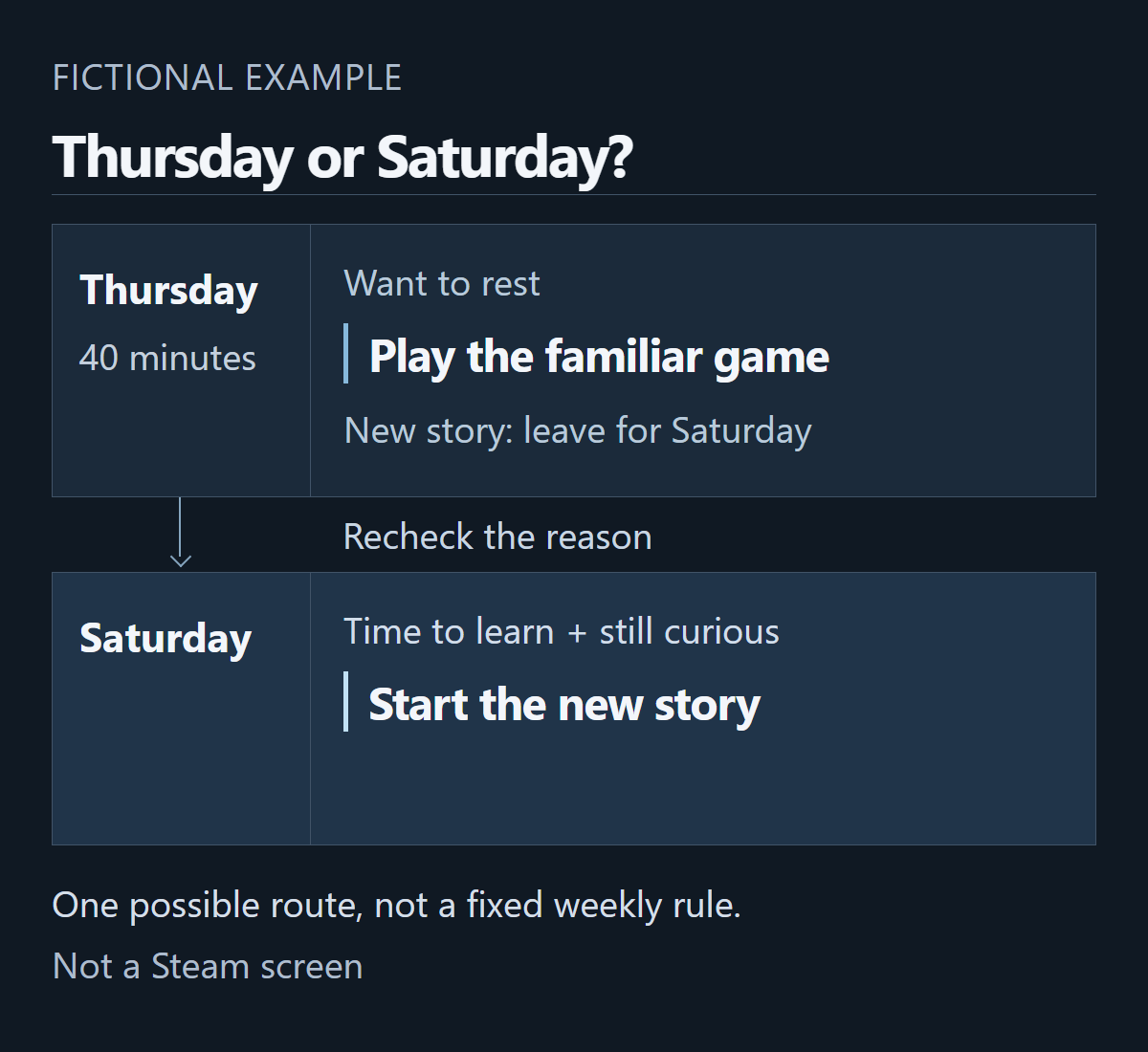
An example to explain a choice. It does not show a recommended playtime or an actual Steam screen.
Even with more time, I might be more curious about the puzzle game. If I've thought of another way to solve the problem that stopped me before, I don't need to discard that idea just because I now have the opportunity to start a new game. In that case, there's a clear reason for changing the plan. But if the new story still interests me most and I keep repeating that it might feel unfamiliar at first, I'd write down more specifically what I need to learn before starting. Changed interests and a lingering reluctance to begin call for different information later.
Between giving a game more time and stopping
There are still decisions to make after starting the new story. Let's continue our fictional Saturday a little further. Suppose I've seen the opening screen and introduction and tried moving around, but I still don't know whether I'm enjoying it. I might wonder whether to move it straight into a "not enjoyable" group or keep it because I've already started.
I'd first try to put the reason I want to stop into specific words. Was I unable to do what I wanted because the buttons were unfamiliar? Were there too many characters for me to understand the situation yet? Or did I dislike the actions I'd already tried? I'm trying to distinguish reasons for expecting a little more play to resolve the problem from reasons that give me no basis for that expectation.
If the controls were the problem, I have a fairly clear idea of what to check next. I could leave a plan to learn how to do the action I wanted and see whether playing still feels frustrating once I can. I still don't know whether I'll end up enjoying the game. I've only identified one thing getting in the way of judging it. The useful part is having something to look at first when I return.
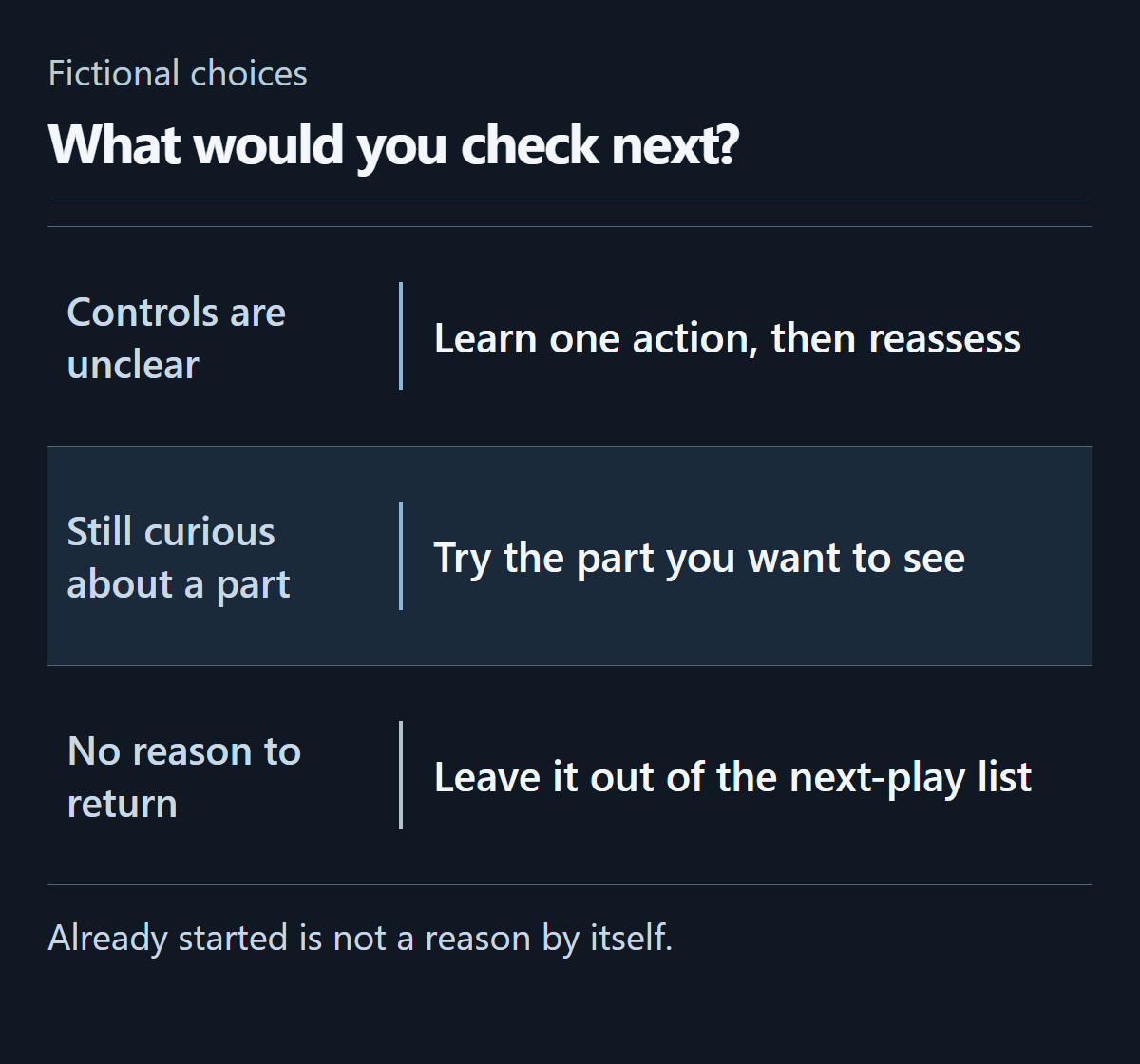
These choices depend on the interest that remains. They do not guarantee that a game will become enjoyable.
Now suppose I understood the actions but didn't want to repeat them. I can't invent a reason to believe familiarity will make me like the game. I'd think about whether I'm curious about the story ahead or looking forward to another part. If there's no interest left, I'd leave it off the list of what to play next. That judgment doesn't have to agree with everyone else's assessment of the game. I'm managing the list I'll choose from.
Some cases fall awkwardly between the two. I might dislike the introduction without having reached the scene that first interested me. Then I'd consider whether I'm still looking forward to that scene or feature. If curiosity makes me want another look, I have a reason to return. If I'm waiting for a payoff I'm not even sure will come because I don't want the time I've spent to be wasted, I'd need to rethink my reason for continuing.
I think it's more useful to ask what I want to see the next time I launch a game than how many hours I should endure. A small goal, such as trying an action I couldn't do before or taking another look at a situation I didn't understand, gives me something to judge afterward. If I try to write down a purpose and all I'm left with is "because I started," I'd choose something else.
Of course, I might end up dropping every unfamiliar game just as quickly. Even then, I wouldn't want to solve it with advice to put up with it and finish. Rereading a few of the reasons I left for stopping could give me something to go on. If I stopped every one of those games before getting used to the controls and still want to play something new, I'd choose the one that interests me most and try again on a day when I have room to learn. I wouldn't reassess every game I'd stopped all at once.
What if the records instead show different reasons for not continuing each game, and I still agree with those judgments? I don't think the number of games I've stopped is a problem by itself. There needs to be some interest left to make a game worth considering again. If reducing the number marked "stopped" becomes the whole purpose, it obscures the information I need to choose what I actually want to play next.
A game I've already spent a long time on can create another hesitation. I might feel close to the ending or feel that I should continue because of the time I've put into the earlier parts. I'd start with where I want to spend my time next. Wanting to see the rest of the story is a reason to return. Launching it only to put it in a "finished" group, without being curious about what's left, is a different state even if it's on the same list. Some people do want the act of finishing itself, of course. If completing one of several games in progress is this weekend's goal, that can be the reason I write down. But I need to be the person who chose that goal. I don't want a record of time already spent to allocate the remaining time to the game automatically. Distinguishing a game I want to finish from one I feel I ought to finish for the sake of tidying up helps me choose honestly.
The effort spent preparing can also provide information for the next choice. Consider a separate case in which I finished learning the controls on Saturday. I only have forty minutes again next Thursday, but part of the reason I initially put this game off has been resolved. If there's new content I still want to see and I now know how to play briefly and stop, I'd consider it for a weekday. If I had grouped it under "new games are for weekends," the label would now lag behind the actual situation. What I learned during that preparation is the reason the choice has changed.
Even after preparing, I might not choose the game again if there's no interest left. Learning the controls may have made the next start easier. Whether I should also keep playing because I don't want that effort to go to waste is a separate question. I'd ask whether, alongside "ready to play," I can also write down something I want to see next. If it's easier to launch on a weekday and I'm still curious, I have both reasons to keep it as an option.
If I haven't learned the controls yet, I'd leave a note on the new story to reassess it after learning them. The puzzle game still has a reason to return: another attempt at the device where I got stuck. Both are options to resume, but the next action differs. Keeping that difference means I don't first have to reconstruct why I put each game on the list when I open it.
Putting those decisions into collections
For the new library released in 2019, Valve's redesign introduction describes organizing games by dragging them into collections and using dynamic collections to group them automatically through tags and filters. It also introduces displaying and sorting collections on home shelves. The currently available Steamworks tag documentation also confirms that tags are used in dynamic collections.
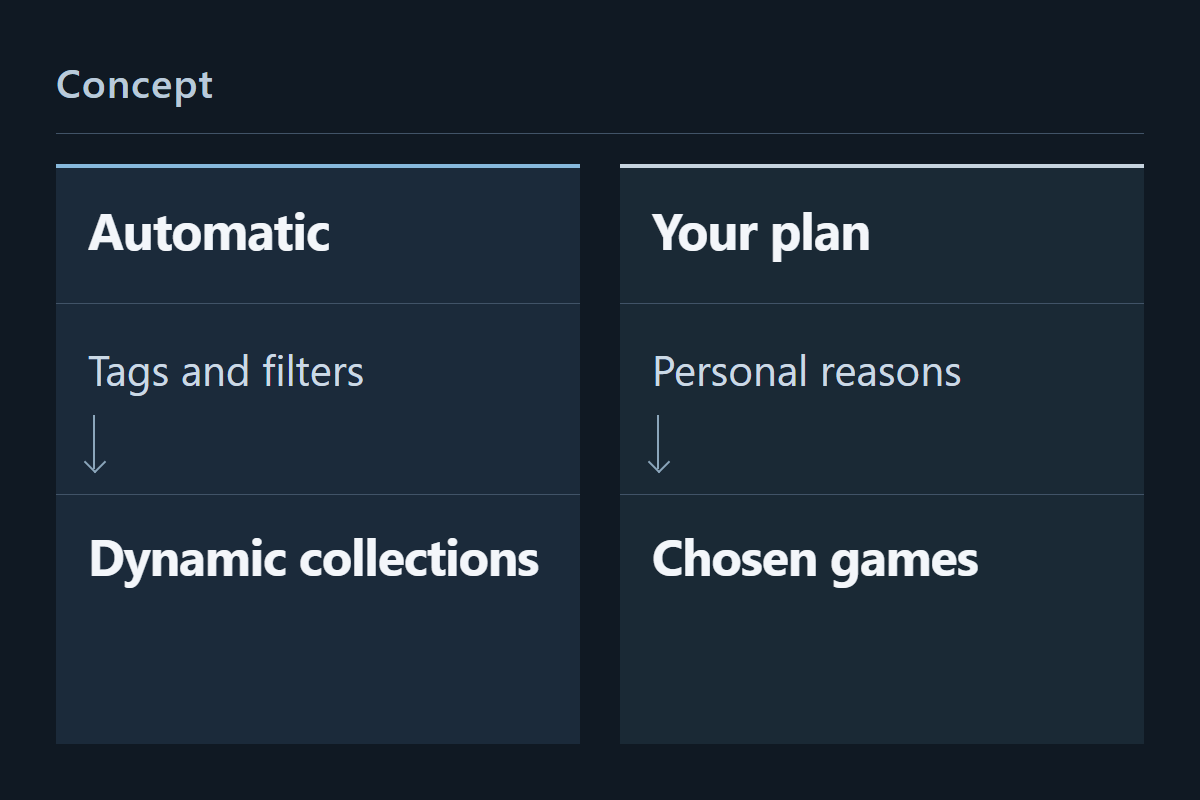
This is a concept diagram, not a Steam screen.
The distinction I'd take from this introduction is simple: keep candidates grouped by conditions separate from my reasons for wanting to play them again.
I could group all four fictional games under "interested." But that name alone would leave me working out again whether I was waiting for time to start a new game, had found a reason to pick up where I left off, or was waiting for a date to play with friends. I'd like the names to reflect choices I actually face often. There's no need to build a classification for every possible situation at the outset.
I think a name is useful when it makes sense on reopening a list, not just when adding a game to it. If I write "play next," I'd like to know whether I meant after finishing my current game or as soon as this weekend. Broad names such as "for now," "miscellaneous," or "someday" are possible too. But if reopening them sends me through the same decision from scratch every time, I'd leave a little more information in the name.
"Stopped" is another name worth examining. If it contains both games I still enjoyed but paused for lack of time and games I stopped because I didn't want to continue, I'll need to distinguish them when choosing next. A collection name could get unwieldy if I tried to fit all of that into it. It may be better to leave the games I want to reconsider on the list and put the reasons I stopped in a short note.
I wouldn't recommend reducing the number of options simply because someone owns lots of games. A 2010 meta-analysis of choice overload combined 63 conditions from 50 experiments involving 5,036 participants. The average effect was close to zero, with substantial variation between studies. This did not rule out every difficulty caused by having many options, nor was it a study of Steam users. It cannot determine the right number of games to consider in my library.
If a list has grown long, I'm more interested in its contents than its size: whether it holds many games I kept after my interests changed, mixes games I'd look for on different days, or remains enjoyable to browse despite its length. In the first case, I'd update it to reflect my current judgment; in the second, I could separate situations that come up often. In the third, I wouldn't feel a need to shorten it just because the number is large.
Leave yourself a first action for a paused game
Let's return to the puzzle game. I want to play it again, but I can't remember what I last tried. If I stop at choosing it as a game to resume, I'll have to search for the same memory again on the day I launch it.
For this fictional puzzle, one line could be enough: "Try changing the order at the eastern device." That gives me a clearer next action than "it was fun" and asks less of me than writing up the solution to the whole game. When I return, I need a reminder of what I was about to try when I stopped more than a summary of how I felt about the game.
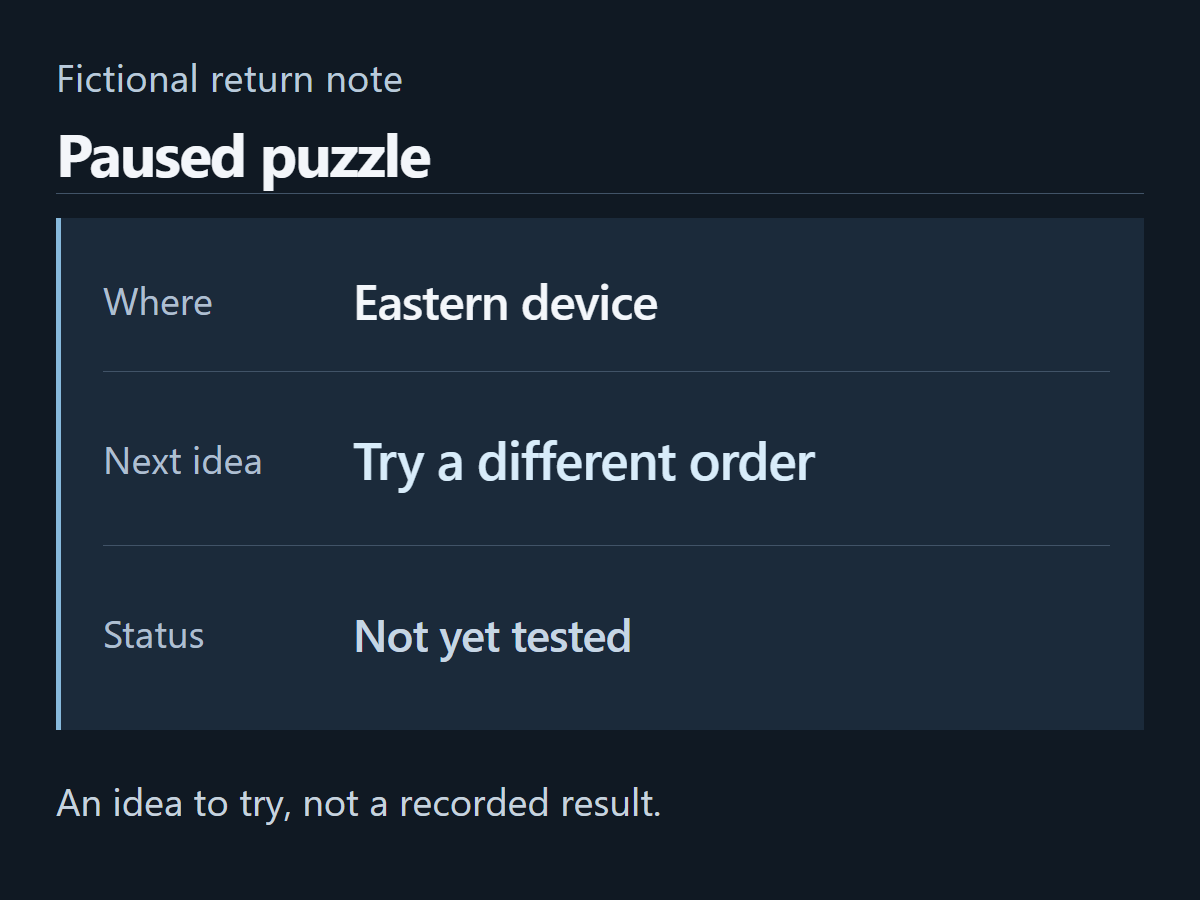
An example of a personal reminder for returning to a game. It does not show a Steam feature or the solution to a real game.
I'd distinguish what I've already tried from what I want to try next. If I already changed the order and it didn't work, but write that down as an idea for next time, I could repeat the same failed attempt when I return. For an idea I'm not yet sure about, "something to try" is enough. Even a short note can distinguish what I confirmed at the time from an idea that occurred to me. A note can also be too short to understand later. "Try that device again" could leave me searching for which device I meant. At the other extreme, trying to record everything around it would make me doubt whether I'd keep doing it. I'd start with the game name, a clue to the location, and the action I meant to try next. If rereading it shows me what was missing, I can add that detail to the next note.
There's no need to choose a particular note-taking app. Leave it with the game's name somewhere you'll look again. The collection name could indicate that these are games to resume, while you keep memories of each game's progress separately.
After launching it again, I might no longer want to pursue my old goal. If I'm still curious about the puzzle's answer but want a fresh look without using my previous approach, I can start that way. The record helps me recall a starting point. If feeling obliged to follow the note makes me put off the game, I'd reread it to see whether I've mixed an idea for future reference with a goal I specifically wanted to continue.
I'm not writing a walkthrough to explain the game to someone else. It only needs to make sense to me later.
A game with friends follows the plan you've made
For the fourth game, let's assume we've already checked the game mode and platform requirements and decided who's playing. Here, the choice turns on how definite the arrangement is, rather than how we'll connect. My weekend looks different depending on whether we've only said "let's play together sometime" or agreed on Saturday evening.
Suppose I plan to start the new story alone on Saturday afternoon and play with friends in the evening. That evening arrangement also matters when I choose my solo game. Even if I want a long first day with the new one, I can't easily promise it the whole afternoon while I don't yet know when I can stop. Once the time with friends is confirmed, I'd record that plan first, because I need to choose my solo option to fit the time left that day.
If we haven't set a date, it's different. I don't need to leave every weekend open just because there's a game we'd like to play together someday. Separating games we'd like to try from the one we'll actually play at our next arranged session helps me avoid reading a list of possibilities as a confirmed schedule. Once we agree on a date, I can keep the game's name wherever I'll check that date again.
Does each friend need a separate list? I think that depends on how the groups actually form. If the same people always play the same game, one plan might be enough. If I play with several different combinations of people, I may need to note whom I meant to play each game with. Rather than creating a space for every friend's name first, I'd find it more useful to ask whether I've mixed up arrangements before. Again, the reason to add a list is information I'll actually need to find later.
If a session is postponed, what to record depends on why. First I'd check whether interest in the game is gone or we just need another date. If the date is the problem, we can keep it as something to play together and arrange another session. If we no longer intend to play together, there's less reason to leave it as a confirmed plan. I can't decide how the other person feels on their behalf, so if we haven't talked about it yet, recording that unresolved state is more accurate.
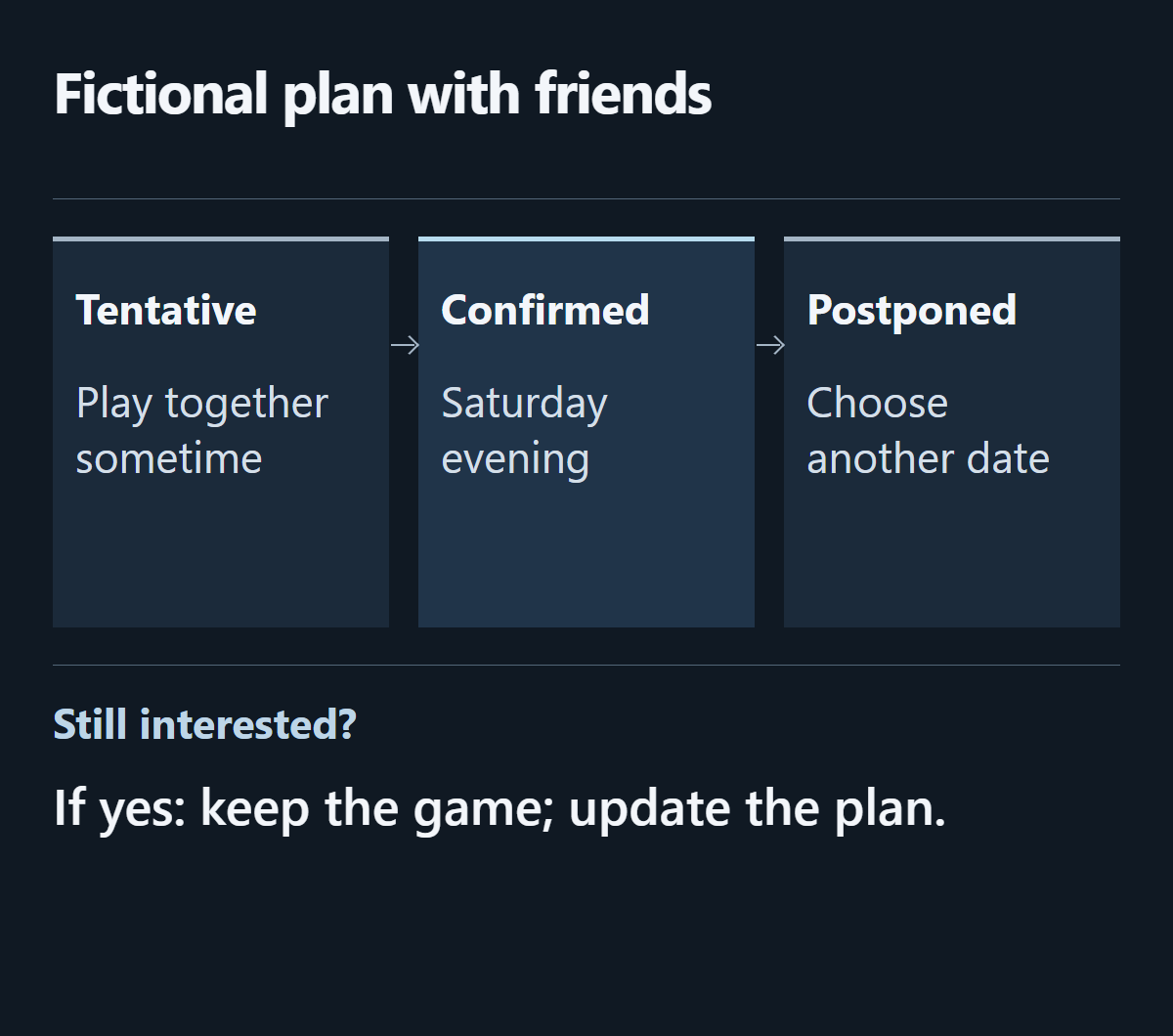
A postponed session alone does not tell you that the other person has lost interest.
What "finished" means on your own list
Suppose the weekend has passed and I open the library again. I've decided to give the new story a little more time, and I've solved the part of the puzzle game that stopped me. I briefly returned to the familiar game on Thursday, and the session with friends has moved to next week. Dividing the four into only "played" and "not played" would lose much of what I decided.
Solving the part that blocked me in the puzzle game might not mean I've finished the whole game. If there are more puzzles I want to do, it belongs among games to continue. If solving that one puzzle satisfies my curiosity for now, I can take it off the immediate play-next list. Which applies is for the fictional player to decide. Neither follows automatically from solving one puzzle.
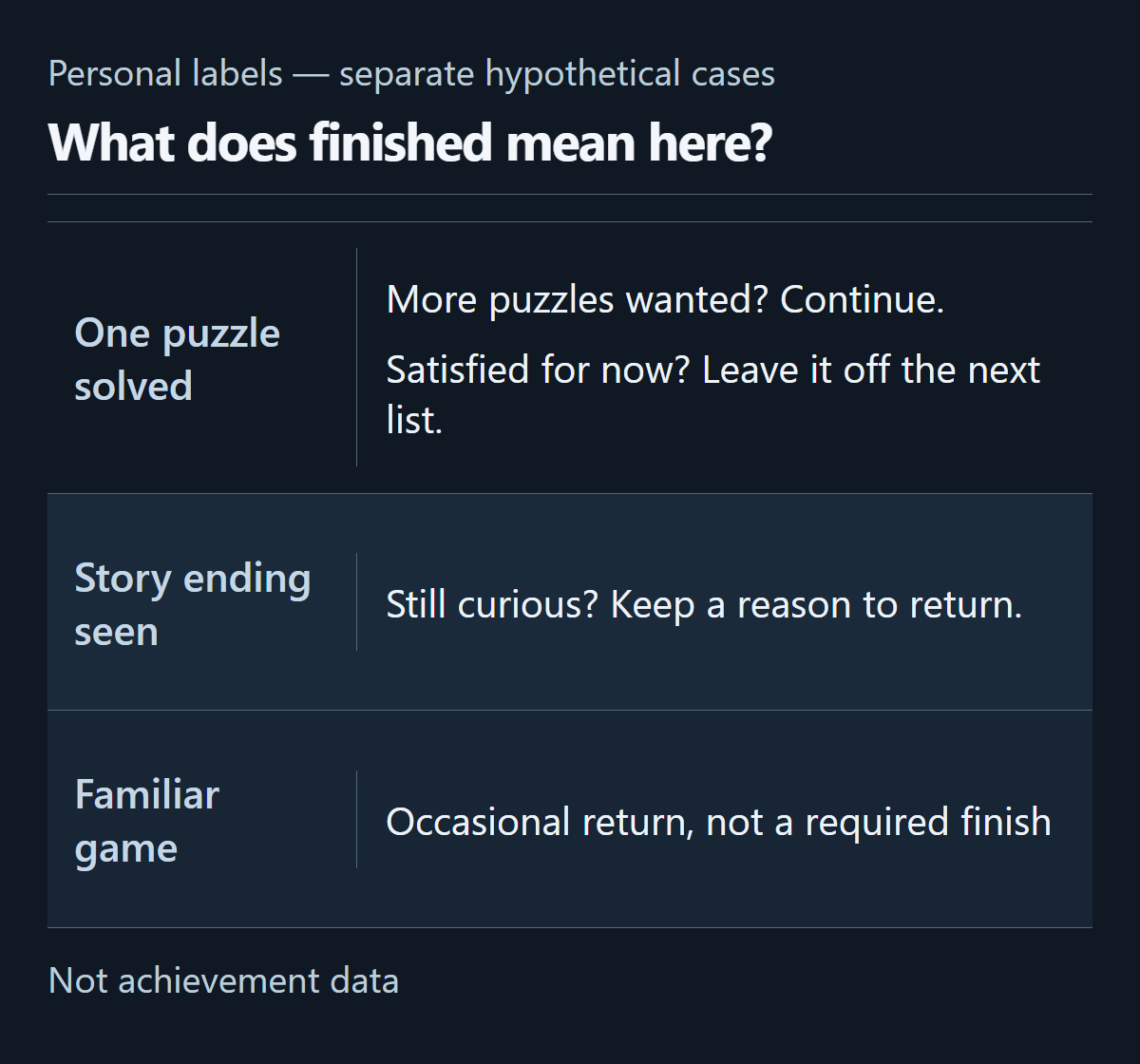
These labels describe personal choices. They are not a feature that changes Steam achievement records.
With a story game, whether I've seen the ending and whether I want to return can also be separate questions. I might see the ending and wonder about other choices, or stop halfway without wanting to continue. Before using a name such as "finished," I'd decide why I want to open that list later. If it's to find games whose endings I've seen, I'd use that criterion. If it's to organize my current plans, I'd record more directly whether I intend to continue.
Achievements can be a personal goal too. Someone who wants every achievement and someone who only wants to see the story's ending will use the same word, "finished," for different states. On a list I manage myself, I just need to be able to tell which meaning I'm using. I'm not suggesting that these lists change actual achievement records, or that Steam automatically applies my definition of finished.
A game I briefly return to because its controls are familiar may fit awkwardly in a "finished" group. If occasional visits are how I enjoy it, "a game I return to" describes my choice better than "something I haven't finished." I might play the same game intensively for one period and only occasionally in another. If my reason for returning changes, I'd update the original status to match.
The new story stays among the games to resume because I've decided to give it a little longer. If I keep seeing the old name about the day I'll first start, I have to revisit a decision I've already made. The reason for waiting to begin is gone, and I have a next action, so that change is what I need to keep. I don't need to reach a whole new verdict on the game before changing its category. If my reason for returning changes, that's worth updating too.
Keep frequently used lists up front, and update reasons when they change
I'd choose which groups to place first according to whether I usually look for games to continue or ones to start next. I'd also choose a sort order based on the details I remember. Something doesn't need to come first every time just because it's already on a list.
If I spend a long time deciding where to put a new game each time I start one, I'd check whether the list names have clear boundaries. If "play next," "play soon," and "play in the near future" are groups I actually open on the same occasions, keeping them separate could create more work. If the names differ but the decision is the same, I'd prefer to combine them. Lists for different arrangements or different preparation still have reasons to stay separate.
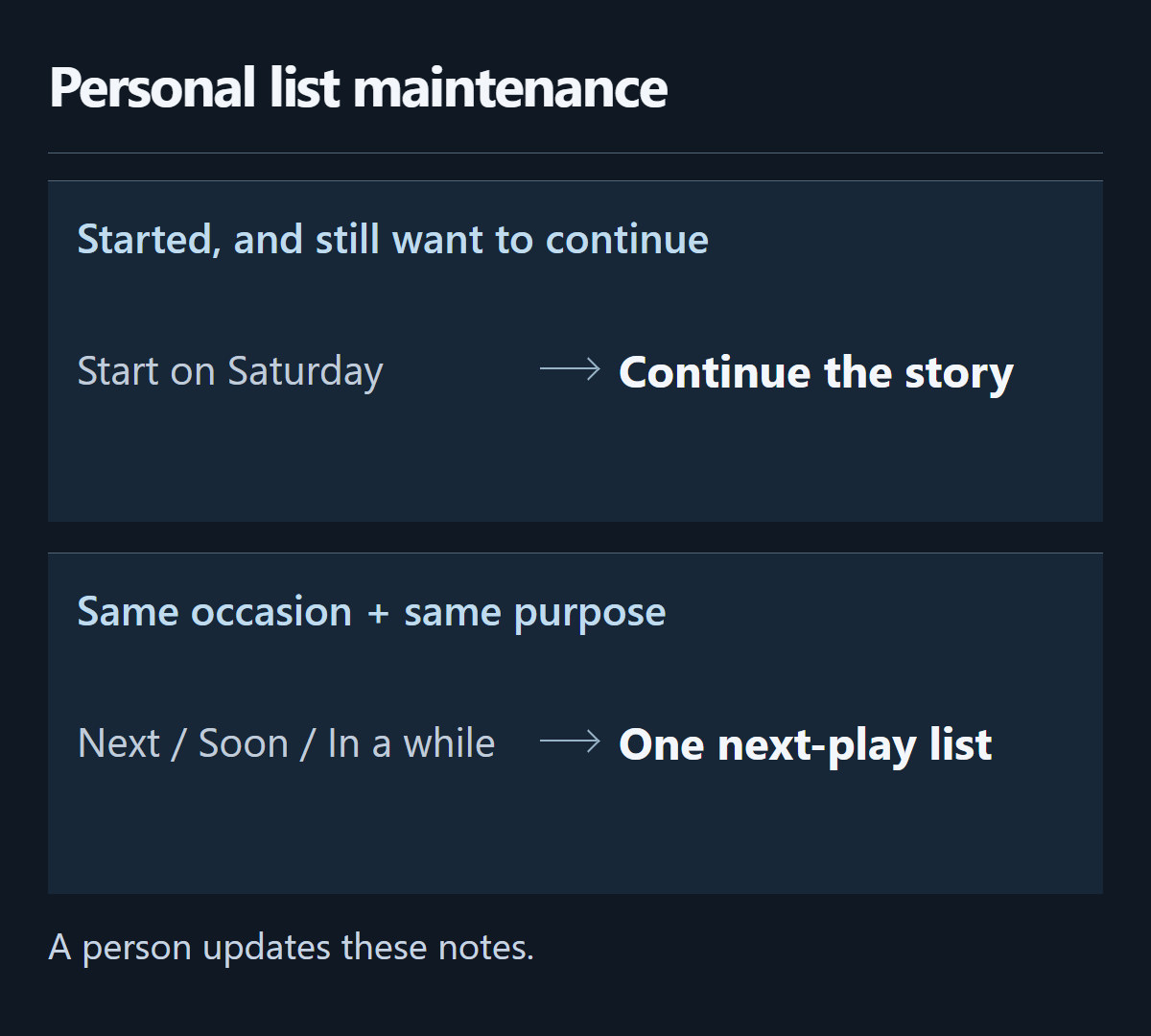
An example of a person updating names and plans. It does not show automatic renaming or a merge feature.
If I can't find the game I want among the options I picked by hand, I'd first check what's missing. The change I need depends on whether I became interested recently and didn't add it, left it under an old plan, or put it elsewhere because a name was unclear. Sometimes another collection might help; sometimes updating a reason I've already written could be enough.
If there isn't much time for upkeep, I'd start by reducing information I didn't read when making my next choice. I might have left a long account of my impressions, then needed only one line about the last action when returning. I might have separated detailed stages of progress, then only looked for games I wanted to continue. It's hard to know exactly what I'll need from the outset. I can revisit the lists a few times before looking at which information I actually used.
If I open this fictional library again, I'd want to see whether I'm repeating Thursday's decision on Saturday. If I've picked out a game because I want to start something new but keep reaching for familiar ones, I'd reconsider when I meant to look at that option. If I lose track of where I stopped every time I launch the puzzle game, I'd add another clue to the note. That's about where I'd suggest starting. Instead of trying to set up every list proposed in this article, I'd work on the places where my own choices actually got stuck, one at a time.