


Steam Cloud Conflict: Which Save Should You Keep?
Which save do you keep in a Steam Cloud conflict? Compare progress and timestamps, preserve game-specific files, and check PC, Steam Deck, and recovery limits.
Article languages
On this page
You try to launch a game, and Steam asks you to choose between a local file and a cloud file. If you aren't sure which one contains yesterday's progress, leave the choice open for now. Find the device you last played on, keep separate copies of the saves you can access, and then compare them. Don't risk overwriting your progress just because one version says “cloud” or has the more recent date.
Before choosing, preserve the files you still have
Read what the warning is asking you to do. A conflict between two versions is different from a warning that Steam can't synchronize right now. With a conflict, you need to decide which saved state to continue from. With a synchronization warning, the immediate question is whether to start playing before the files have synchronized. A message saying that sync failed does not, by itself, establish that two saves already conflict.
Valve's Steam Cloud FAQ warns that playing despite a synchronization failure can cause conflicts or lost progress. Being able to launch the game doesn't tell you which progress it will load. Even if the warning lets you continue, there is good reason to check your last session first, especially if it was on another device.
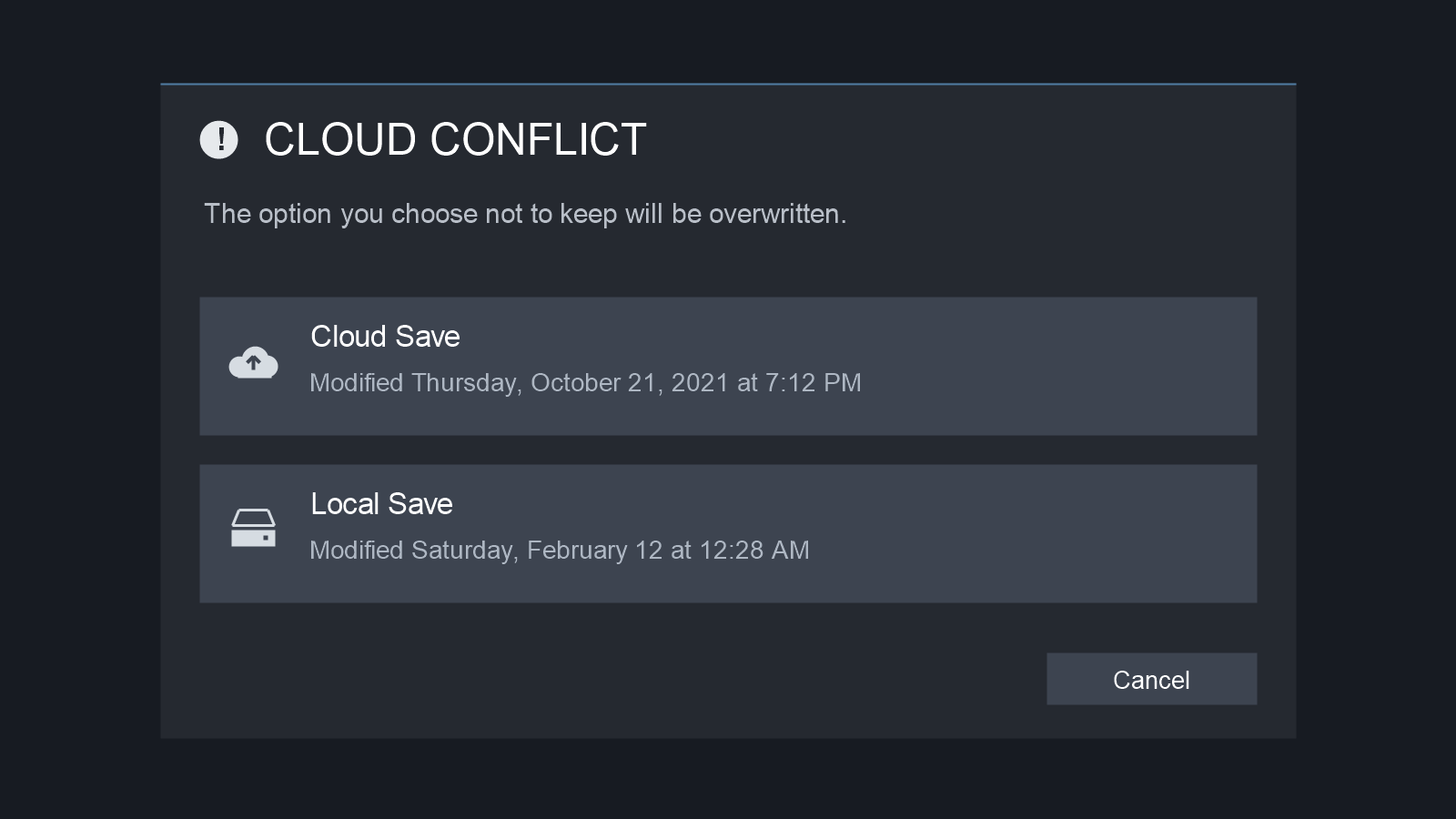
This first image reconstructs the older Portal conflict example in the official FAQ. The mockups and diagrams in this article are not screenshots of a current account conflict or evidence of a successful recovery. Follow the labels and layout in your own Steam client.
Record the game name, the dates in the conflict dialog, and which direction each option moves the files: upload or download. “Local” refers to the device displaying that dialog. “Cloud” refers to the copy on Steam's servers. Your desktop doesn't remain the local side simply because you usually play there. If you open the dialog on a laptop today, read it from the laptop's perspective.
Next, check the device used for your last session and the Steam account currently signed in. Similar-looking profile names matter less than knowing which account actually ran the game. On a shared PC, check the operating-system user too; a different user can mean a different save location. We'll look at documented locations for individual games below.
I'd first work out what each side holds, before trying to make the warning disappear. Copying an accessible save folder outside the game's synchronization paths preserves the files as they were before further work. Make a copy; don't move or rename the original folder. This doesn't mean every cloud version is available to download. A file listed on screen is not the same as a copy you've stored separately.
If the game is already running, don't start a new game or save to another slot just to investigate. Some games save on exit, so you need to understand that game's saving behaviour before deciding what to do with an active session. If you're still at the pre-launch warning, there is no need to enter the game just to look for its files. Avoid copying while the game is changing those files. If you don't know what happens on saving or quitting, read the developer's instructions first.
I wouldn't take screenshots of both dates, choose at random, and rely on a support request if it goes wrong. A screenshot preserves what the dialog displayed, not the save itself. If the other device isn't available or you can't yet identify the progress you want, you can defer the choice.
The newer timestamp may belong to the earlier save
Dates are useful when you can connect them to what you actually did. Start with the progress you remember: which device you beat the last boss on, when you saved after entering a new area, or the name of the character you've been playing. Remembering when you launched a game isn't quite the same as knowing when you finished saving it.
The following is a hypothetical example to explain the comparison. It isn't a report of a player's lost save or a description of a particular game's autosave system. Every time uses Korea Standard Time (KST), and chapters 5 and 7 are illustrative.
| Hypothetical time | Device and action | Save remaining in this example |
|---|---|---|
| September 1, 21:00 | Save at chapter 5 on the desktop; synchronization completes | A chapter 5 save that another device can download |
| September 2, 20:00 | Continue that save to chapter 7 on the laptop, then save while offline | Chapter 7 on the laptop, not yet uploaded |
| September 2, 22:00 | Briefly play from the desktop's chapter 5 save, then save and upload | A newer cloud save that does not include the chapter 7 progress |
| September 3 | Assume a conflict dialog appears when the laptop goes online | The laptop save needs to be compared with the cloud save |
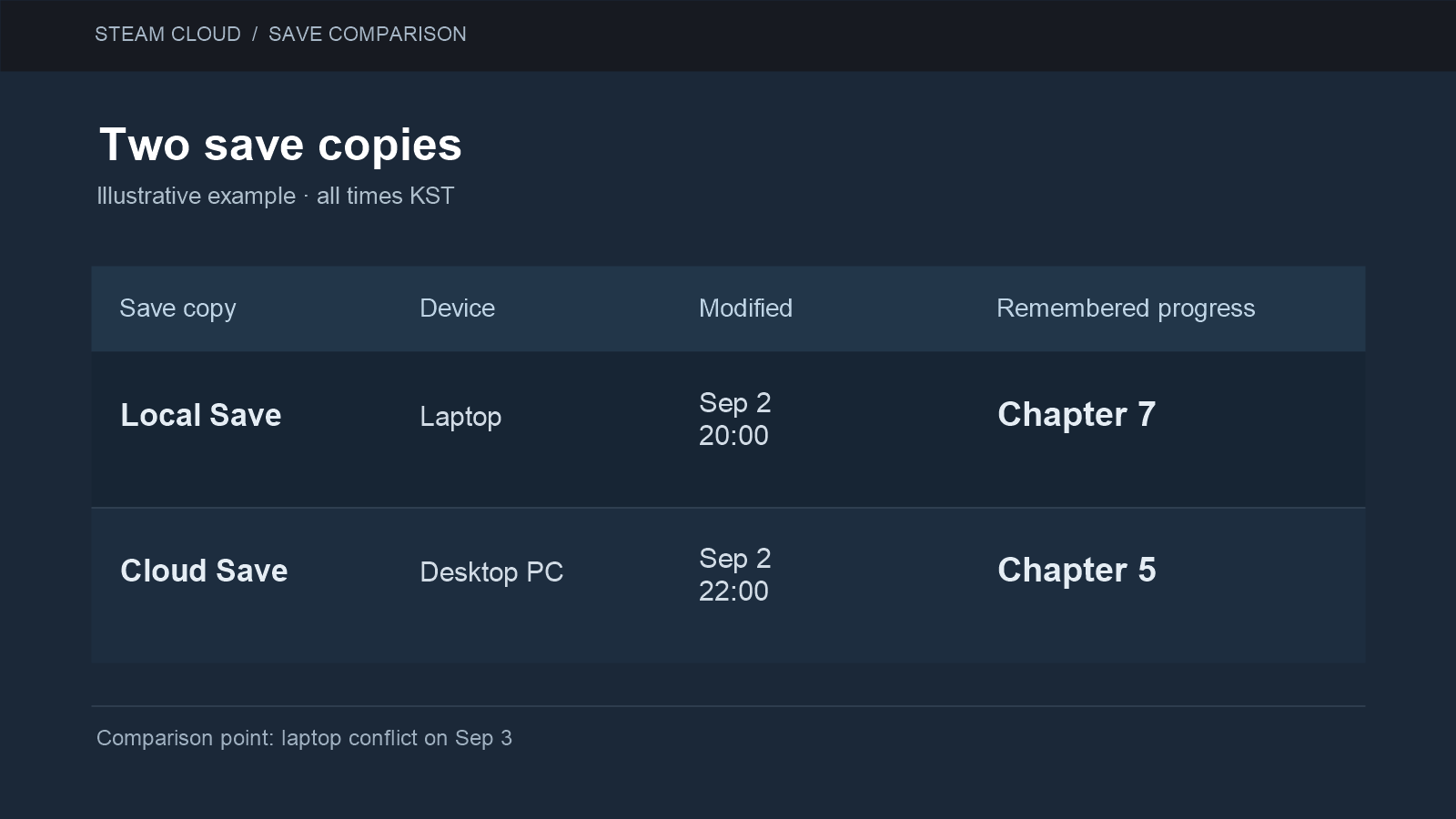
Under those conditions, the laptop's save is the one to preserve if you want to continue chapter 7. It is also the local side, because that's where the dialog is open. The cloud's later 22:00 timestamp belongs to the desktop session that continued from chapter 5. Downloading it simply because it is newer would replace the progress you meant to keep.
In a real case, fill in only what you know. If you remember saving on the laptop but didn't check the upload, record those separately. Writing “sync completed” because you assume it must have happened after quitting gives an unverified event too much weight in the comparison. Playing again on the other device before examining its remaining files can also make the sequence harder to untangle.
Sometimes the evidence does point clearly to the cloud. If you last saved the progress you want on another PC and can establish that its upload is the current cloud copy, that's the copy you want to bring over. Knowing that the computer in front of you is newly set up or hasn't been used in a long time also helps. Don't delete its older saves first, though. There might be a separate character you had forgotten about, and you can keep those files while establishing which version you need.
The choice becomes harder if you played differently on both devices. Perhaps one session advanced the story while the other collected items. Neither version is necessarily a complete continuation of the other. Don't expect the conflict dialog to combine the best parts of both. Any separate merge or import feature depends on the game; putting the files together in one folder won't merge the two play sessions.
Don't let file size settle the choice. There is no established rule that a larger save must contain more quests or more playing time. A size difference gives you something to investigate. Equal sizes don't prove equal contents either.
If the dates don't fit your memory, check what you're comparing before forcing an answer. Are both screens using the same date format and time zone? Is one number a file's modification time and another the playtime shown inside the game? “Saved yesterday” becomes ambiguous around midnight. Keep the original displayed values and note the actual date and device alongside them; that also makes a later support request easier to explain. I wouldn't change file timestamps to make them line up.
Before pressing a button, try stating the choice in one sentence: “I want to keep chapter 7 from the laptop, so I'm using the current local files.” If your reason is only that the button is on top, or that people usually say to choose the cloud, you still lack the information needed to decide. Read the actual upload or download direction and establish which side will replace the other.
What the Steam Cloud label actually tells you
For a concrete look at the store's support labels, we queried the public Steam Store data for Portal 2, Stardew Valley, and Hades and checked their Steam Cloud category and operating-system fields.
The three responses arrived between 07:57:01 and 07:57:03 UTC on September 5, 2026—16:57:01 to 16:57:03 KST. Each game was requested once, using the same US region and English language settings, and all three requests succeeded. The table separates the Steam Cloud feature entry from the returned platforms values.
| Game queried | Steam Cloud entry | Windows | macOS | Linux |
|---|---|---|---|---|
| Portal 2 | Present | true | false | true |
| Stardew Valley | Present | true | true | true |
| Hades | Present | true | true | false |
Here, true and false are the operating-system flags in those store responses. They are not the results of installing and testing the games. Hades's false Linux value must not be read as a claim that it cannot run on Steam Deck or through Proton. Portal 2's macOS value is likewise what this response returned, not a judgment on every version's historical support.
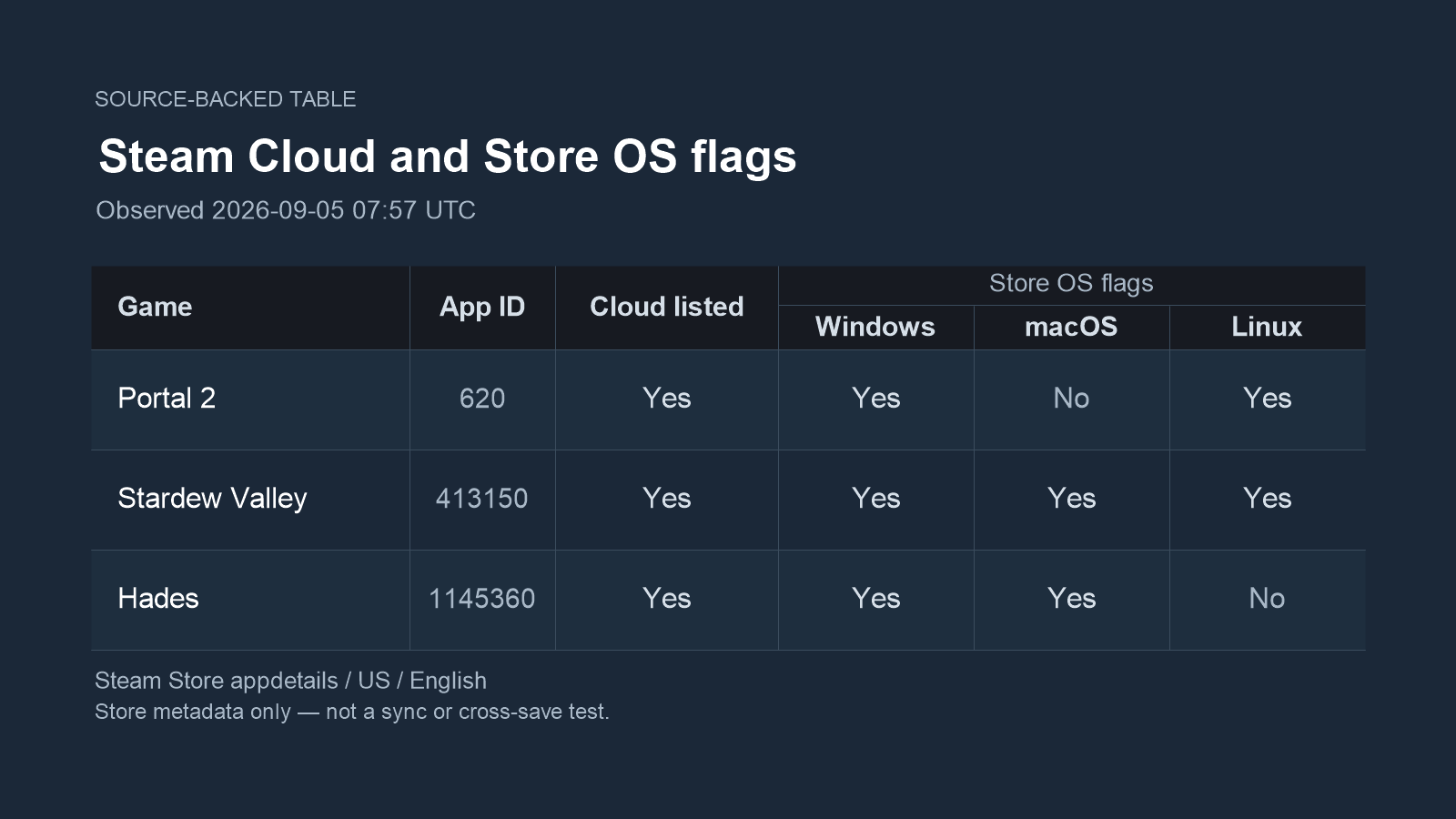
These games were chosen to illustrate the distinction, not to represent Steam's entire catalogue. We didn't measure cloud error rates or recovery success. Public store responses may also be cached, so the response time doesn't tell us when each underlying field was last updated. What the query established was that all three games carried the Steam Cloud feature entry. Whether Cloud is enabled for your account, which files the game includes, and whether your latest save uploaded still need separate checks. No account was accessed and no game was launched for this observation; it cannot establish that all settings and mods will be restored.
Steamworks' Cloud documentation explains that developers configure the file groups and paths to synchronize. Auto-Cloud sharing between operating systems also depends on the configured roots and overrides for other platforms. For a player moving away from Windows, that means looking for two separate answers: can this version run on the other operating system, and can it continue the same save? The Cloud badge alone doesn't settle both questions.
Check the developer's instructions for save locations, compatible versions, and excluded files. If a particular slot or setting didn't transfer, first establish whether it was included in synchronization at all. If some settings transferred, check the save separately. If one setting reset, don't assume the whole save disappeared with it.
The store's feature entry is also separate from the setting on your device. Open the game's Properties in your Steam Library, then look for Steam Cloud under General. If you're there to investigate, note the existing setting before changing anything. Toggling the checkbox cannot decide which save you should keep. While you're still trying to preserve progress from another device, leaving settings changes out of the investigation makes the file comparison easier to follow.
Find the game's save folder, not just its installation
Copying the Steam installation folder can feel like a way to take every game's saves with you. You need the location chosen by each game, though. Finding a game's installed files through the Library doesn't establish that its saves are stored there. Before using a path from a search result, check that the developer's instructions match the game, operating system, and version you're using.
Stardew Valley provides a useful example of why file roles matter. Its developer's missing and corrupt save guide gives %appdata%/StardewValley/Saves as the Windows location. Within it, look for the folder named after your character, followed by an underscore and numbers. The guide distinguishes these files:
| Item inside a Stardew Valley character folder | Role described by the developer |
|---|---|
| File with the same name as the character folder | The actual saved character data needed to load the character |
SaveGameInfo | Character information displayed in the load menu |
Main save filename followed by _old | A previous save copy created by the game, if present |
SaveGameInfo_old | A previous copy of the menu information, if present |
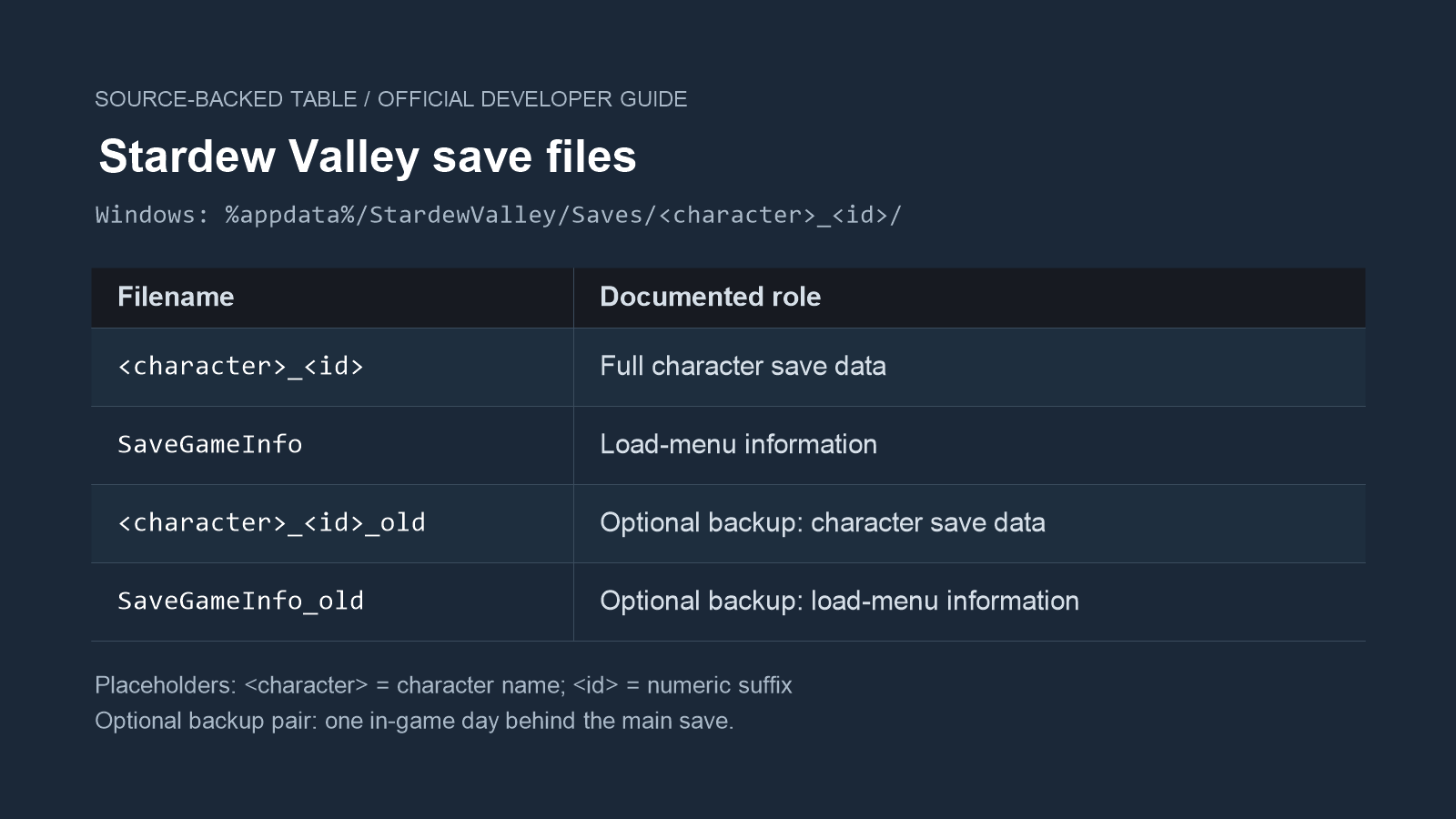
The developer explains that a missing or damaged SaveGameInfo can prevent a character from appearing in the load menu even when the actual save remains. A missing menu entry therefore doesn't establish that Cloud deleted the whole farm. Seeing one file, however, isn't enough to conclude that the game can load it successfully.
At this stage, copy the complete character folder. Don't leave out a small file because it looks unimportant, and keep any _old files with the rest. The developer's _old copies refer to the previous in-game day. They are not cloud snapshots accumulated every 24 real-world hours, and other games don't necessarily have equivalents. Understand which files belong to one character before selecting just one from the group.
If you can't find the folder, check which Windows user you last played under; the developer also advises checking that you're using the same Windows account. Looking in another user's folder calls for a different next step from discovering that the folder is missing from the correct location. Creating a new folder with the expected name won't restore missing progress.
The official Hades technical support guide lists C:\Users\[USERNAME]\Documents\Saved Games\Hades\ as the default Windows location and ~/Library/Application Support/Supergiant Games/Hades for macOS. [USERNAME] stands for the actual user's name. These are Hades paths, not Hades II paths or a template for every Steam game. If Documents has been redirected or another save location configured, check the actual location.
The same guide distinguishes slot 1's progress file, Profile1.sav, from its settings file, Profile1.sjson. Similar names do not mean the files do the same job. Before applying advice to “reset the settings file” to a save conflict, read what that advice would actually change. The distinction here is for identification, not a recommendation to delete or replace either file.
Make it easy to tell the preserved copies from the originals. You could name a separate storage folder with the device and copying date, then put the unchanged save folder inside it. Don't rename files within the folder the game reads or overwrite them with another device's files. If you obtain saves from both devices, give each its own storage folder. Combining identically named folders during copying can erase the distinction you were trying to preserve.
Check where those copies will live as well. A copy inside the game's save path may be subject to the same synchronization as the original. I recommend keeping it outside the paths the game reads and synchronizes. If another file-sync service manages your chosen location, check what that service can change, and avoid a setup that automatically replaces your preserved copy along with the original game folder.
After copying finishes, open the destination folder. Make sure the character folder and its files are actually there, rather than just an empty directory. You don't need to launch the game or save through an editor to check this. Compare names and file counts to establish that the copy exists. Copying is not a recovery test: if a source file was already damaged, the copy may carry the same damage.
Official guides can include more advanced repair procedures, but transplanting part of another character's data or renaming save files requires understanding the conditions for that game. This article stops at preserving the originals and identifying file roles. Don't run a deletion command from an online guide if you don't know precisely which path and files it targets.
Moving between a PC and Steam Deck
If you switch devices regularly, checking at the handoff is less work than reconstructing a conflict later. In ordinary use, save as the game requires, quit normally on the source device, and check Steam's synchronization status before moving to the other device. Check the sync status on the destination device too, and don't hurry past a failure warning to launch. If you're already dealing with a conflict, this is not a suggestion to launch the game again and test that routine.
Valve's developer documentation describes ordinary synchronization before launch and after exit. Pressing Save inside a game doesn't establish that the other device received anything. That's why it is worth checking Steam's status before shutting down the source device or disconnecting it. There is no verified waiting time that applies to every game. Look at the current sync status instead of counting minutes.
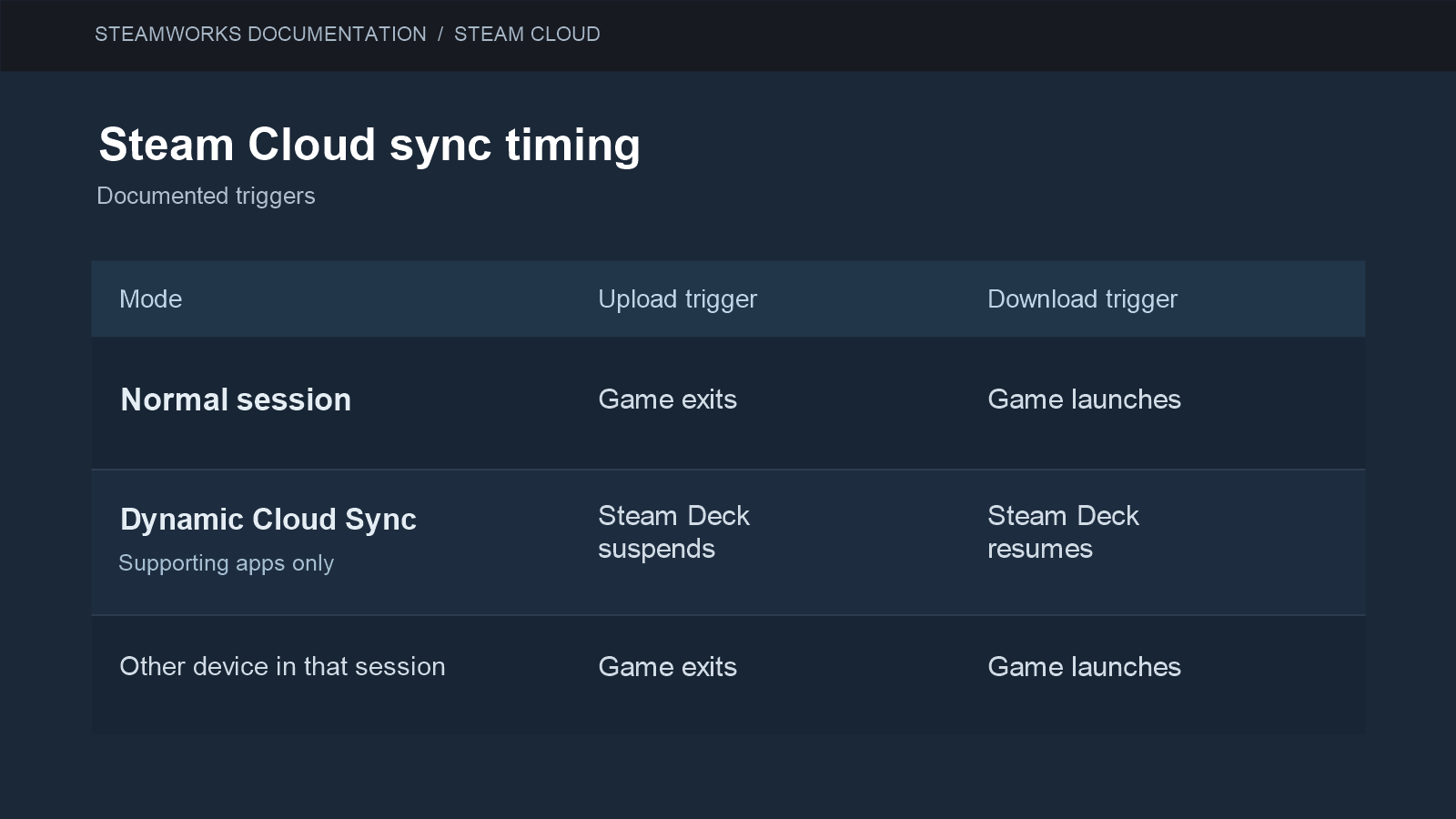
Keep track of offline sessions in particular. Progress made without an internet connection cannot reach another device until the source goes online. When you get home and turn on the desktop first, don't assume it already has the progress from your trip. Establish what remains on the device you played offline and whether you have since played on the other one. If the saves have already diverged, return to the comparison above instead of automatically following your usual switching routine.
Suspending a Steam Deck shouldn't be treated as identical to quitting a game. Valve offers Dynamic Cloud Sync: a game configured to support it can upload files on suspend and receive changes from another device when the Deck wakes. The game must also handle the changed files. This conditional feature doesn't mean every game continues that way simply because you put the device to sleep. If you haven't confirmed the game's support, use saving, quitting, and checking sync status as your normal handoff routine. Don't try to force support on through developer test commands. Switching the feature on is only part of the work: the running game also needs to handle any saves that change beneath it.
Hades makes the distinction visible. Its store response above did not carry a Linux support flag, yet Supergiant's guide says that, with Cloud saves enabled and the same Steam account signed in, data should synchronize automatically between the PC or Mac Steam version of Hades and Steam Deck. That statement comes from the game's developer. Check the relevant version's documentation separately for another game or a release from another store.
Sometimes the account and the way the game is running matter more than the device name. Access through a relative's Library is covered by Steam Families' game-access conditions. Remote Play Together is different from transferring a save to an invited device for independent play. Establish who is actually running the game before deciding where to look for its local files.
One useful preparation before travelling is to note the save location and official support page for the games you expect to play. You don't need to search every folder each time. For the game you're taking with you, be able to identify the account, where you last saved, and the current Cloud status. Before opening an old game on a laptop you haven't used for months, think back to the device you last played it on.
If the game has already loaded the wrong save
Once you realise that the game hasn't loaded the progress you wanted, avoid making more progress or opening and saving other slots. If you don't know what has been saved since launch, record that uncertainty too. Games don't all autosave at the same moment, so a forced quit cannot be called universally safe. Record the current screen and which side you chose, then check how to preserve what remains in light of that game's saving behaviour.
If an older file might still be on another device, don't check by immediately bringing that device online and launching the game. A new synchronization or save may affect the file you meant to inspect. Start by listing copies you can already access, backups made by the game, and save folders you stored separately. Distinguishing what exists from what you merely hope exists is enough for this first list.
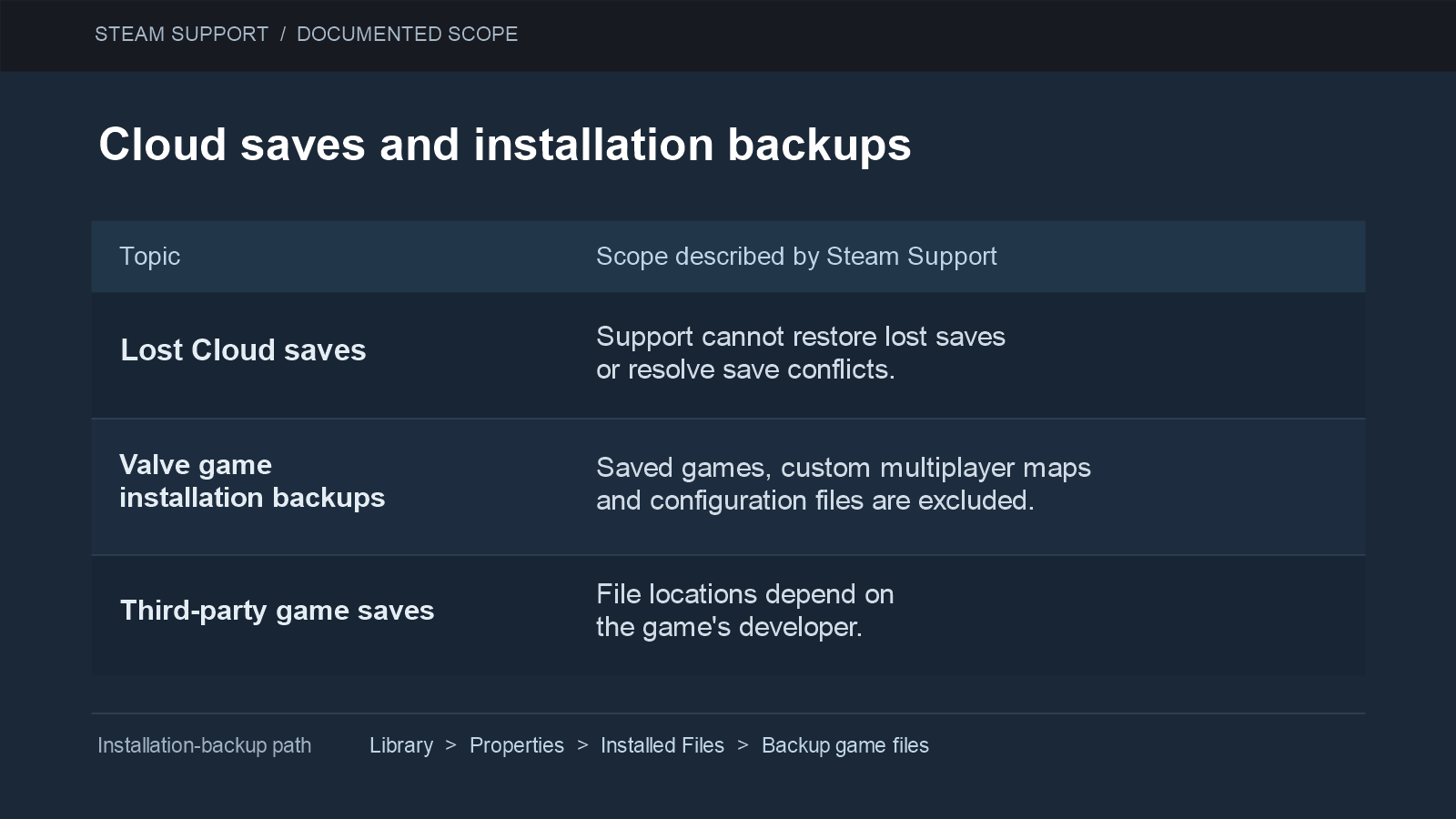
Valve's guidance on lost save data sets a firm limit on what to expect from a support request. The Steam Cloud FAQ's introduction warns that lost data is unlikely to be recoverable. Its lost-save section is more explicit: Steam Support cannot recover lost saves or help resolve Cloud conflicts. Don't expect Support to work out which file contains the session you meant to keep and choose it for you.
That does not rule out every possibility involving a file you still have. What a developer can advise depends on whether the game made separate copies, whether some files remain, and which version they belong to. Stardew Valley's _old files and load-menu metadata show why Steam's sync status cannot explain everything inside a game. Consult that game's official instructions. Hades's developer also provides a contact route in its lost-progress guidance when its own procedures don't resolve the problem. Neither is a promise of recovery.
A useful private support note can separate the game and device details from the sequence of events and the warning you saw:
- Give the game name and AppID, operating system, original playing device, and device you launched next.
- State the last progress you remember, followed by the date, time, and time zone of the warning.
- Include the exact warning and which side you selected. If you haven't chosen, say so. If the upload wasn't verified, leave it marked unverified.
An AppID can help distinguish a similarly named edition or sequel. The three games queried above are Portal 2, 620; Stardew Valley, 413150; and Hades, 1145360. These are game identifiers visible in the store URLs, not private account numbers. Check the store address and version for the game you're asking about.
Steam's cloud_log.txt records Cloud file writes and retrievals. It is a troubleshooting log, not a save copy containing your progress. If support requests logs or files, send only the necessary material through an official private channel. Usernames, folder paths, or account identifiers may be included, so don't post an entire account folder in public comments. There is no reason to provide a password or authentication code.
An installation backup also needs a separate check for saves. Valve's game backup FAQ says that installation backups of Valve games exclude saved games, custom multiplayer maps, and configuration files. It directs players to other developers for those games' save locations. Being prepared to reinstall a game isn't the same as being prepared to return to where you left off. Inspect what is actually in your preserved folders instead of relying on the backup tool's completion message.
The fact that inventory items can remain after a game is uninstalled shouldn't be extended to save files. Inventory items and game progress are stored differently. If you want to keep a save while clearing out an old game, check its location and preserve its copies separately. Learning every Steam feature at once is a lot to ask; identifying what you're trying to keep is a manageable place to start.
The documentation and store observations here were checked on September 5, 2026. No recovery procedure or synchronization on a real account was tested. If the dialog still shows two dates and you don't know which version contains the progress you want, today's task can end with obtaining the files from the device you last played on. You don't have to press the selection button yet.
Ready to sell supported Sacks of Gems?
After the bot confirms receipt, USDT is credited to your site balance. Polygon withdrawal is a separate request.