


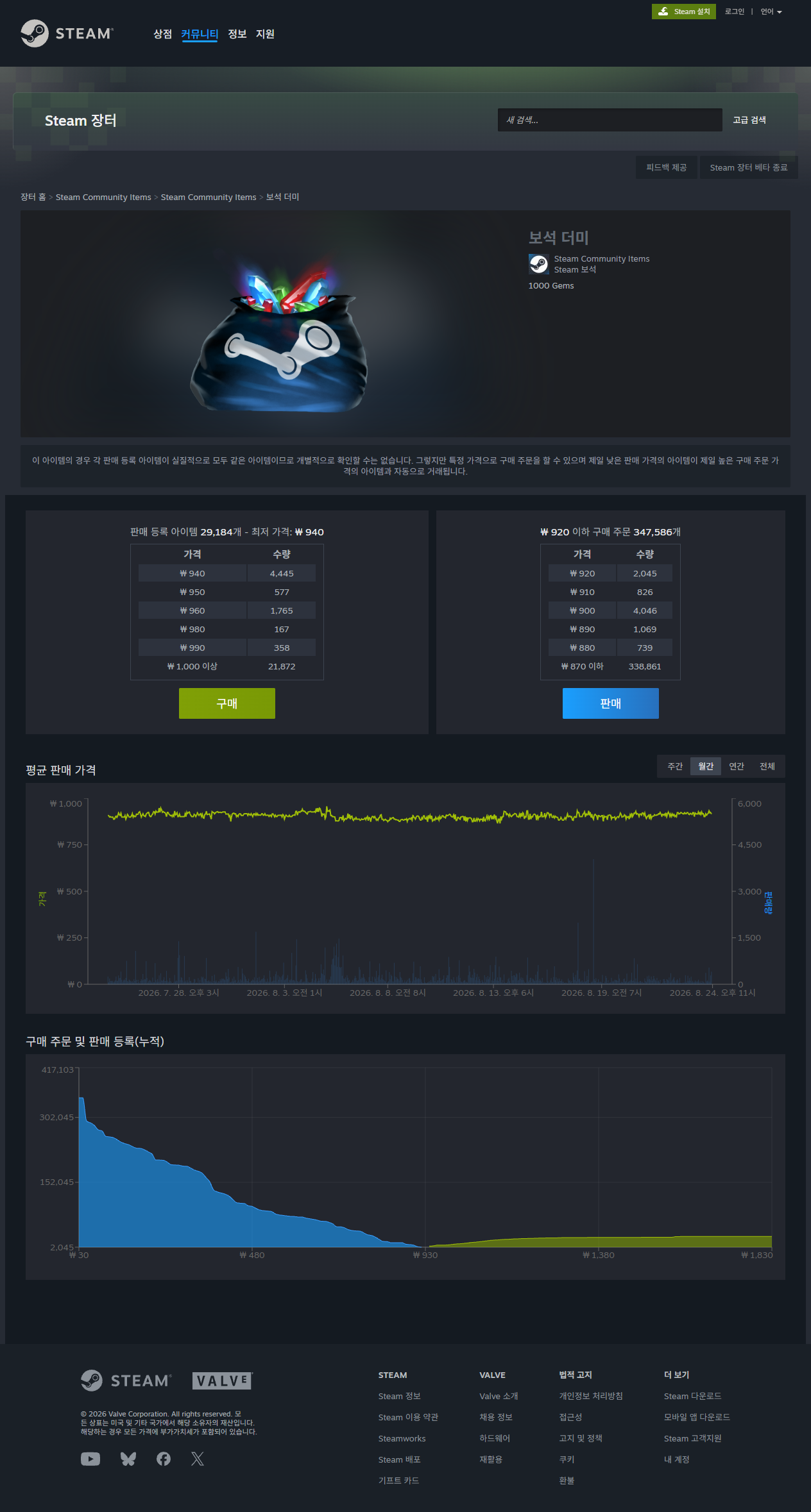
On the Steam Market, the first number people notice is usually the lowest visible price. Sack of Gems might show ₩930 on one day, $0.65 in another currency view, and 0,57€ in a third. It is tempting to treat that number as an instruction: list a little lower and the item should sell. Then the signed-in sell form rejects a smaller amount, shows a minimum-price notice, or stops the listing because of a Wallet limit.
Neither screen is necessarily wrong. A public Market page records public market information at that moment. The sell form checks whether the amount can be listed in the seller's Steam Wallet currency and current account context. Two screens can place a price next to the same item while answering different questions.
This is not a guide to choosing a price. It does not calculate fees or forecast tomorrow's Market value. It separates the roles of a public lowest price, a public median field, currency-specific display, a seller-form minimum notice, and a Steam Wallet boundary. The practical conclusion is deliberately narrow: a public lowest price is evidence about what was visible in the market; only the seller's own form can establish the lowest input Steam will accept for that listing.
Every number below is dated. On 24 August 2026, three items were queried in USD, EUR, and KRW. At 00:42 KST on 25 August, the last 168 hourly records embedded in three Korean-won public pages were recalculated. Narrowing the sample this way matters. A screenshot from a different currency and a different time can look like a simple comparison while quietly combining facts that do not answer the same selling question.
One public response already contains two different things called a price
At 12:23:37 UTC on 24 August 2026, a public Steam price response was checked for three items in three currencies. In the table, the first amount is the response field lowest_price; the second is median_price. Both came from the same response, but they are not the same field. Rather than attach an undocumented meaning to the labels, this article uses them for one modest point: even before a seller opens the sell form, a public response does not offer one universal number called “the price.”
| Item | USD — lowest / median | EUR — lowest / median | KRW — lowest / median |
|---|---|---|---|
| Sack of Gems | $0.65 / $0.67 | 0,57€ / 0,57€ | ₩930 / ₩921.32 |
| Mann Co. Supply Crate Key | $2.30 / $2.29 | 1,96€ / 1,96€ | ₩3,190 / ₩3,174.92 |
| Dreams & Nightmares Case | $1.65 / $1.66 | 1,41€ / 1,43€ | ₩2,290 / ₩2,303.03 |
For Sack of Gems, the KRW response displayed ₩930 as the lowest price and ₩921.32 in the median field. The USD key response had $2.30 and $2.29. The EUR case response had 1,41€ and 1,43€. The point is not whether those gaps are large. Before treating a public figure as the item's definitive value, it is necessary to know whether the figure was the lowest displayed price or the recorded median field.
Currency adds another layer. In the Steam Community Market FAQ, Valve says sellers list in their native Steam Wallet currency and buyers see prices in their native Wallet currency. Steam applies an exchange rate updated daily for cross-currency transactions and tells users to sign in to see their correct local-currency price. A friend's $0.65 screenshot and a seller's KRW page are therefore dated observations in different Wallet currencies, not interchangeable inputs for the seller form.
This rule removes a misleading assumption: the three values do not have to collapse into one permanent result when divided by a general exchange rate. The table is not an attempt to reverse-engineer Steam's currency formula. Steam documents a daily-updated rate, not a formula for converting another person's historical screenshot into the amount a particular seller may enter. What the observation does establish is simpler and more useful: save the currency, field name, and timestamp with a public price, not just the item name and number.
The public response also exposes a volume field, but it is intentionally not used here. Steam does not document the period or definition of that field in the public response. A large number is not enough reason to rename it daily sales, liquidity, or a probability of a quick sale. Having a field and knowing what it measures are different things.
A 168-hour record puts similar screenshots in very different places
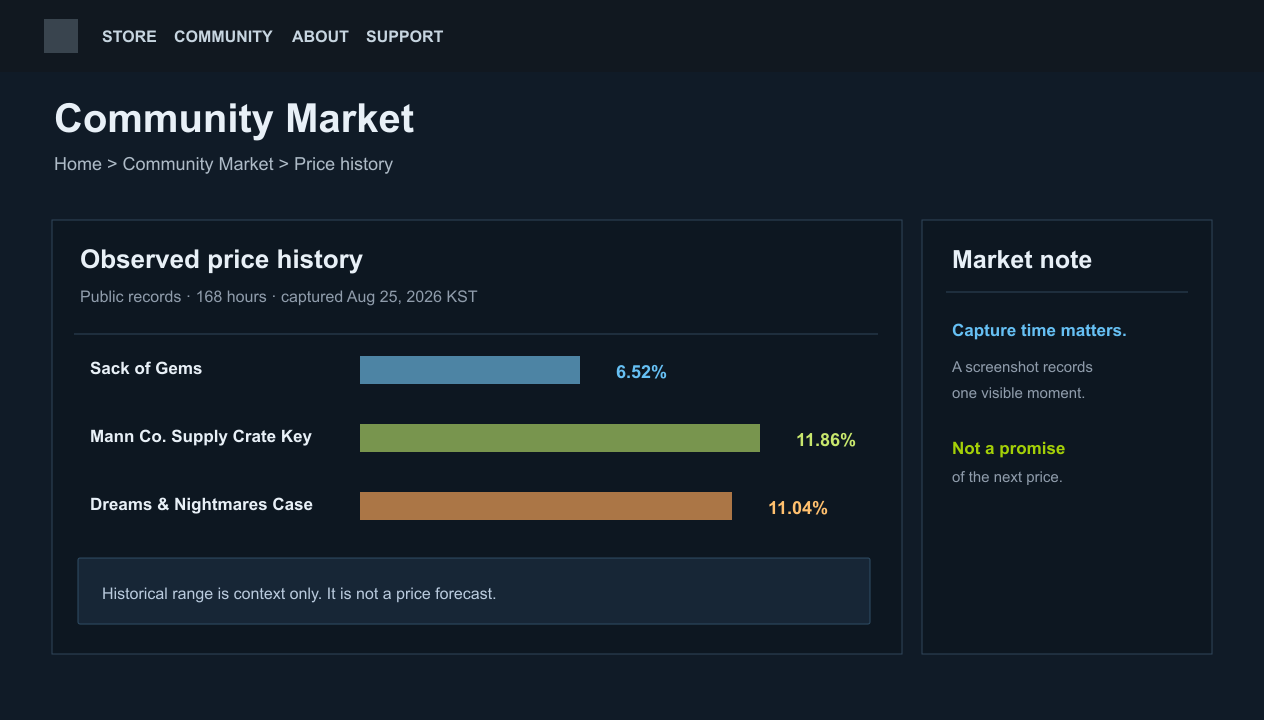
It is easy to assume that a screenshot from yesterday is close enough. The public history gives that assumption a boundary. At 00:42:59 KST on 25 August 2026 (15:42:59 UTC on 24 August), the last 168 chronological hourly records embedded in three KRW public Market pages were selected. Their windows ran from roughly late 17 August KST through midnight on 25 August. The values below use the page's raw price_median records; the range, position, and comparison are calculations made for this article.
| Item | Raw median range across 168 hours | Range | Last record | Position inside the range | Last record vs raw-purchases weighted mean |
|---|---|---|---|---|---|
| Sack of Gems | ₩876.10–₩933.25 | 6.52% | ₩923.46 | 82.86% | +1.54% |
| Mann Co. Supply Crate Key | ₩3,135.45–₩3,507.25 | 11.86% | ₩3,147.86 | 3.34% | −2.35% |
| Dreams & Nightmares Case | ₩2,210.53–₩2,454.56 | 11.04% | ₩2,251.93 | 16.97% | −4.51% |
“Position” is (last record − range minimum) ÷ (range maximum − range minimum). The final Sack of Gems record sat in the upper 17% of its observed range; the key sat near the bottom; the case was also on the lower side. All three can honestly be described as recent public prices, yet one screenshot can capture a high part of its recent window while another captures a low part. That is why the capture time belongs beside the price.
A second calculation used the page's raw purchases field as a sample weight. It produced ₩909.48 for Sack of Gems, ₩3,223.53 for the key, and ₩2,358.27 for the case. The last records were respectively +1.54%, −2.35%, and −4.51% from those calculated values. This is not a claim that purchases is official volume. Steam does not publicly define its period or exact meaning on the page. The weighting only makes the calculation reproducible and shows that the latest visible point can sit above or below the preceding observed window.
Nothing in this table predicts the next record. A Sack observation near the upper end is not evidence that it will fall; a key observation near the lower end is not evidence that it will rise. A forecast would need a longer period, broader conditions, and a defensible method. The conclusion here is smaller: a screenshot tells the reader where the market was at one visible moment. It does not tell the reader what a signed-in sell form will accept.
The 168-hour label also needs care. These are the last 168 chronological embedded records selected for this observation, not a Steam-published “official seven-day statistic.” The amount of retained history and its final time can change when the page is refreshed. That is why the collection time is included. Without it, a reproducible observation quietly turns into stale evidence for a new listing.
A public lowest listing and a minimum selling price are different rules
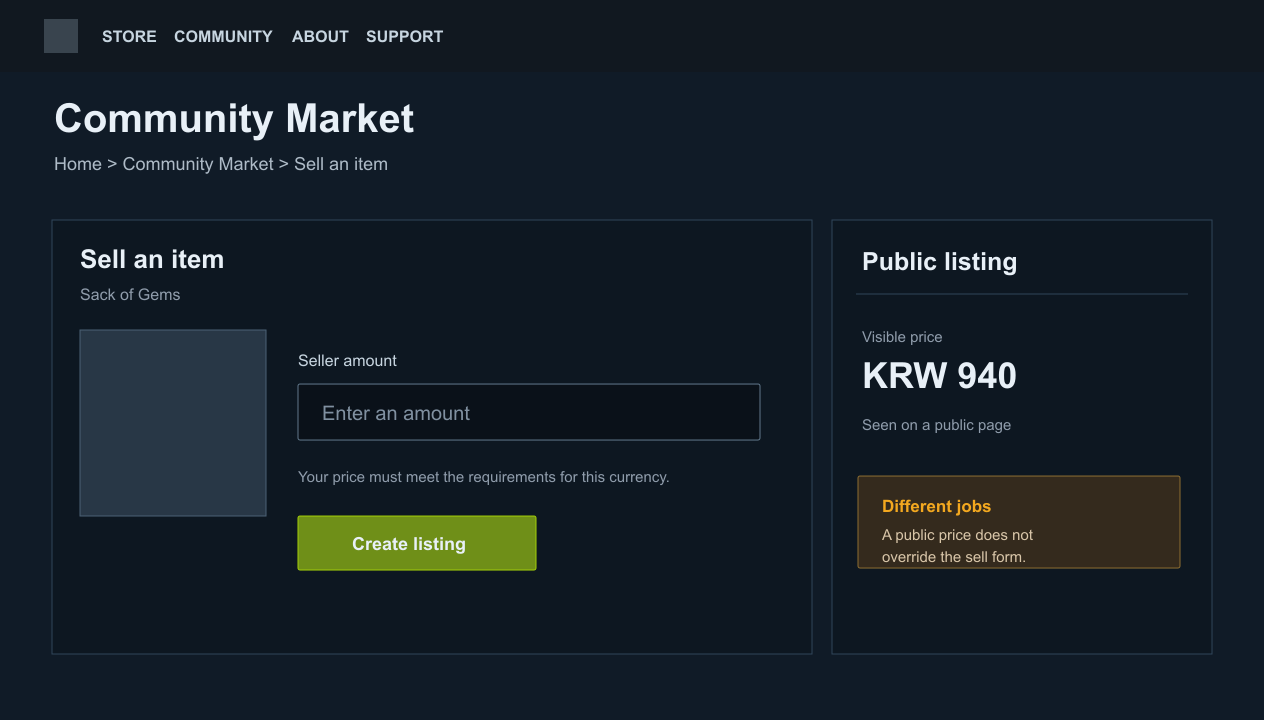
The phrase “Steam Market minimum price” often merges two separate ideas. One is the lowest listing visible on a public page at a given time. The other is a minimum sale price Steam may require when a seller enters an amount. The first describes public market state. The second describes whether a listing input passes a seller-side rule. Sharing the word “minimum” does not make them one number.
Valve's FAQ is precise about the boundary it documents: some currencies may have a minimum sale price, and Steam will tell the seller when a listing does not meet it. The FAQ does not say that every item's public lowest listing equals the minimum accepted sale price in that currency. It does not provide a universal minimum-price table or an item-by-item formula. Deriving an accepted seller input from a public lowest price would turn an undocumented calculation into a claim about a decision the sell form actually makes.
Seeing ₩930 as the observed KRW lowest_price for Sack of Gems on 24 August establishes exactly that observation: that field showed ₩930 at 12:23:37 UTC. It does not establish whether the account can submit a lower amount, the same amount, or what warning Steam will show immediately before listing. The signed-in sell form handles that information. Substituting a public page for the form changes the question.
The reverse mistake is also unhelpful. A seller-form minimum message does not erase public market context. The form is strong evidence about whether the current input passes the current rule; the public page is strong evidence about what was visible in that currency at that time. They work together when their scopes are kept separate: record the public currency and timestamp, then inspect the actual message after entering an amount in the seller's own form.
This article does not reverse-calculate fees. A public lowest price, the seller's entered amount, the buyer-facing amount, and the balance eventually shown in the Wallet are not automatically the same number. Even when fees are the question, the public lowest price should not be treated as a complete calculation. The scope here comes before that: observing a public market price does not establish the amount a particular sell form will accept.
The listing maximum and Wallet cap are not a price valuation
Minimum-price confusion has an upper-end equivalent. A search for “Steam Market maximum price” can make a high visible listing and Steam's permitted listing ceiling sound like the same thing. They are not. One is a public listing at a particular moment; the other is an operating boundary for the listing system.
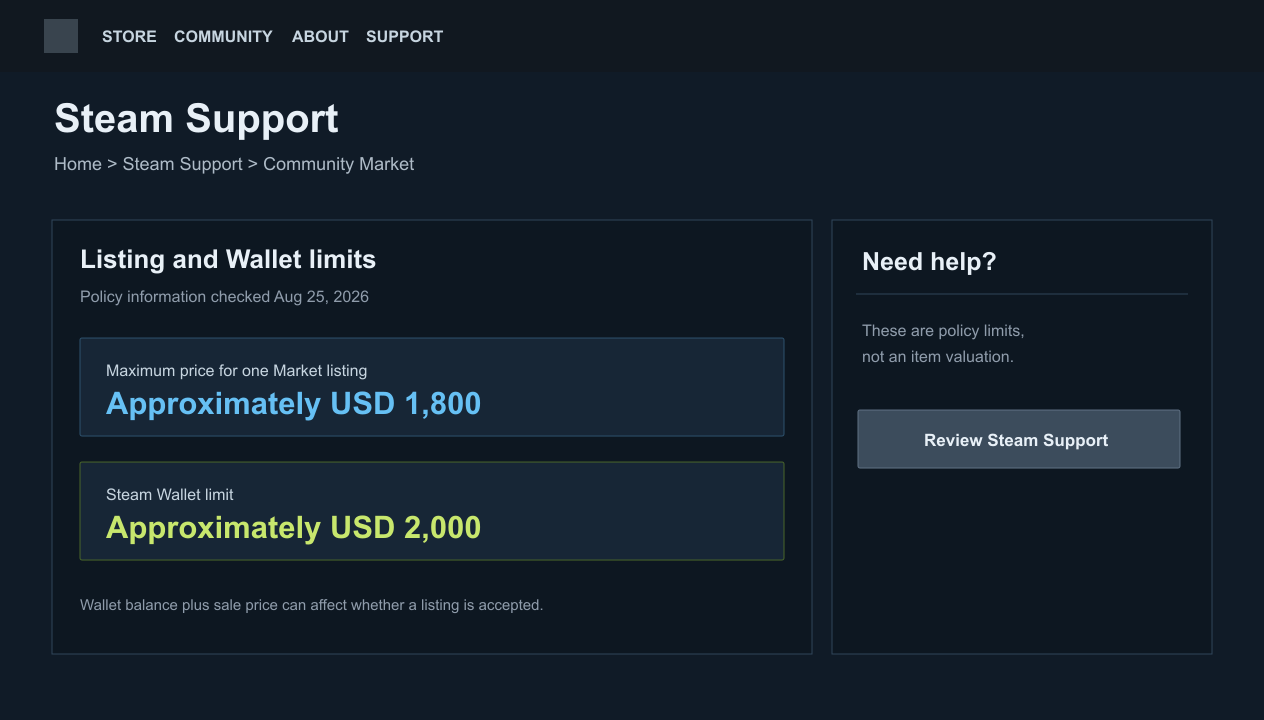
The current Steam Community Market FAQ says the maximum price of a single listing is approximately equivalent to USD 1,800 in the listing currency. It also describes a Steam Wallet balance limit of approximately USD 2,000. If the existing Wallet balance plus the sale price would exceed that limit, Steam may restrict the listing. Valve further says that associated Steam Wallet balances can be aggregated when applying the limit.
The word “approximately” is part of the policy. Valve describes other-currency limits as values close to USD 1,800 or USD 2,000. The FAQ does not turn a particular KRW number into a permanent global constant, and it says the restriction may change. The boundary is useful for interpreting a message in a sell flow; it is not a live price table for each item.
It is also not a statement of an item's value. The maximum listing amount tells us how far Steam may allow a listing input to go. It does not establish whether a public high listing will sell, whether a lower listing will appear, whether the seller's own Wallet balance blocks the action, or what the item is worth outside that one policy rule. A ceiling on accepted input is not a market appraisal.
When a high amount produces a problem, the right first evidence is the seller form and the current Wallet context, not the high point of a public graph or someone else's expensive screenshot. A low amount may run into a minimum-price rule; a high amount may run into a single-listing or Wallet boundary. Both can look like “a price error” if the reader only compares numbers, even though the rules being checked are different.
Use each screen for the one question it can answer
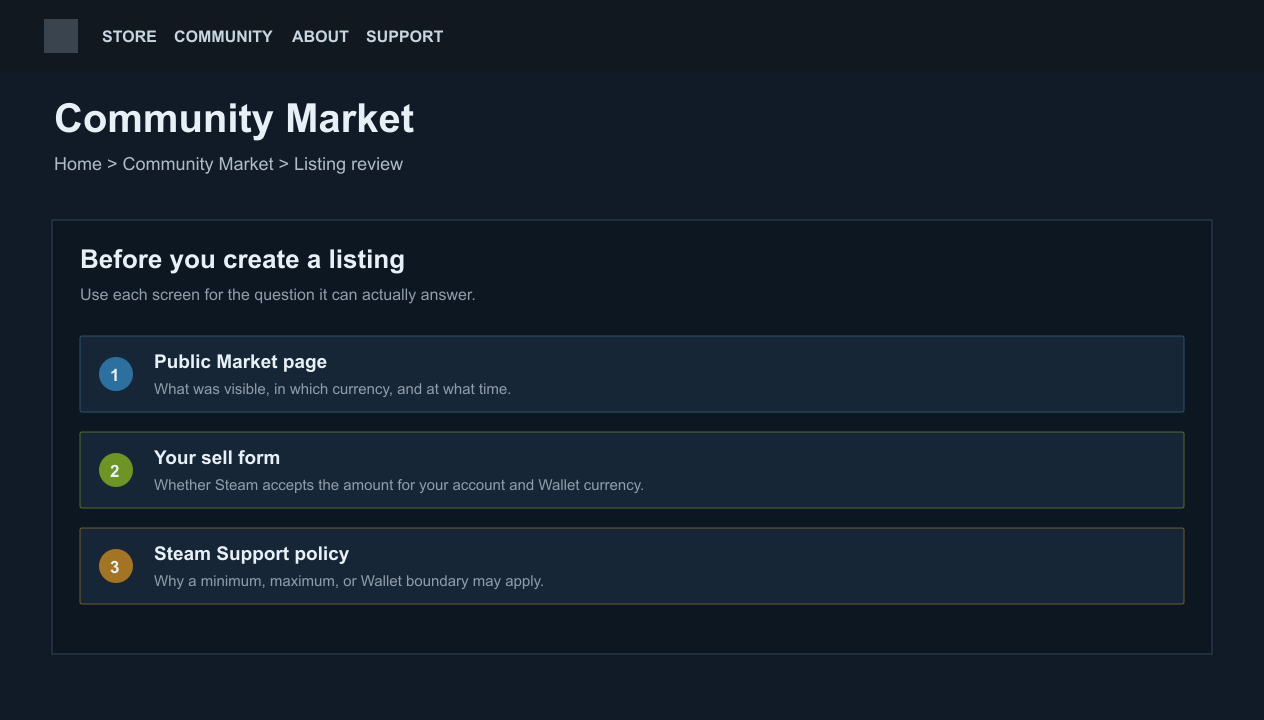
When a public price and a proposed selling amount do not line up, more screenshots do not automatically improve the evidence. The useful move is to separate the questions each source can answer.
| Screen or source | What it can establish | What it cannot establish |
|---|---|---|
| Public Market listing or lowest display | What price was visible, in which currency, at that time | Whether the seller's account will accept that input |
Public lowest_price and median_price response | That two dated public price fields existed | That either field is the seller's required minimum |
| Last 168 embedded records | Where the final observed record sat within that sample window | A future price, sale probability, or a fair price |
| The seller's signed-in form | What Steam currently says about the seller's input and Wallet currency | A past price in another currency or a future market value |
| Steam Support FAQ | The documented general range of minimum, maximum, and Wallet rules | An immediate decision for one account |
The practical order follows from that table. First, open the public item page and record the item, currency, and time. At this stage, the only answer is what the public market showed. Next, open the item in the seller's own inventory and enter the amount. If Steam displays a minimum-price notice or another condition, that message is the most direct evidence about the current listing input. A screenshot in a different currency or a graph from several days ago does not override it.
If an error appears, inspect the screen carrying the error before treating it as a price disagreement. A problem with a public listing being visible and a problem with an amount being rejected in the sell form are not the same workflow. This article does not diagnose account restrictions or an item's tradable-after date, but it does prevent one common detour: assuming that a message in a sell flow has been disproved by a public lowest price.
Finally, check the FAQ for the general policy. It can confirm that a minimum sale price may apply in some currencies, that a single listing is capped around USD 1,800, and that the Wallet boundary is around USD 2,000. It cannot see the seller's live form. Likewise, one form message should not be turned into a universal rule for every item and currency. Keeping those evidence scopes apart avoids claims such as “it is below the public minimum, so it must fail,” “it appears in another country's view, so my currency must allow it,” or “it is below the graph high, so it must be listable.”
Public data remains useful. It is the right starting point for understanding the market around an item. It is not the final authority for the minimum amount the seller can enter. That authority is the live sell form opened by the seller's own account.
How this observation was made, and when it must be refreshed
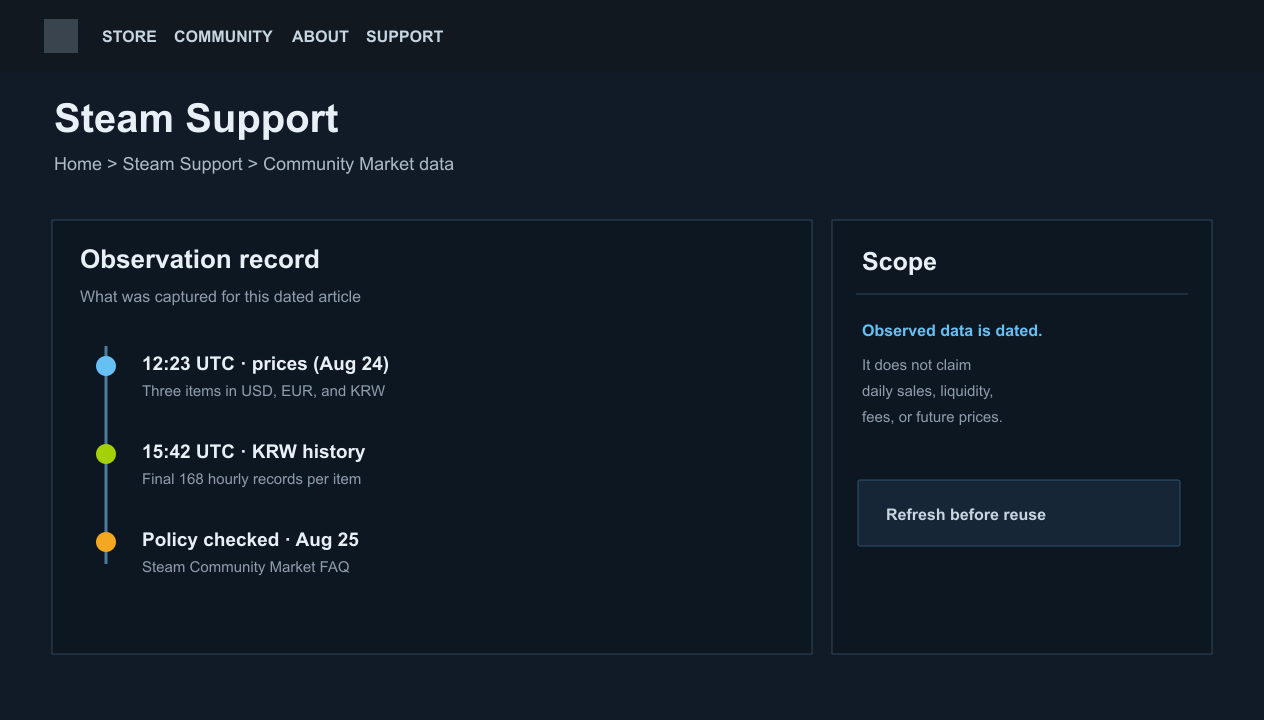
The observation used public pages and public price responses only. It did not sign in, buy, trade, access an inventory, or use private account data. At 12:23:37 UTC on 24 August 2026, Sack of Gems, Mann Co. Supply Crate Key, and Dreams & Nightmares Case were queried in USD, EUR, and KRW. At 00:42:59 KST on 25 August, the final 168 hourly records were selected from the three KRW public pages to calculate the ranges, positions, and weighted means. The pages contained 4,987 raw records for Sack, 5,716 for the key, and 2,389 for the case; only the last 168 for each item were compared as one observation window.
The public volume response field and embedded purchases field were recorded as raw fields, not relabeled as daily sales, official volume, liquidity, or demand. Steam did not provide their period or formal definition in the materials checked for this article. purchases was used only as a transparent sample weight in a reproducible calculation. Showing both the calculation and its limit is better than hiding the field or presenting it as a stronger metric than its source supports.
Refresh the date before reusing any number. Public prices move, and Steam says its cross-currency exchange rate is updated daily. Do not copy the historical ₩930, $0.65, 0,57€, or the observed seven-day ranges into a new listing decision. Reopen the current public page, then sign in with the actual Wallet currency and open the seller form. If that form differs from this article's table, it does not disprove the article: the table is a dated observation, while the form reflects current account conditions.
The direct sources were the public Market pages for Sack of Gems, Mann Co. Supply Crate Key, and Dreams & Nightmares Case, plus the Steam Community Market FAQ. For the basic Market flow, see What Is the Steam Community Market?.
The final boundary is simple. A public lowest price is valid evidence that a number was visible in the market. On its own, it cannot establish the minimum input for a seller, the seller's Wallet limit, sale proceeds, a completed sale, or a future price. This article is designed to keep those claims apart.