


What to Check Before Confirming a Steam Trade
Review the account, item lists, outside payment promises and mobile confirmation before approving a Steam trade. Includes account recovery and the limits of CS2 Trade Protection.
Article languages
On this page
- Record what you agreed to send and receive
- Recheck the account behind a familiar nickname
- Inspect the item basket, not just the total
- Separate the receiving side from outside promises
- Read the mobile confirmation, not only the button
- Stopping is allowed when something cannot be verified
- If an outgoing offer was not created by you
- Recovery has a defined scope and cost
Even when the price is settled, the trade window still needs its own review. The item you were promised must actually be in the offer, and the account sending it must be the account you intended to trade with. The confirmation screen is where you can check both.
I would rather take a little longer than approve an offer while one of those points is unclear. This is not a safety score for the other person. It is a way to compare the offer that arrived with the agreement. The Valve guidance used here was checked on September 5, 2026. The card examples and images are explanatory mockups, not observations of a real trade or loss.
Record what you agreed to send and receive
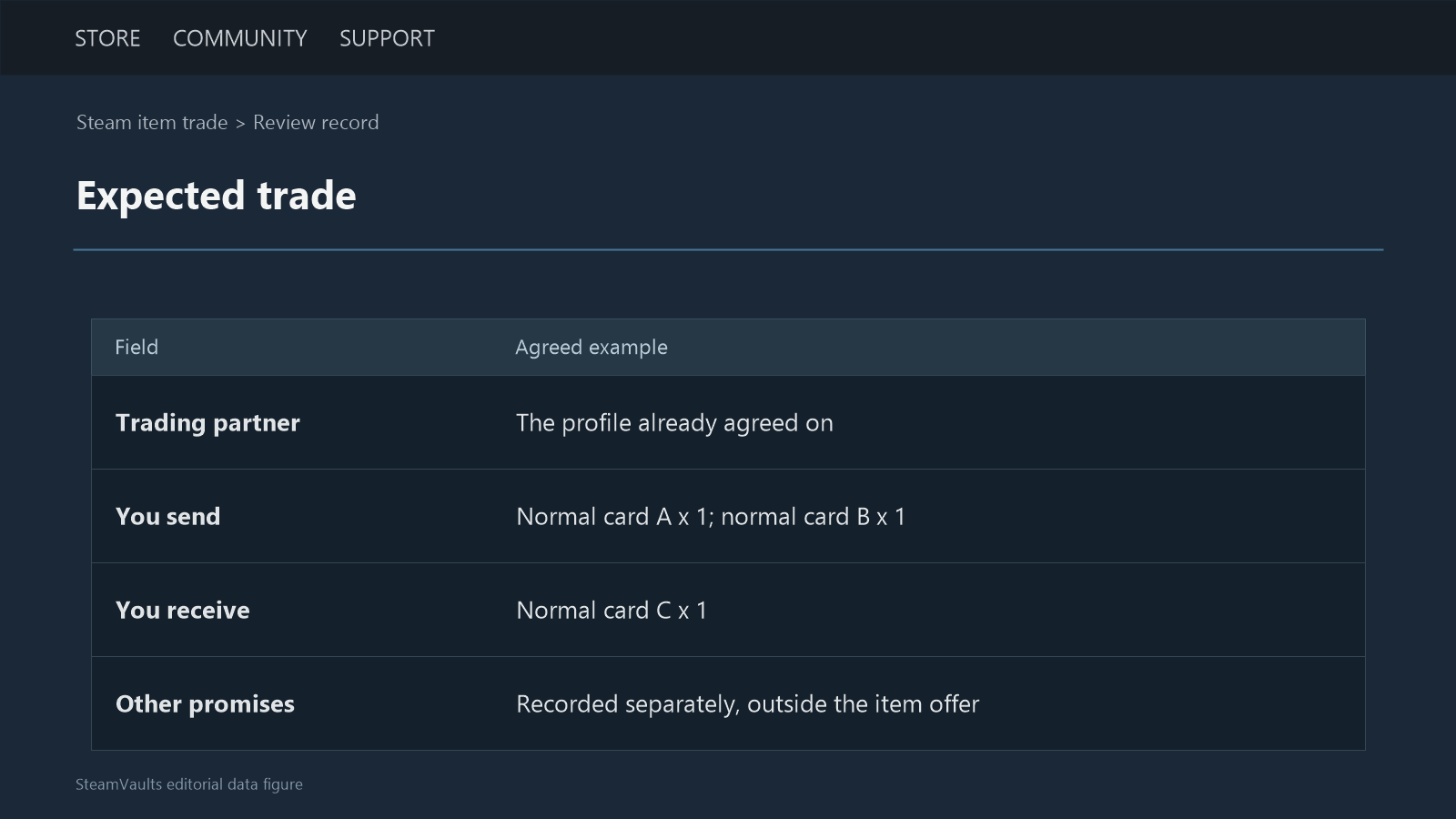
Write down the other account and the item and quantity on each side. For example: send one normal card A and one normal card B, and receive one card C. If the agreement was for a foil card, record that condition too. If the terms change, update the note so you still have a fair comparison.
A photo showing card C in the other person's inventory is not an offer to give you C. Use the order details or the earlier conversation as the reference, then compare it with the receiving side of the actual offer. You do not need to follow a new login link someone sends as “verification.”
Recheck the account behind a familiar nickname
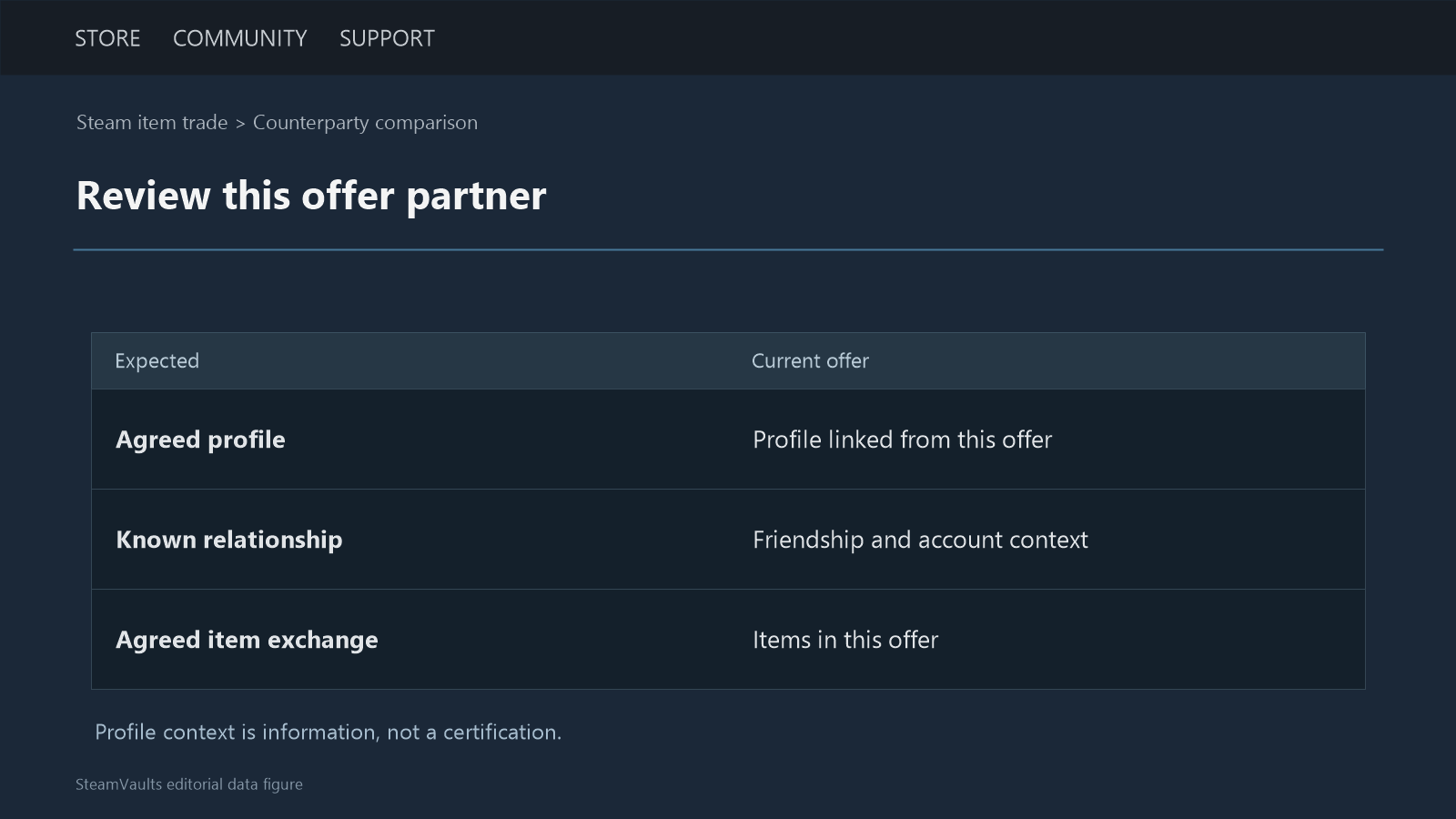
Valve's safe-trading guidance warns that a friend or trader can be impersonated and says to check the information in the offer. If you recorded a profile URL or SteamID earlier, compare it with the account attached to the current offer. A nickname and profile picture are not enough.
An old account or a high level is not a pass mark. Steam's trading guidance says reputation comments can be fabricated. Friendship length and comments are background information; they do not identify the account in today's offer.
If someone says a bot has changed and a different account appears, use the service's normal path to verify that the order is connected to that account. If the order says A but the offer shows B and you cannot establish why, leave it unresolved. You do not have to call it a scam, but you also have no reason to approve it by guessing that both accounts have the same operator. An unusual request from a friend should be confirmed through a contact method you already know.
If Steam addresses are difficult to distinguish, see how to share a Steam Trade URL safely. A valid Steam address and the correct trading counterpart are separate checks.
Inspect the item basket, not just the total
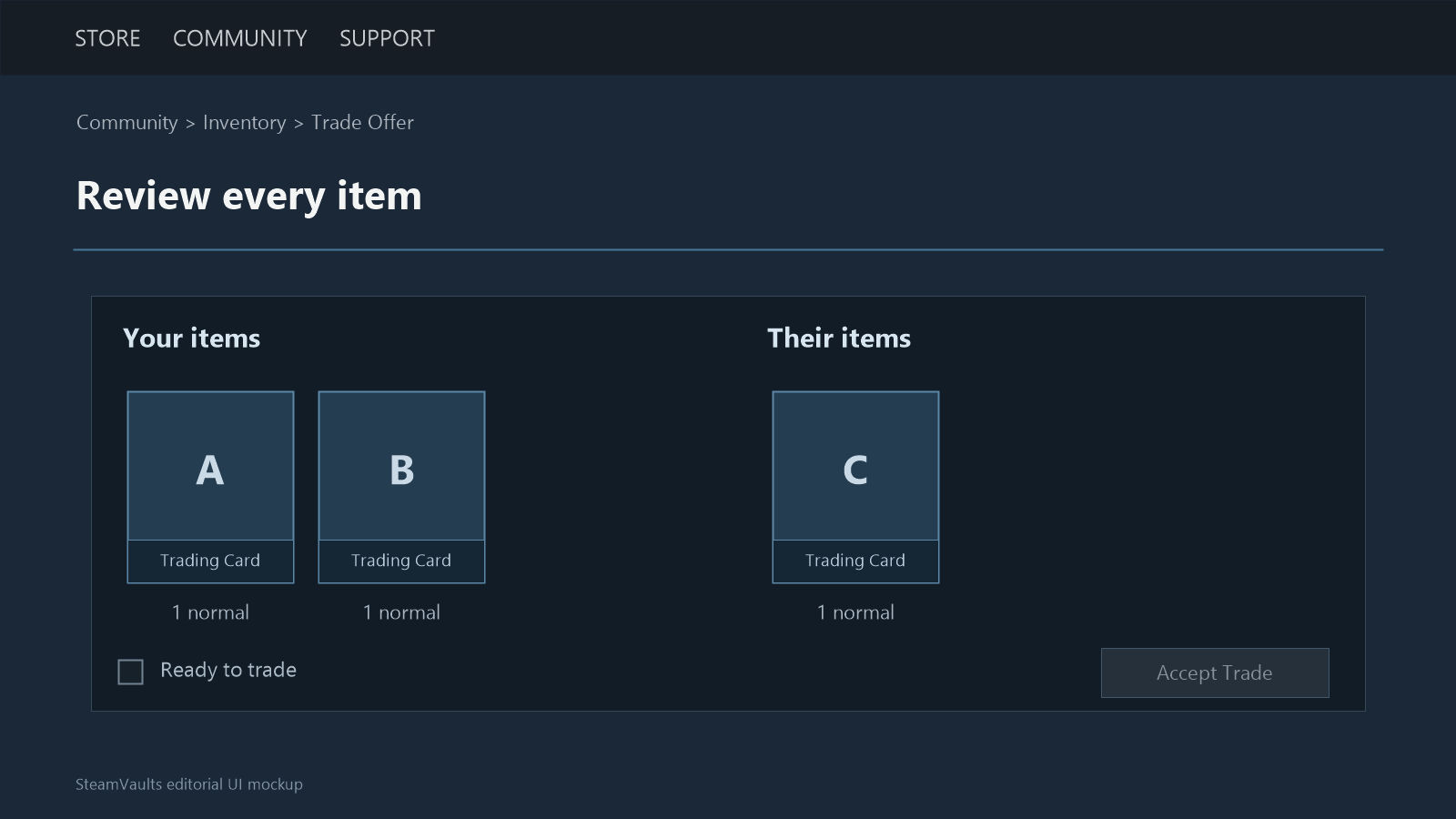
Steam recommends checking an item's name, quality, description, and effects. Familiar artwork does not prove that two items are the same. Start with the receiving list: find the agreed names and quantities, then check the properties that affect the item's price or use.
These examples show how to check composition. They are not market prices or records of an actual trade.
| Agreement | What to check in the offer |
|---|---|
| Receive one card A and one card B | Confirm there is one of each, not two copies of A. |
| Receive a particular type with a familiar name | Confirm the agreed type and attributes in the detailed description. |
| Send several items at once | Make sure an item you meant to keep is not mixed into the outgoing list. |
The total number can match while the contents do not. Read the lower items in the list too. If an attribute is unfamiliar, understand the item before judging its price; a careful price calculation for a different item is still wrong.
For a tradable date or restriction marker, see Steam item trading and market restrictions. Making a Steam inventory public is a separate issue. A public inventory does not grant permission to take an item, and it does not require you to accept a trade offer.
Separate the receiving side from outside promises
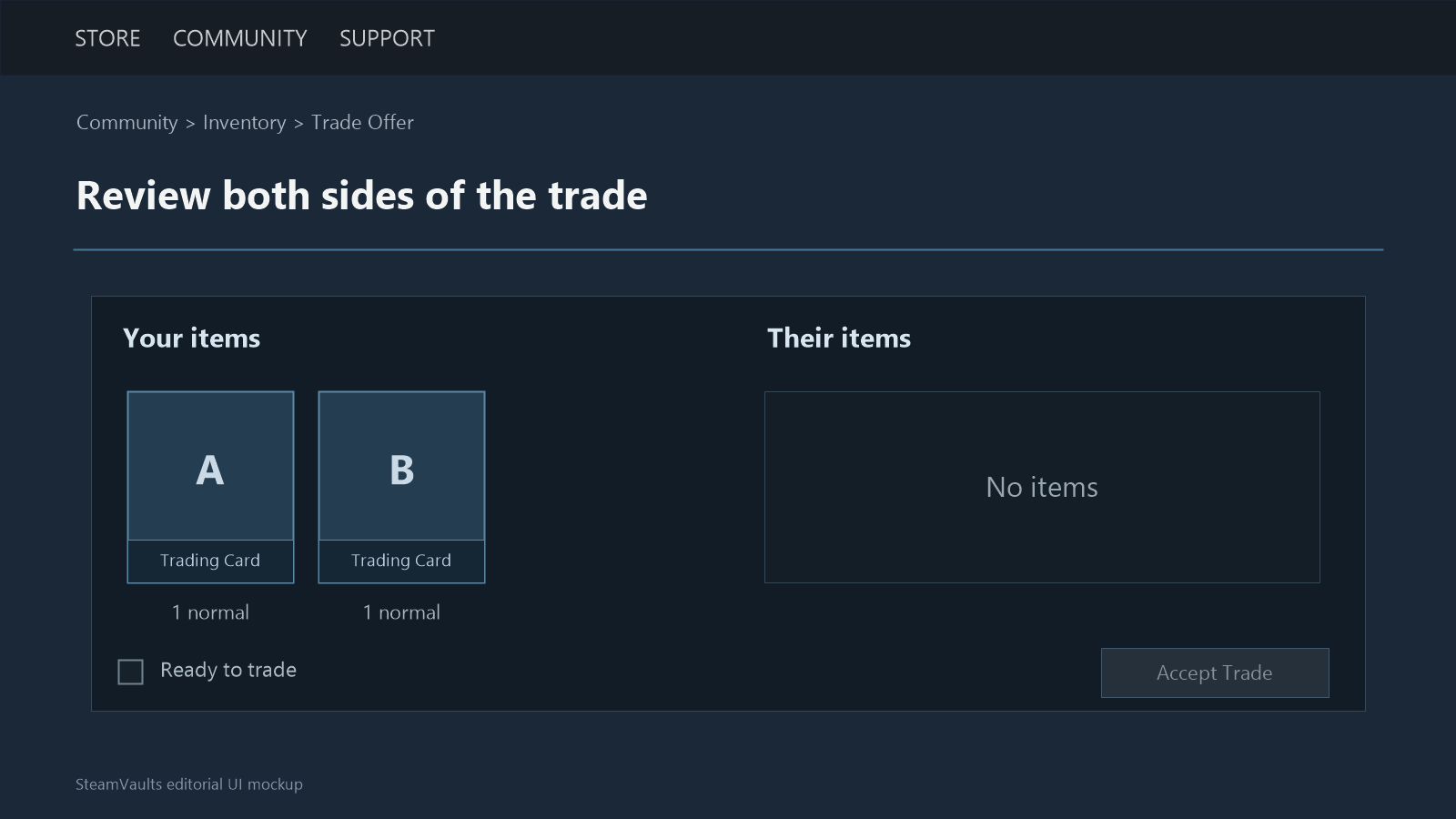
An empty receiving side means the current Steam offer contains no item for you. That can be correct if you intended to give a gift, so an empty side alone does not prove a scam. If you expected money or another item, identify where that consideration is supposed to appear.
Valve's guidance says a Steam trade does not transfer Steam Wallet balance, PayPal funds, gift cards, or other money. It also advises against sending an item first and receiving the consideration in another trade, or relying on a middleman. An order number or amount in the offer message does not add money to the trade.
When an outside service is meant to pay, Steam's item movement and that payment are separate. Check the payment through the payment method you normally use rather than trusting a deposit screenshot. Confirmation, disputes, and cancellations follow the outside service's rules. SteamVaults is independent of Valve, too: a completed Steam item transfer does not mean Valve guarantees the outside service's payment.
A promise to lend an item and return it later has no automatic return function. If you do not understand the payment condition or cannot verify the return promise, leave the offer unconfirmed.
Read the mobile confirmation, not only the button
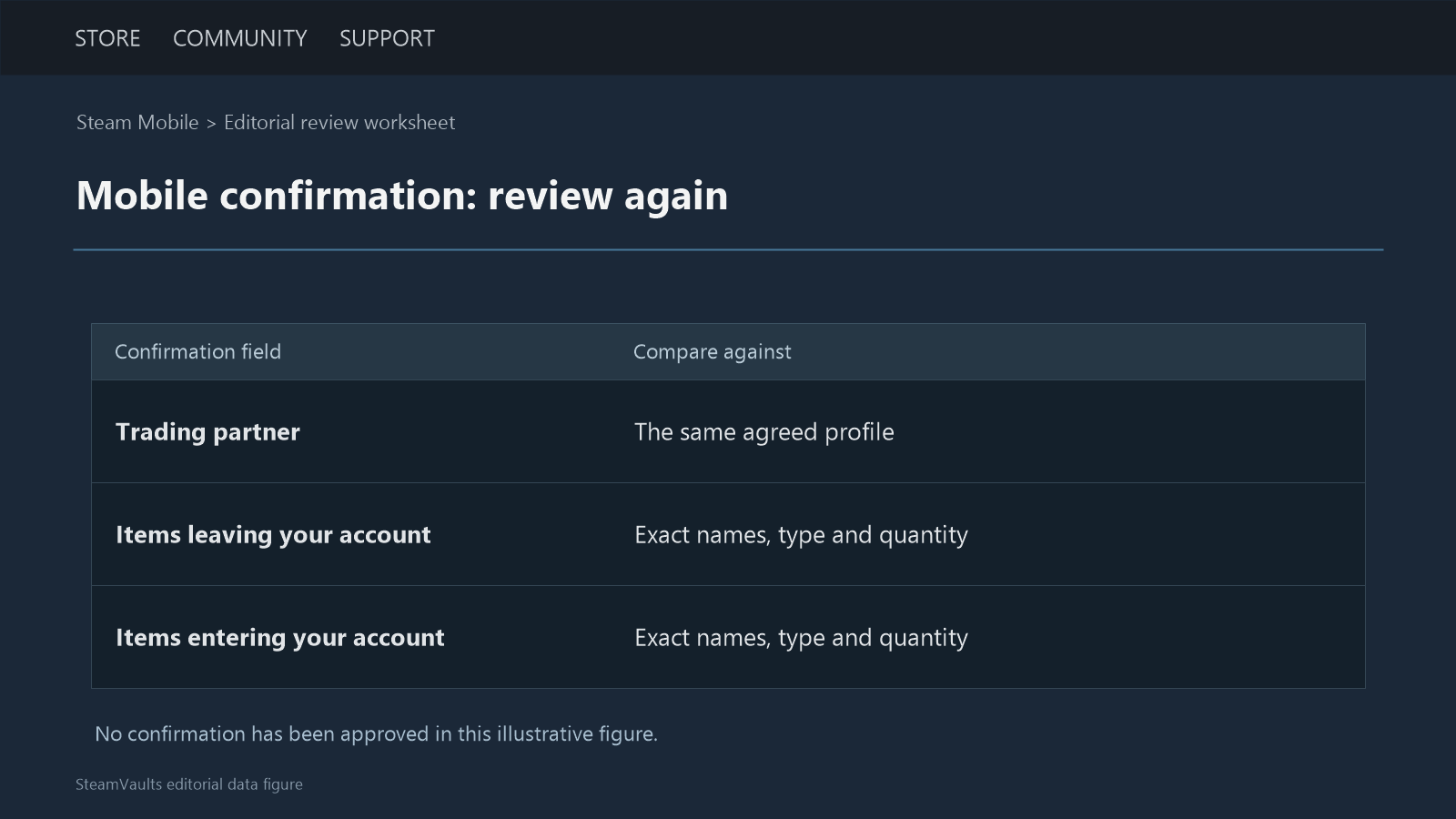
Valve's trade-redirection guidance explains that a compromised account can have its original trade canceled and a new offer created for an impersonating account. On Steam Mobile, reread the counterpart and the names, types, and quantities of the items on both sides. Do not choose an offer by notification order or arrival time.
Review an offer that arrives after a cancellation as a new offer. Even if someone says only the quantity changed, check the other fields again. After an error, first inspect the earlier offer's state. Do not approve a new request while you still do not know whether the old one completed or remains open. If confirmation is complete but item movement is held, see the difference between a trade hold and a Market hold.
Stopping is allowed when something cannot be verified
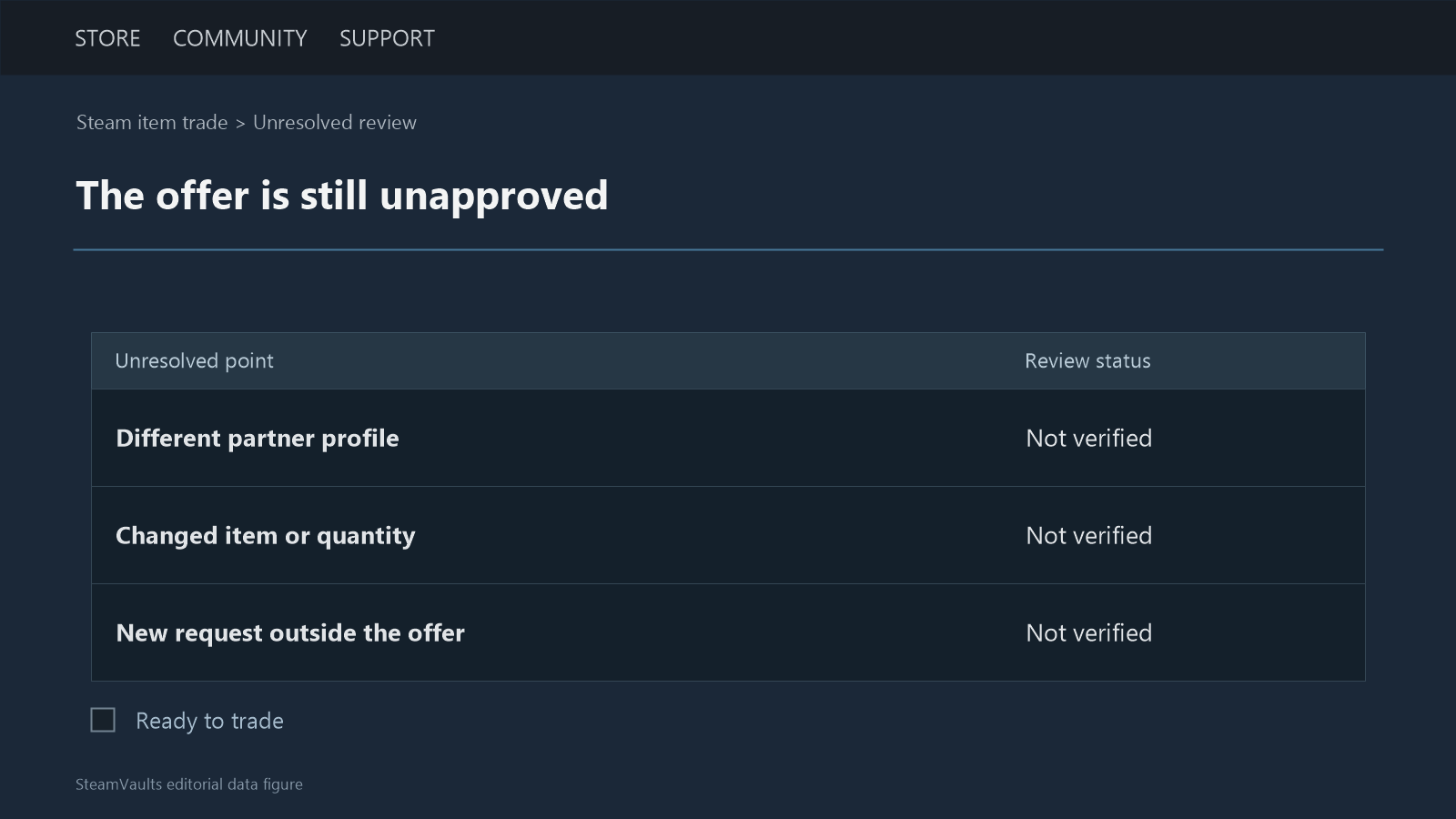
If the counterpart changed without an explanation, an item is unreadable, or the payment condition is unclear, delay confirmation. A long conversation or a rushed request does not require you to guess what an empty field means.
I would note what I could not verify and leave the items unsent that day. I would not hand them to someone who claims to verify the trade for me, and I would not send a small amount as a test.
If an outgoing offer was not created by you
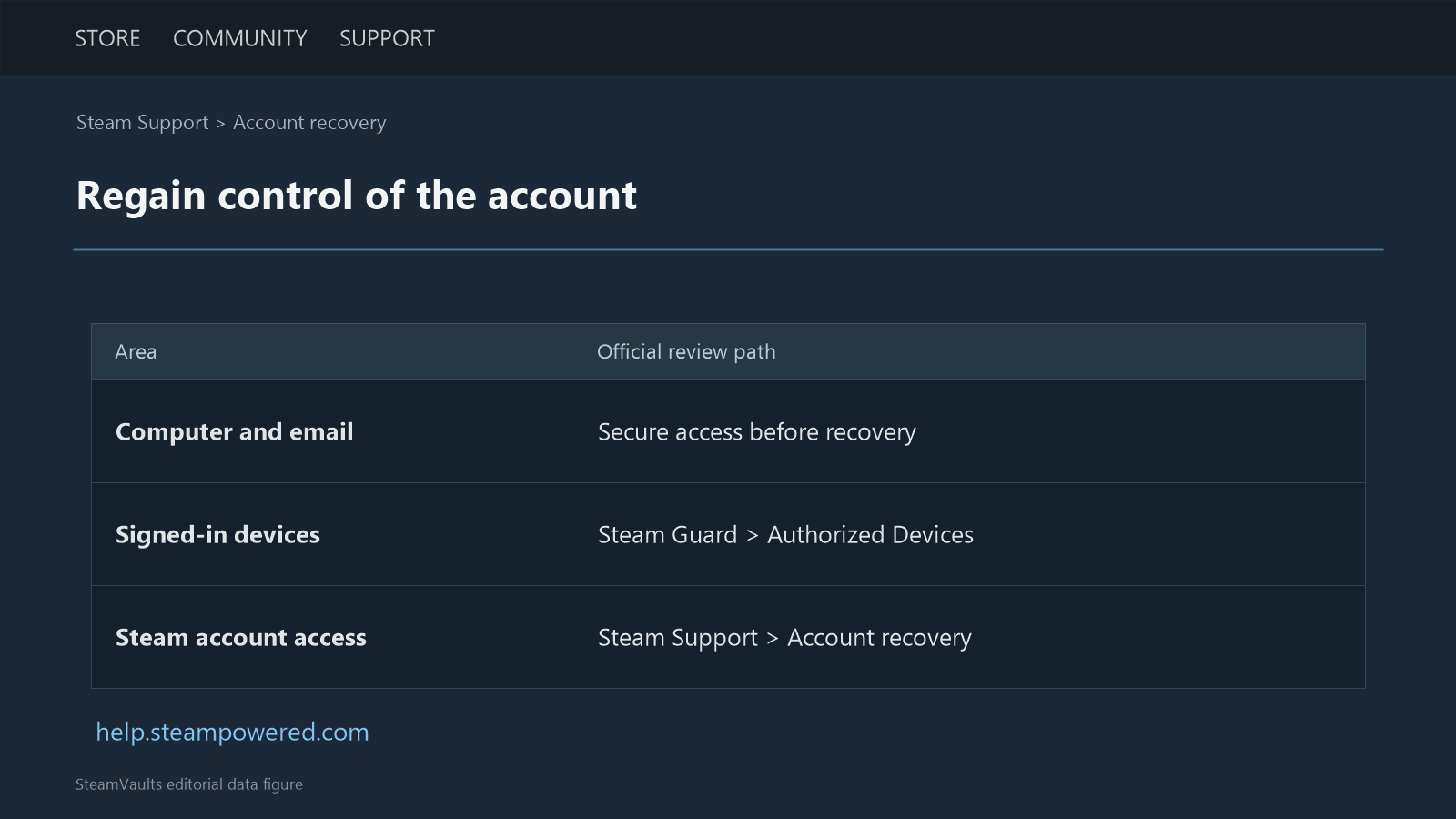
If an outgoing offer you did not create appears in your sent history, check control of the account before continuing the trade. An unsolicited incoming offer from a stranger, by itself, does not prove that your account was compromised.
Use Steam's account-security guidance and the stolen-account recovery path. Check the computer for malware and secure the connected email account first. Review Authorized Devices and sign out of all devices if necessary, then change the Steam password and continue through the official recovery route.
This process does not involve giving a password, recovery material, or Steam Guard code to someone in chat or Discord who claims to be Support. If you need to report the account, use the profile menu and Report Player, describing the actual interaction. Do not post recovery material publicly.
A report, account recovery, and an item return are different outcomes. After regaining control, compare any remaining offers again.
Recovery has a defined scope and cost
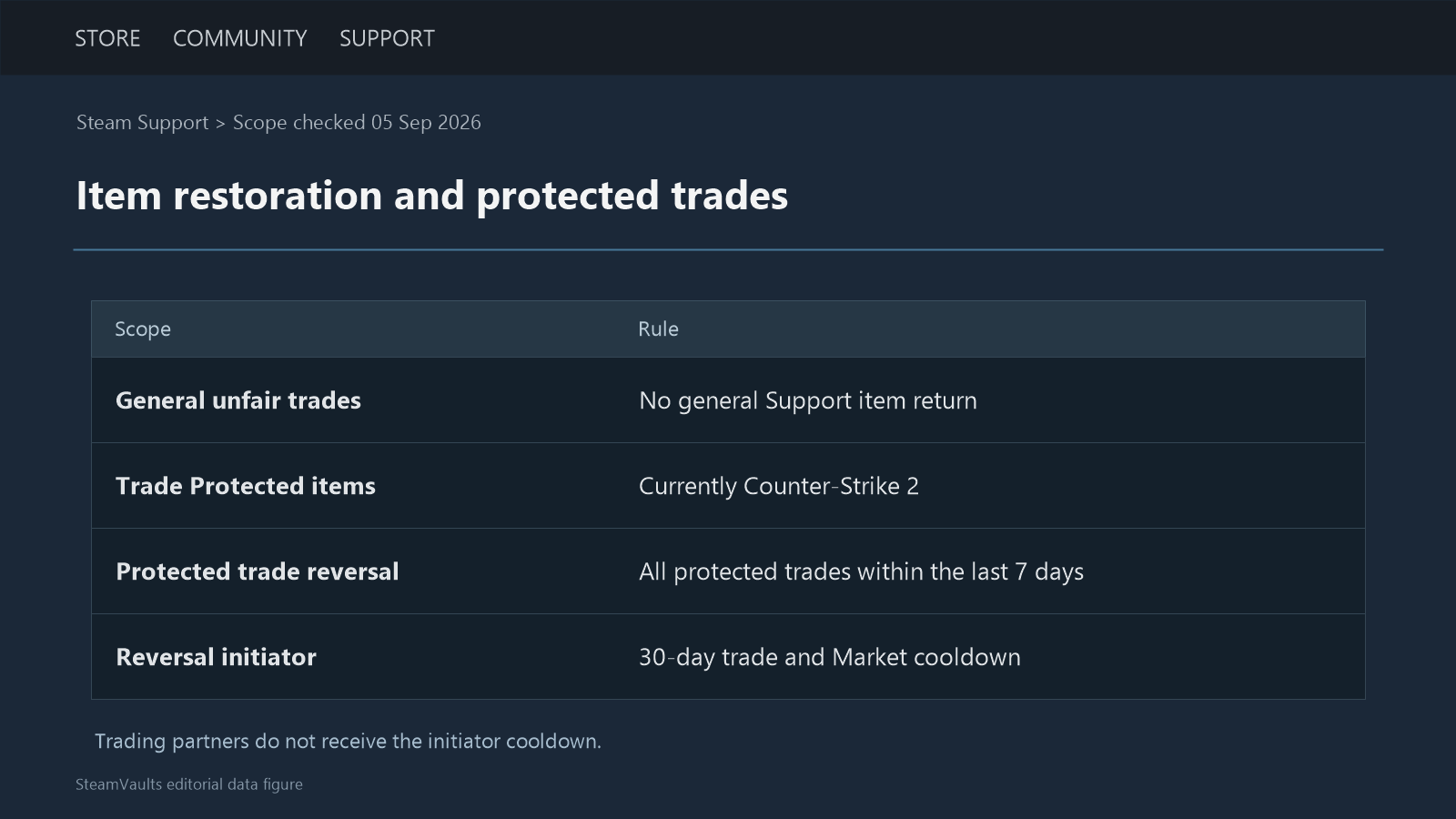
Steam's trading guidance says Support does not return items or gifts simply because a trade felt unfair. Keeping a conversation record does not make every transfer reversible.
Trade Protection is a separate feature. The official guidance checked on September 5, 2026 names Counter-Strike 2 as its supported game. A protected trade can be reversed for 7 days; after that, it cannot be reversed. Recover account control first, then check the trade history for that trade's eligibility.
Starting a reversal affects all protected trades from the recent 7-day period, not only the one that prompted you to act. The account that starts it receives a 30-day trade and Market restriction; the other account does not receive that restriction. Market listings from the initiating account return to that account, and pending trade offers are canceled.
Do not apply these conditions to another game or to every Steam transfer. Check the protection marker and the options in the trade history. Reversing a protected Steam trade does not promise to reverse an outside cash payment.
Ready to sell supported Sacks of Gems?
After the bot confirms receipt, USDT is credited to your site balance. Polygon withdrawal is a separate request.