


How to Safely Sell Steam Sacks of Gems: P2P, Marketplaces & Instant Liquidity Pools
Comprehensive safety guide to selling Steam Sacks of Gems: API scam defense, P2P marketplaces vs instant liquidity pools, custodial escrow risks, and settlement timing.
I design SteamVaults pricing and inventory rules and write about the Steam Wallet, Community Market, item liquidity and trade constraints.
Article languages
On this page
- Steam Community Direct Trade Risks: API Scams, Fake Middlemen, and Chargebacks
- Third Party Marketplaces vs Instant Pool Architecture: Order Books vs Instant Buyout
- Escrow Systems vs Non Custodial Trading: Smart Contracts and Platform Custody
- Steam Guard Trade Offer Verification: The 5 Step Integrity Protocol
- Timing Your Sale: Seasonal Sale Cycles, Badge Crafting Rallies, and Rate Fluctuation
- SteamVaults Zero API Architecture: Non Custodial Instant Liquidation Mechanism
- Pre Trade Security Audit Algorithm: Step by Step Liquidation Checklist
Within the Steam Community ecosystem, the Sack of Gems (1,000 gems) serves as a universal, fungible commodity. Whether generated by recycling unwanted trading cards, emoticons, and profile backgrounds, or acquired on the market, gem sacks form the baseline monetary unit for booster pack crafting and Steam profile leveling.
However, many users face a fundamental barrier when attempting to liquidate large gem inventories: Valve's Subscriber Agreement (SSA) Section 3.C strictly prohibits the withdrawal of Steam Wallet balances into real-world currency (fiat bank accounts, PayPal, or crypto networks).
To realize actual cash value from accumulated gem inventories, sellers must navigate external avenues: peer-to-peer (P2P) community trading, third-party listing marketplaces, or automated instant liquidity pools. Unfortunately, the off-market trading ecosystem is fraught with catastrophic counterparty risks—ranging from automated Steam Web API key interception (API hijacking) and fake middleman impersonation to chargeback fraud and custodial platform bankruptcies.
This guide provides an exhaustive, engineering-level operational manual for liquidating Steam Sacks of Gems with 0% asset loss risk. We dissect the technical architecture of API scams, contrast P2P order books against automated instant buyout pools, evaluate custodial escrow vs non-custodial settlement, detail a 5-step Steam Guard verification protocol, analyze seasonal market timing cycles, explain SteamVaults' zero-API infrastructure, and provide an end-to-end pre-trade security algorithm.
Steam Community Direct Trade Risks: API Scams, Fake Middlemen, and Chargebacks
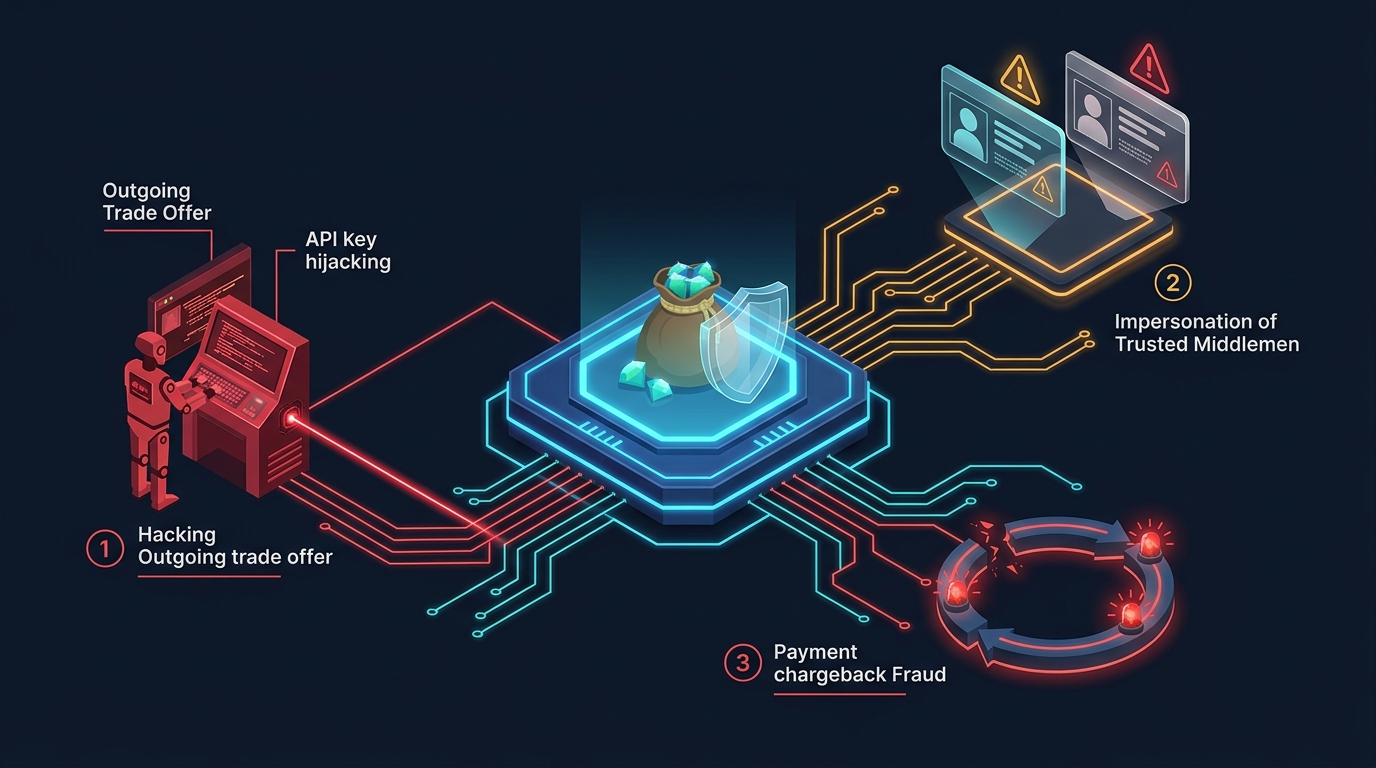
Direct peer-to-peer trading via community channels (such as Reddit r/SteamTrading, Discord trading hubs, Telegram groups, or Steam Community forums) promises zero intermediary fees. However, this apparent cost advantage is overshadowed by extreme operational hazards. In unbrokered transactions, sellers consistently encounter three primary attack vectors:
1. The Technical Architecture of Steam Web API Scams (Man-in-the-Middle Hijacking)
The most destructive and widespread scam in modern Steam trading is the API Key Interception Attack. This attack does not require the attacker to know your Steam password or possess your mobile authenticator device; it exploits compromised credentials obtained via third-party phishing portals:
1. Phishing Infiltration: The user attempts to log into a counterfeit third-party site (e.g., a fake tournament bracket, price-checker, or bogus trade site) that presents a spoofed Steam OpenID login modal. The victim unknowingly authorizes or inputs credentials. 2. Silent API Key Registration: The malicious server uses the stolen session token to visit https://steamcommunity.com/dev/apikey on the victim's account. It registers an unauthorized Web API Key without triggering a mobile push notification. 3. Continuous Offer Polling: The attacker runs an automated daemon that queries Valve's IEconService/GetTradeOffers endpoint every few seconds, monitoring all incoming and outgoing trade offers on the victim's profile. 4. Interception & Cancellation: When the victim initiates a legitimate trade offer to send Sacks of Gems to a genuine buyer or platform bot, the attacker's daemon detects the pending offer and immediately fires an automated IEconService/CancelTradeOffer call. 5. Spoofed Counter-Offer Dispatch: Within 200 to 500 milliseconds of cancellation, the attacker's bot creates an identical clone of the recipient account (copying avatar, display name, level, and badge showcase) and dispatches a fraudulent trade offer requesting the exact same gem sacks, giving nothing in return. 6. Victim Authorization: The victim opens their Steam Mobile Authenticator app, sees a trade confirmation matching the expected avatar and name, and taps "Confirm Trade." The gem sacks are permanently transferred to the scammer's disposable bot.
2. Fake Middlemen and Identity Spoofing
In manual P2P deals, parties often agree to use a "trusted middleman" from recognized communities like SteamRep or verified Discord servers. Fraudsters exploit this through sophisticated social engineering:
- Homoglyph & Unicode URL Attacks: Scammers register Steam accounts with vanity URLs that visually mimic genuine middlemen (e.g., replacing lowercase
lwith uppercaseI, or using Cyrillic homoglyphs). - Three-Way Group Impersonation: The scammer invites the seller to a private Discord or Telegram group containing a second account controlled by the scammer, masquerading as a reputable middleman with forged reputation screenshots.
- Steam Admin Badge Forgery: Attackers claim to be "Valve Trade Investigators" or "Steam Support Admins" inspecting items for "fraudulent duplication," threatening account termination if items are not deposited into an "investigative escrow bot." (Valve staff never contact users via chat or request item transfers).
3. Payment Reversal and Chargeback Fraud (Friendly Fraud)
Even if an item transfer succeeds, receiving payment via traditional consumer payment rails (PayPal, Venmo, Zelle, or credit card wire) introduces severe chargeback exposure:
- PayPal "Friends & Family" Deception: Buyers encourage sellers to accept "Friends & Family" payments to avoid fees. However, buyers frequently fund these transactions with compromised credit cards or hacked accounts. When the legitimate cardholder files an unauthorized transaction claim, the payment processor reverses the transfer immediately.
- Zero Seller Protection for Virtual Assets: Payment networks explicitly exclude digital goods and virtual game items from seller protection programs. Because Valve's Trade Offers cannot be verified as legal bills of lading by banking processors, financial institutions invariably rule in favor of the buyer during chargeback disputes.
- Valve SSA Non-Recourse: Valve's Support staff maintains a strict policy: trades confirmed via Steam Mobile Authenticator are final and irreversible. Valve will never restore items lost in unbrokered real-money transactions.
| Attack Vector | Primary Mechanism | Financial Risk | Mitigation / Prevention |
|---|---|---|---|
| API Key Hijacking | Automated polling and offer substitution | 100% loss | Revoke API key at /dev/apikey; verify partner join date |
| Fake Middleman | Profile impersonation & homoglyph vanity URLs | 100% loss | Never use manual middlemen; inspect raw SteamID64 |
| Chargeback Fraud | Stolen credit cards & PayPal dispute abuse | 100% loss | Avoid consumer payment rails; use crypto or licensed platforms |
| Phishing Modals | Fake OpenID popups capturing Steam credentials | Account takeover | Check browser address bar for genuine steamcommunity.com EV SSL |
Third-Party Marketplaces vs Instant Pool Architecture: Order Books vs Instant Buyout
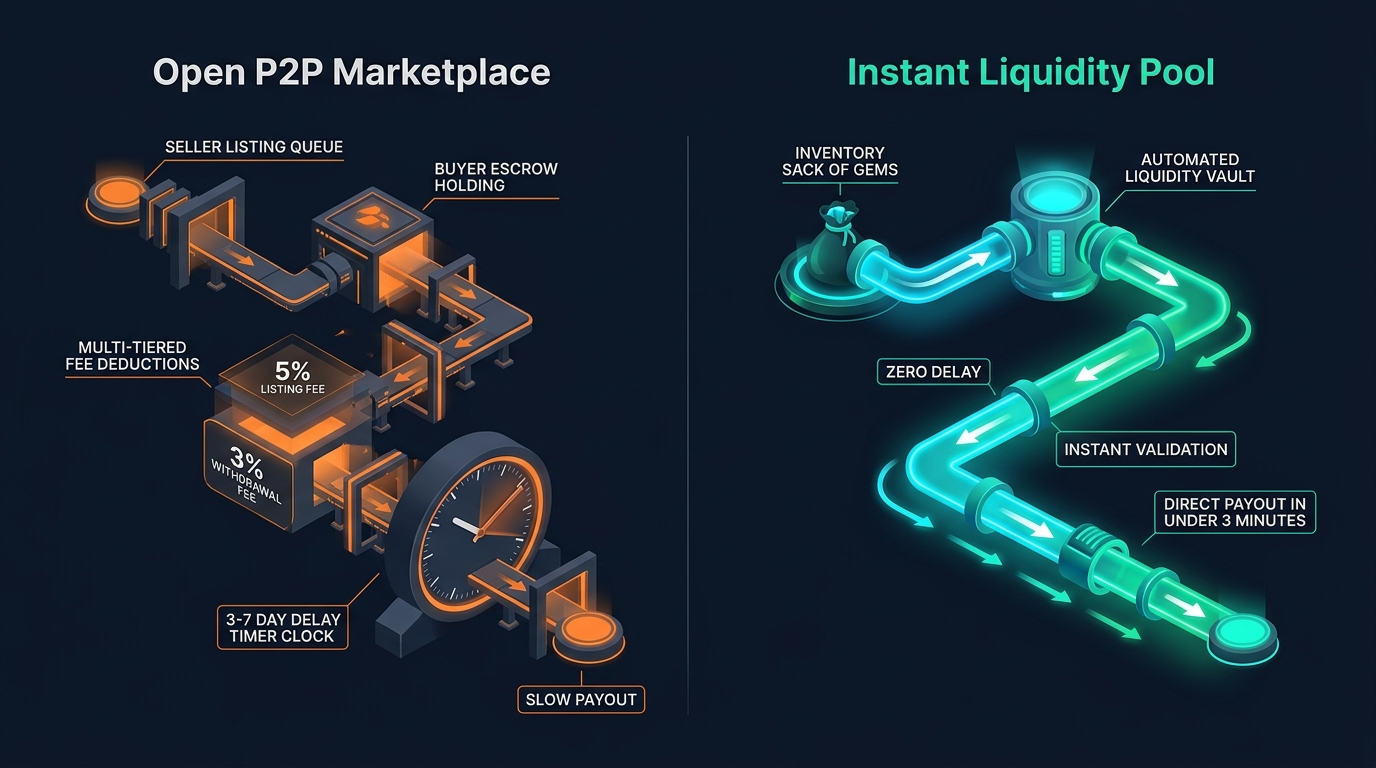
When moving away from high-risk manual P2P trades, sellers generally choose between two structured institutional models: Third-Party Listing Marketplaces and Automated Instant Liquidity Pools.
1. The P2P Listing Marketplace Paradigm
Listing marketplaces operate an order book where sellers list their Sacks of Gems and wait for individual retail buyers to purchase them:
- Fee Stacking: Marketplaces typically levy a multi-tier fee structure. A seller pays a listing/sales commission (typically 2.0% to 7.0%), followed by a cashout fee (1.0% to 5.0% depending on payout rail: SEPA, wire, card, or crypto).
- Execution Delay: Your inventory remains locked in an active listing state until a buyer matches your ask price. During market downturns or outside major sale events, sell orders can sit unfulfilled for days or weeks.
- Counterparty Fulfillment Risk: When a buyer purchases your listing, you must manually dispatch a trade offer within a strict time window (usually 1 to 2 hours). If your mobile device is inaccessible or the Steam network encounters downtime, you incur platform penalties, trust score deductions, or temporary account suspensions.
- Minimum Withdrawal Thresholds: Marketplaces often enforce minimum cashout balances ($10 to $50). Small-scale liquidations leave stranded fractional balances that cannot be withdrawn.
2. The Instant Liquidity Pool Paradigm (SteamVaults Model)
In contrast, an Instant Liquidity Pool functions as an automated market maker (AMM) for digital commodities. Rather than matching you with individual buyers, the platform buys your inventory directly into its programmatic treasury:
- Immediate Execution: Liquidation is instantaneous. Once you submit your desired quantity, an automated trade offer is dispatched within seconds. There is zero waiting for retail buyer discovery.
- Deterministic Settlement: The platform locks a transparent, pre-negotiated quote rate before you confirm the trade. You are never exposed to order book slippage, fluctuating bid depths, or partial fills.
- Unified Fee Architecture: There are no hidden listing fees, unsold cancelation fees, or account holding charges. The quoted payout rate reflects the exact net proceeds transferred to your payout destination.
- Near-Zero Counterparty Delay: Funds are disbursed automatically via API-connected payment rails (SEPA instant, domestic wire, USDT/USDC) within 3 minutes of Steam Guard mobile trade confirmation.
| Operational Dimension | P2P Listing Marketplaces | Instant Liquidity Pool (SteamVaults) | Strategic Trade-Off |
|---|---|---|---|
| Matching Engine | Central limit order book (buyer discovery) | Automated institutional inventory buyout | Instant Pool |
| Execution Speed | Hours to weeks (depends on retail demand) | Sub-3 minutes (Instant settlement) | Instant Pool |
| Slippage on Bulk Orders | High (depletes thin order book tiers) | Zero (Pre-locked quote rate) | Instant Pool |
| Fulfillment Responsibility | Manual dispatch within 1–2 hours | Automated bot offer sent to seller | Instant Pool |
| Platform Fee Overhead | 3%–10% (sales fee + payout fee) | Single transparent net spread | Neutral |
| Minimum Cashout Limits | Often $10–$50 minimum balance | Ultra-low or zero minimums | Instant Pool |
Escrow Systems vs Non-Custodial Trading: Smart Contracts and Platform Custody
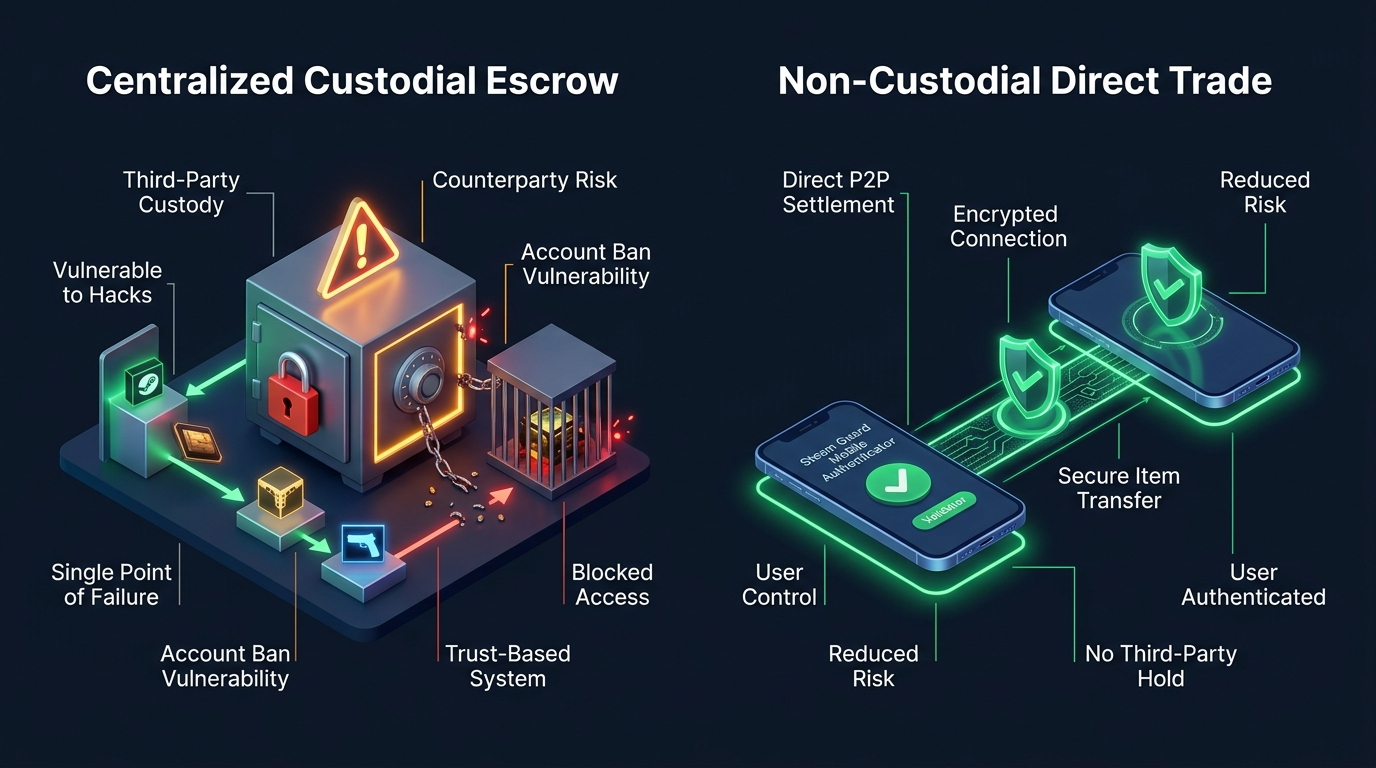
A vital architectural distinction in virtual asset trading is the storage and custody of your items during the settlement lifecycle: Custodial Escrow vs Non-Custodial Direct Settlement.
The Vulnerability of Custodial Escrow Deposits
In legacy marketplace models, sellers must "deposit" their Sacks of Gems into platform-owned Steam bot accounts before items can be listed on the marketplace. This custodial architecture introduces catastrophic systemic vulnerabilities:
1. Valve Trade Ban Exposure (Bot Waves): Valve continuously polices commercial trading activity. If Valve's automated risk algorithms flag a platform's central bot cluster for commercial policy violations, the bots are hit with irreversible Community Bans. All deposited inventory held on those bots is permanently frozen. Sellers possess zero legal standing to recover seized assets from Valve. 2. Platform Insolvency & Exit Scams: Custodial platforms hold total custody of both user inventory and fiat reserves. In the event of management fraud, technical bankruptcy, or regulatory freezes, depositors face 100% capital destruction. 3. Double Trade Hold Friction: Depositing items into a bot incurs an initial trade confirmation and possible trade hold. If an item fails to sell and you request a withdrawal, you face a second withdrawal trade lock, freezing your capital for up to 14 days.
The Security of Non-Custodial P2P Architecture
Modern financial standards favor Non-Custodial Architecture:
- Asset Preservation: Your Sacks of Gems remain entirely inside your personal, authenticated Steam Inventory. You never deposit your items into a communal bot reservoir.
- Atomic Trade Execution: The asset transfer occurs only at the exact millisecond when the transaction is ready for final authorization. If a pricing dispute occurs or you change your mind, you retain full physical control of your assets.
- Cryptographic Independence: Because items never leave your inventory prior to final settlement, a platform-level failure, server outage, or external regulatory action cannot compromise your unsold inventory.
Steam Guard Trade Offer Verification: The 5-Step Integrity Protocol
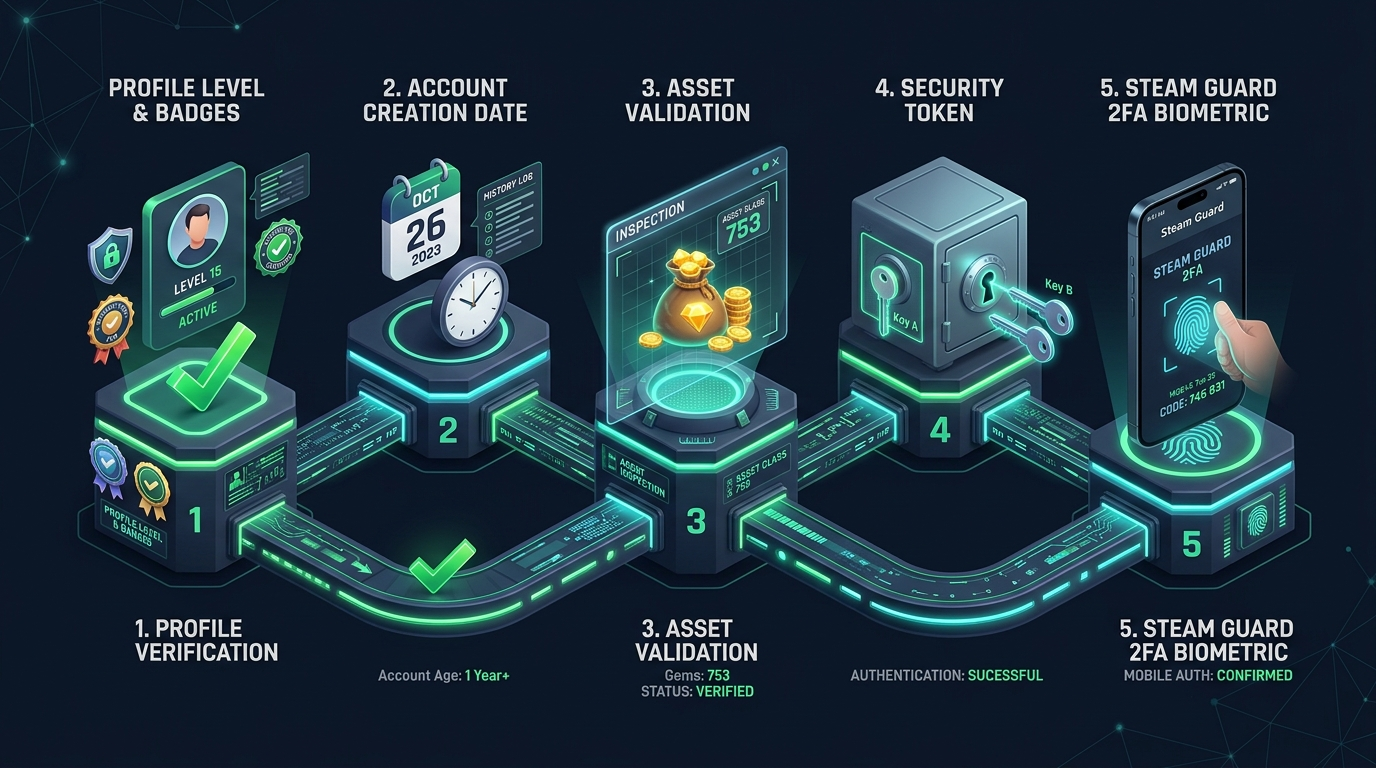
Whether executing a trade on a non-custodial platform or conducting an OTC deal, you must enforce a rigorous verification routine before confirming any transaction on your mobile device. Follow this 5-Step Integrity Protocol:
Step 1: Steam Account Creation Date & Level Inspection
When you receive an incoming trade offer or inspect a trade partner, verify their Steam profile metrics:
- Genuine trading bots and institutional market makers operate established, high-level accounts created years prior.
- If the trade partner's profile shows a recent registration date (e.g., created 3 days ago), Level 0 or 1, or private profile metrics, abort immediately. This is the universal hallmark of a disposable scam bot.
Step 2: Exact SteamID64 Cross-Verification
Scammers easily clone display names, avatars, and vanity URLs (e.g., steamcommunity.com/id/OfficialBuyerBot). However, the underlying 64-bit numerical identifier (SteamID64) is immutable and permanent:
- Use tools like SteamID.io to inspect the trade partner's raw numerical ID (format:
76561198xxxxxxxx). - Verify that this exact SteamID64 matches the verified bot ID listed on your trading portal's settlement screen.
Step 3: Trade Token & Trade Hold Verification
Ensure the trade partner has valid Steam Guard Mobile Authenticator status:
- If Steam displays a banner stating: "The trade will be held for 15 days because [User] has not had Steam Guard enabled," do not proceed.
- Institutional platforms and reputable buyers always maintain active mobile authenticators to enable 0-day instant trade completion.
Step 4: Gem Sack Item Integrity & Count Checksum
Before accepting an offer:
- Confirm that the items transferred are indeed Sacks of Gems (Item Def: 753) containing 1,000 gems each, rather than loose, unpacked gems disguised with misleading inventory descriptions.
- Verify the exact count of sacks in the trade window against your agreed order quantity. Ensure the recipient is taking only the agreed number of sacks.
Step 5: Mobile Authenticator Two-Factor Final Audit
The Steam Mobile Authenticator confirmation screen is your absolute last line of defense:
- Open the Steam Mobile App and navigate to Confirmations.
- Carefully inspect the trade summary: verify that the items leaving your inventory match your order, and cross-reference the recipient's name and registration date displayed in the prompt.
- If anything looks anomalous (e.g., an unexpected account name or an offer that appeared without your manual initiation), tap Cancel and immediately investigate your account security.
| Step Number | Verification Checkpoint | Expected Parameter | Failure Indicator / Action |
|---|---|---|---|
| 1 | Account Age & Level | Aged profile, established level | Account < 30 days old $\rightarrow$ Reject |
| 2 | SteamID64 Match | Exact match with platform prompt | Numerical ID mismatch $\rightarrow$ Reject (API Scam) |
| 3 | Trade Hold Status | Zero hold (Instant trade) | 15-day escrow banner $\rightarrow$ Reject |
| 4 | Item Type & Checksum | 1,000-gem Sacks of Gems | Unpacked loose gems $\rightarrow$ Reject |
| 5 | Mobile Confirmation | Matches desktop session | Uninitiated offer $\rightarrow$ Reject & Revoke API |
Timing Your Sale: Seasonal Sale Cycles, Badge Crafting Rallies, and Rate Fluctuation
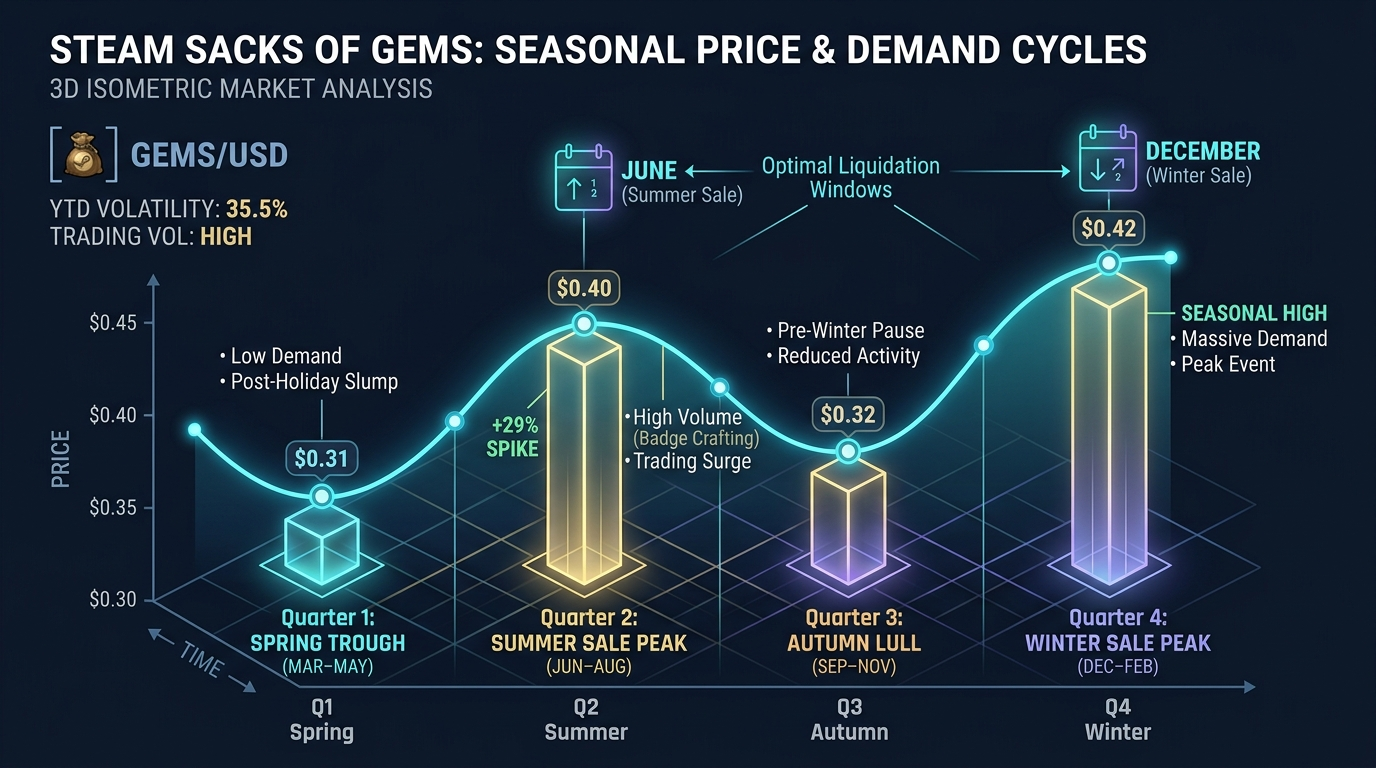
The market price and liquidity depth of Steam Sacks of Gems are not static. Because gems are the consumable fuel used to craft trading card booster packs, gem valuation is strictly correlated with the Steam Profile Leveling and Badge Crafting Cycle.
Understanding these seasonal rhythms enables sellers to capture a 15% to 35% premium on their inventory compared to selling during off-season troughs.
1. Major Seasonal Sale Surges (Summer & Winter Sales)
The most lucrative windows for gem liquidation occur twice annually:
- The Pre-Sale Speculation Window (D-14 to D-3): Approximately two weeks prior to the Steam Summer Sale (late June) and Steam Winter Sale (late December), high-tier badge crafters and card bots begin stockpiling millions of gems to craft booster packs. During this peak demand phase, Sack of Gems prices reliably surge from standard baseline levels ($0.30–$0.33) to seasonal highs ($0.38–$0.44).
- The Event Period (Sale Day 1 to Day 14): Once the sale commences, Steam awards Mystery Cards and Event Trading Cards for badge crafting. Demand remains elevated for the first 72 hours, after which the market experiences massive card dumping, causing gem prices to stabilize and gradually retrace.
2. Off-Season Slump Windows (Spring & Autumn)
Outside major sale events, gem demand drops substantially:
- Post-Sale Retracement (July–August & January–February): As badge crafters exhaust their budgets, market liquidity cools. Buy orders thin out, and the bid-ask spread widens.
- Spring and Autumn Flash Sales: While minor seasonal promotions (e.g., Autumn Sale in November, Spring Sale in March) provide slight bumps in activity, they lack event trading card incentives, resulting in modest price fluctuations ($0.29–$0.32).
3. Currency Devaluation and Regional Arbitrage
Macroeconomic factors also influence global gem pricing:
- Following Valve's transition of volatile regional markets (such as Turkey and Argentina) to standardized USD pricing, regional currency exploit loops have diminished.
- However, global foreign exchange movements (EUR/USD, GBP/USD) still produce micro-arbitrage opportunities where international buyers leverage currency strength to purchase bulk gems on external venues.
To maximize capital efficiency, large inventory holders should accumulate loose gems throughout seasonal lulls, pack them into sacks, and execute liquidations into instant pools or OTC buyers during the 2-week pre-sale rally window.
SteamVaults Zero-API Architecture: Non-Custodial Instant Liquidation Mechanism
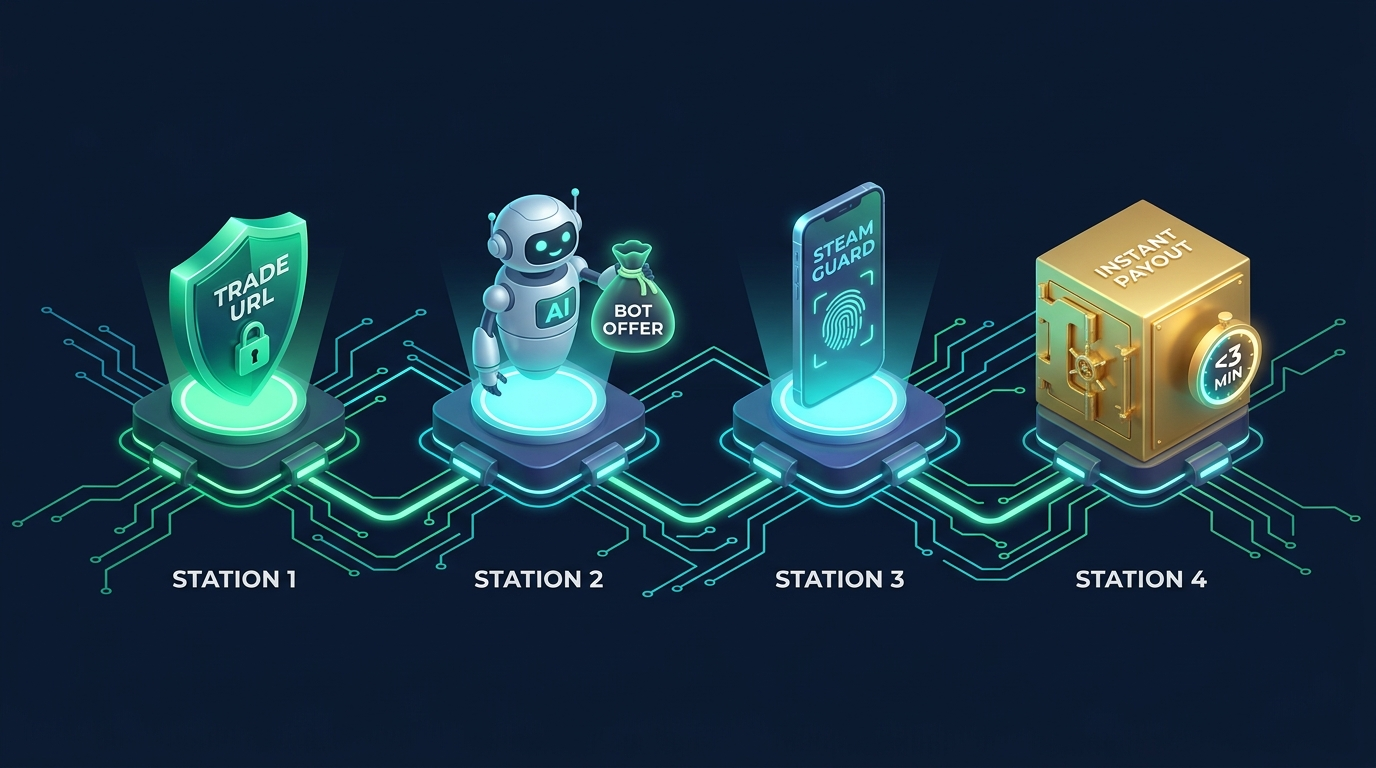
At SteamVaults, the liquidation of Steam commodities is engineered around two uncompromising pillars: Zero-API Security and Non-Custodial Instant Settlement.
The Zero-API Security Standard
Unlike insecure trading bots that require users to register or share a Steam Web API Key, SteamVaults enforces an absolute Zero-API Policy:
- Zero Account Credentials Required: We never ask for your Steam login password, OpenID session hijacking tokens, or Web API keys.
- Pure Public Trade URL Communication: All transactions are coordinated exclusively through your official Steam Public Trade URL (
steamcommunity.com/tradeoffer/new/?partner=...). - Complete Immunity to API Hijacking: Because SteamVaults never requires or accesses your API key, your account remains entirely immune to man-in-the-middle trade offer manipulation from our platform interface.
The 4-Stage Automated Settlement Pipeline
1. Real-Time Inventory Valuation & Rate Lock: Navigate to the Sack of Gems item portal or Sell portal. Enter your desired quantity. SteamVaults locks a firm, guaranteed net cash payout rate for 15 minutes. There is zero order book slippage, regardless of volume. 2. Automated Non-Custodial Offer Dispatch: SteamVaults' automated server cluster dispatches an official Steam Trade Offer directly to your account. You receive the exact SteamID64 and bot credentials in your browser session for verification. 3. Steam Guard Mobile Confirmation: You inspect the trade offer details on your mobile device. Because items remain in your personal inventory until this moment, you maintain complete custody until you physically tap "Confirm" in your Steam Mobile App. 4. Sub-3 Minute Automated Cashout: The instant our blockchain and banking gateways receive confirmation of trade completion from Steam's network, your payout is automatically dispatched. Whether routing to SEPA instant, local bank transfer, or stablecoins (USDT/USDC), funds arrive within 3 minutes.
Pre-Trade Security Audit Algorithm: Step-by-Step Liquidation Checklist
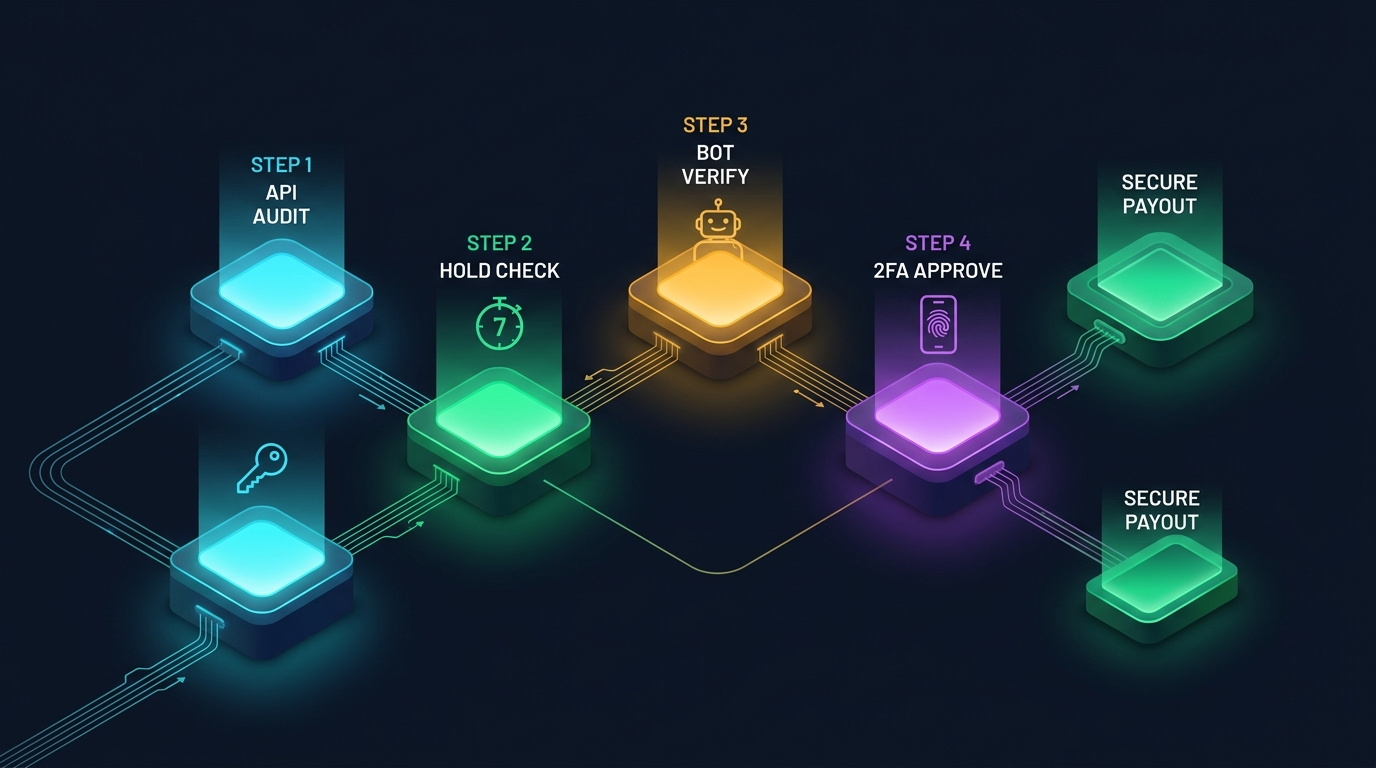
Before executing any sale of Steam Sacks of Gems, execute this definitive operational security checklist:
Step 1: Steam Web API Key Audit & Revocation
- Open your browser and navigate directly to:
https://steamcommunity.com/dev/apikey - Audit Condition: If the "Domain Name" field contains an active domain or key that you did not explicitly create for software development:
- Action: Click Revoke My Steam Web API Key immediately. - Remediation: Change your Steam account password, deauthorize all devices under Steam Guard settings, and create a fresh Steam Trade URL.
Step 2: 7-Day Mobile Authenticator Verification
- Verify that your Steam Mobile Authenticator has been continuously active on your current smartphone for at least 7 consecutive days (168 hours) without interruption.
- Audit Condition: If you recently transferred your authenticator to a new phone or enabled it less than 7 days ago:
- Action: Do not attempt off-market trading. Steam will impose a mandatory 15-day trade hold, preventing instant execution.
Step 3: Packing & Trade Lock Audit on Loose Gems
- If your gems are currently loose in your inventory:
- Action: Pack them into 1,000-unit sacks only if the underlying gems are free of trade restrictions. - Warning: Packing gems that carry an active trade lock will transfer that lock to the entire resulting Sack of Gems, rendering it untradable for 7 days.
Step 4: Platform Architecture & Custody Selection
- Evaluate your liquidation venue:
- Preferred: Select an automated non-custodial liquidity pool (such as SteamVaults) for fixed rates, zero slippage, and sub-3 minute settlement. - Alternative: If listing on an order book marketplace, account for cumulative platform fees (3%–10%) and minimum withdrawal thresholds. - Avoid: Reject all unbrokered direct P2P trades with unknown individuals offering PayPal or untrusted escrow bots.
Step 5: Trade Offer Credential Cross-Check
- When the trade offer arrives:
- Verify the bot's numerical SteamID64 against the transaction screen. - Confirm the bot's Steam join date and profile level. - Verify that the trade contains strictly the agreed number of 1,000-gem sacks.
Step 6: Final Two-Factor Authorization
- Open the Steam Mobile Authenticator app. Confirm the trade. Monitor your chosen payout destination for automated fund arrival.
> Data Verification & System Integrity — September 20, 2026: All technical protocols, API attack models, and security workflows detailed in this document reflect verified Steamworks ecosystem rules, Steam Guard authentication specifications, and live platform standards. Always verify recipient credentials prior to authorizing transactions on mobile hardware.
Ready to sell supported Sacks of Gems?
After the bot confirms receipt, USDT is credited to your site balance. Polygon withdrawal is a separate request.