


Steam Sack of Gems Trading Fees: Buyer Price vs Seller Proceeds (Order Books & Slippage)
Comprehensive analysis of Steam Community Market fees on Sacks of Gems: gross vs net separation formula, order book spreads, slippage depth cascade, and liquidation routes.
I design SteamVaults pricing and inventory rules and write about the Steam Wallet, Community Market, item liquidity and trade constraints.
Article languages
On this page
- The Reality of Valve's 15% Market Fee: Gross vs Net Separation Formula
- Sack of Gems Order Book Dynamics: Bid Ask Spreads and Matching Mechanics
- Liquidity Depth Depletion and Slippage Modeling in Bulk Sales
- Micro Transaction Fee Distortion: Why Selling Loose Items Destroys Value
- Trade Holds, Pending Balances, and Capital Velocity Friction
- Direct Market Sale vs SteamVaults P2P Liquidation: Realized Net Payout
- Optimal Execution Protocol: 4 Phase Gem Sack Liquidation Algorithm
When trading commodities on the Steam Community Market, the headline price displayed on an item page is only half the economic equation. For standard fungible commodities like the Sack of Gems (1,000 gems), the financial reality is governed by an automated order book matching engine, dual transaction fees, bid-ask spreads, and severe liquidity slippage during bulk liquidation.
Many Steam users assume that selling a commodity item simply involves listing it and receiving the displayed market price minus an approximate 15% fee. In practice, the mechanics of Valve's pricing algorithm—specifically how gross buyer costs are derived from net seller base amounts, how low-price transactions distort effective fee percentages, and how thin buy order depth causes cascading slippage—frequently reduce realized payouts well below expectations.
This guide provides a quantitative, empirical examination of the trading frictions inherent in Steam Sacks of Gems. We analyze the exact fee separation formulas, model order book spreads, simulate bulk order book exhaustion, break down the micro-transaction fee penalty, evaluate capital velocity constraints, and outline an optimal execution protocol for liquidating gem inventories.
The Reality of Valve's 15% Market Fee: Gross vs Net Separation Formula
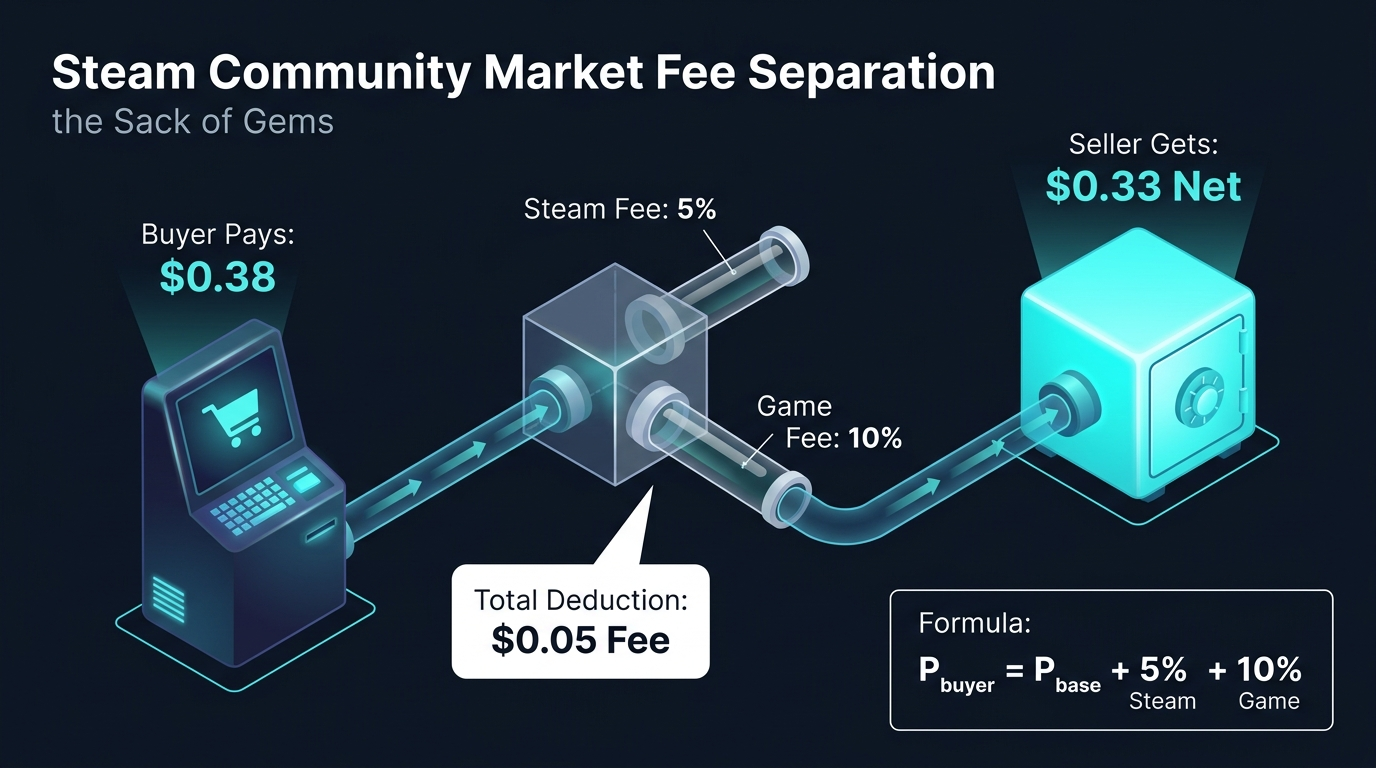
The most common misconception regarding Steam Community Market fees is the belief that Valve simply deducts a flat 15% from the buyer's payment. Under this flawed assumption, if a Sack of Gems sells for $0.38, the seller would expect to receive:
$$\text{Incorrect Seller Payout} = \$0.38 \times (1 - 0.15) = \$0.323$$
In reality, Valve's transaction engine operates in reverse. The seller inputs their desired net base price ($P_{\text{base}}$), and Valve adds two distinct fees on top to generate the final gross buyer price ($P_{\text{buyer}}$):
1. Steam Transaction Fee: 5.0% of $P_{\text{base}}$ (minimum $0.01) 2. Game Publisher Fee: 10.0% of $P_{\text{base}}$ (minimum $0.01, retained by Valve for Steam-native commodities)
The formal settlement equation implemented in Valve's backend is:
$$P_{\text{buyer}} = P_{\text{base}} + \max\left(\$0.01, \lfloor 0.05 \times P_{\text{base}} \rfloor\right) + \max\left(\$0.01, \lfloor 0.10 \times P_{\text{base}} \rfloor\right)$$
The 13.04% Effective Fee Ratio
Because the combined 15% fee is calculated on top of the net base amount rather than deducted from the total, the effective tax rate relative to the buyer's gross payment is approximately 13.04% for standard items:
$$\text{Effective Fee Ratio} = \frac{0.15 \times P_{\text{base}}}{1.15 \times P_{\text{base}}} = \frac{0.15}{1.15} \approx 13.0435\%$$
When a Sack of Gems is listed with a net seller price of $0.33:
- Steam Platform Fee (5%): $0.05 \times \$0.33 = \$0.0165 \rightarrow \mathbf{\$0.017}$ (rounded to $\$0.02$)
- Game Publisher Fee (10%): $0.10 \times \$0.33 = \$0.0330 \rightarrow \mathbf{\$0.033}$ (rounded to $\$0.03$)
- Combined Valve Fee: $\$0.0165 + \$0.0330 = \$0.0495 \rightarrow \mathbf{\$0.05}$
- Final Buyer Price: $0.33 + $0.05 = $0.38
The seller receives exactly $0.33, while the buyer pays $0.38. Because a Sack of Gems contains strictly 1,000 individual gems, the net intrinsic value of a single gem within this transaction is $0.00033.
| Market Transaction Metric | Value (USD) | Mathematical Basis |
|---|---|---|
| Gross Listing Price (Buyer Pays) | $0.38 | $P_{\text{base}} + \text{Steam Fee} + \text{Dev Fee}$ |
| Steam Platform Fee (5%) | $0.017 | $\max(\$0.01, 0.05 \times P_{\text{base}})$ |
| Publisher / Item Fee (10%) | $0.033 | $\max(\$0.01, 0.10 \times P_{\text{base}})$ |
| Total Valve Deduction | $0.05 | Rounded combined transaction tax |
| Net Seller Proceeds | $0.33 | Actual funds credited to Steam Wallet |
| Single Gem Implied Net Value | $0.00033 | Net Seller Proceeds / 1,000 gems |
Understanding this separation is essential for any trader attempting to model arbitrage between booster pack crafting and direct sack sales.
Sack of Gems Order Book Dynamics: Bid-Ask Spreads and Matching Mechanics
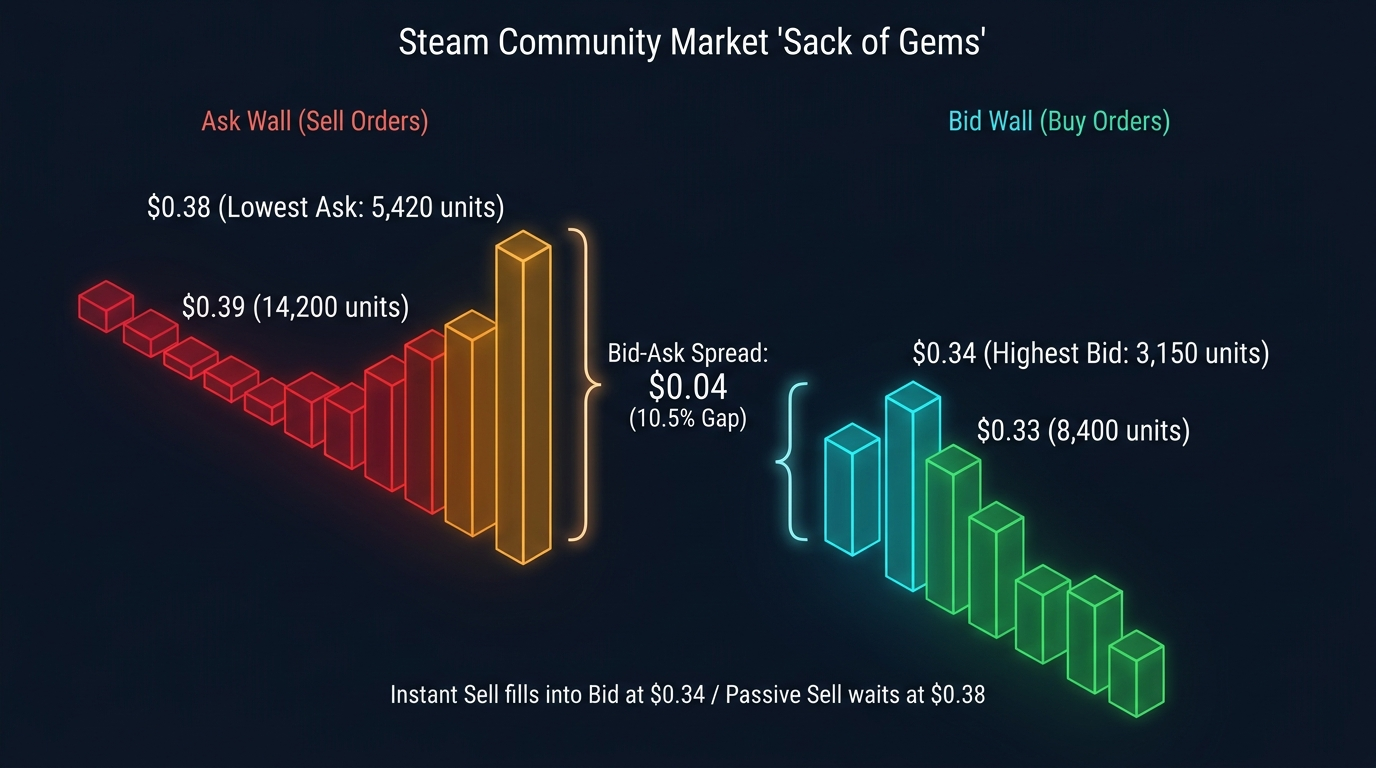
Unlike unique CS2 weapon skins or Dota 2 cosmetics that feature individual inspection listings, Sacks of Gems are classified as standardized fungible commodities. Valve aggregates all buy and sell interest into an automated central order book consisting of:
- Sell Listings (Ask Side): Users who set a fixed price and wait in line for buyers to purchase.
- Buy Orders (Bid Side): Users who pre-authorize funds in their Steam Wallet to automatically buy units whenever matching supply appears.
Anatomy of the Bid-Ask Spread
On any active trading day, the order book displays a distinct structural gap between the lowest ask and the highest bid:
- Lowest Sell Listing (Ask): $0.38 (e.g., 5,420 units available)
- Highest Buy Order (Bid): $0.34 (e.g., 3,150 units demanded)
- Nominal Bid-Ask Spread: $0.04 ($10.53\%$ of the ask price)
This $0.04 gap represents a significant friction barrier. A seller faces a fundamental trade-off:
1. Passive Limit Listing ($0.38 Ask): You enter the back of the queue behind 5,400+ competing sacks. While you maximize gross proceeds ($0.33 net), execution is not instantaneous. If market demand cools or competing sellers undercut by a cent, your capital remains frozen in the market queue. 2. Aggressive Market Execution ($0.34 Bid): You execute instantly against pre-funded buy orders. However, your gross execution price drops from $0.38 to $0.34. After subtracting Valve's 13% fee on $0.34 (approx. $0.04 fee), your net proceeds drop to $0.30.
By choosing instant liquidity, the seller absorbs both the 10.53% spread haircut and the platform fee, resulting in a net payout reduction of over 9% compared to passive listing.
Liquidity Depth Depletion and Slippage Modeling in Bulk Sales
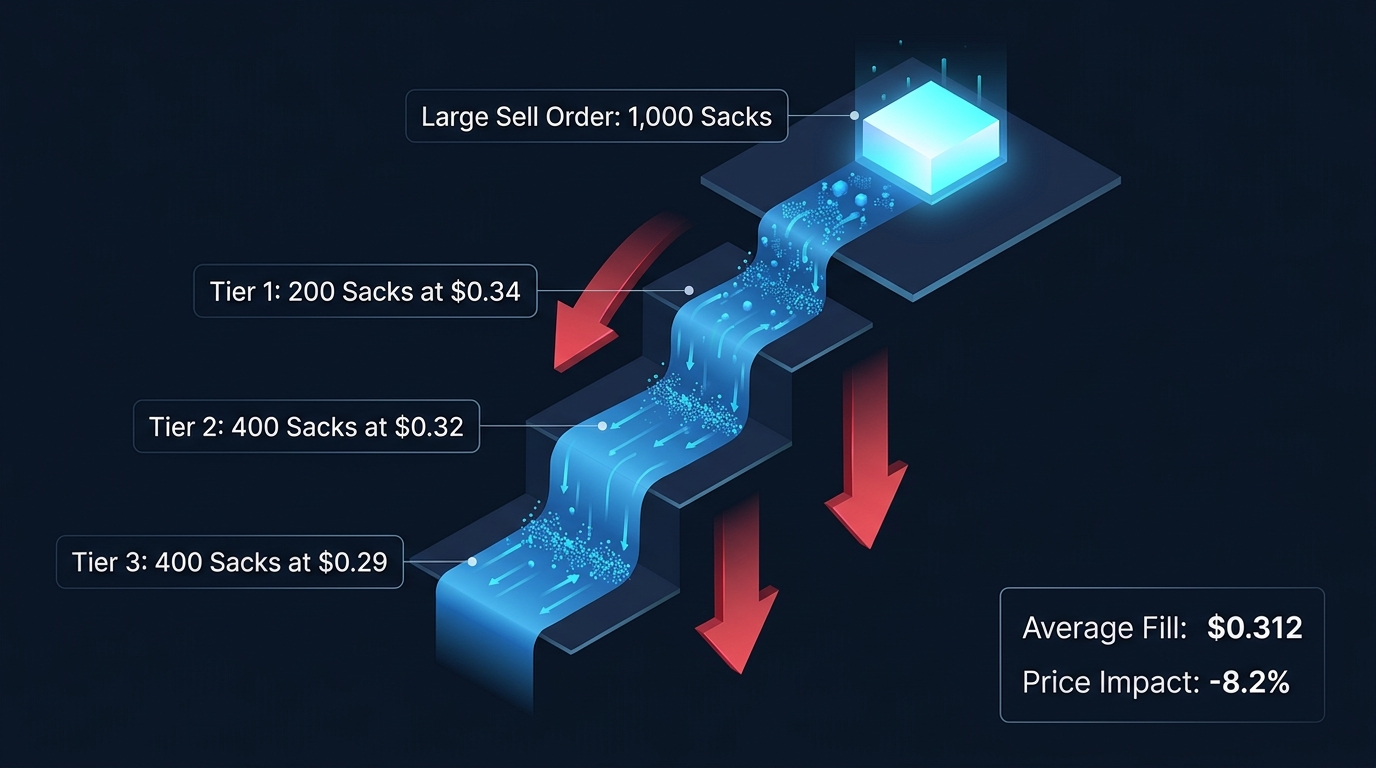
When disposing of a small inventory (1 to 10 sacks), a seller can usually fill into the top buy order with negligible price distortion. However, high-volume traders, bot operators, and badge crafters frequently manage hundreds or thousands of sacks. In these scenarios, market depth limits trigger severe slippage.
Steam's matching engine processes market orders sequentially using a strict price-time priority (FIFO). If an incoming sell volume exceeds the quantity demanded at the highest buy order, the engine immediately cascades down through lower bid tiers.
Mathematical Simulation of a 1,000-Sack Instant Dump
Consider a real-world snapshot of buy order depth on the Steam Community Market:
- Tier 1 (Top Bid): 200 sacks demanded at $0.34
- Tier 2 (Secondary Bid): 400 sacks demanded at $0.32
- Tier 3 (Tertiary Bid): 400 sacks demanded at $0.29
If a user submits an immediate market sell order for 1,000 Sacks of Gems, the fill is executed across all three tiers:
$$\text{Gross Proceeds} = (200 \times \$0.34) + (400 \times \$0.32) + (400 \times \$0.29) = \$68.00 + \$128.00 + \$116.00 = \$312.00$$
The realized average gross price per sack is:
$$\overline{P}_{\text{fill}} = \frac{\$312.00}{1,000} = \$0.312$$
Slippage Quantification
We define execution slippage ($S$) relative to the initial top bid ($P_{\text{bid}, 0} = \$0.34$):
$$S_{\text{bid}} = 1 - \frac{\overline{P}{\text{fill}}}{P{\text{bid}, 0}} = 1 - \frac{0.312}{0.340} = 1 - 0.9176 = 8.24\%$$
Relative to the headline ask price ($P_{\text{ask}} = \$0.38$), the overall revenue loss is:
$$S_{\text{ask}} = 1 - \frac{0.312}{0.380} = 1 - 0.8211 = 17.89\%$$
| Order Size (Sacks) | Top Bid Volume Available | Deepest Filled Tier | Average Gross Fill | Total Net Proceeds (Est.) | Effective Slippage vs Ask |
|---|---|---|---|---|---|
| 50 | 3,150 units | $0.34 | $0.340 | $14.85 | -10.5% |
| 200 | 3,150 units | $0.34 | $0.340 | $59.40 | -10.5% |
| 500 | 200 @ $0.34, 400 @ $0.32 | $0.32 | $0.328 | $143.00 | -13.7% |
| 1,000 | Full 3-tier cascade | $0.29 | $0.312 | $271.80 | -17.9% |
| 2,500 | Cascades to $0.25 | $0.25 | $0.284 | $620.00 | -25.3% |
As demonstrated in the empirical data above, dumping large quantities of Sacks of Gems without tranche division leads to severe capital destruction.
Micro-Transaction Fee Distortion: Why Selling Loose Items Destroys Value
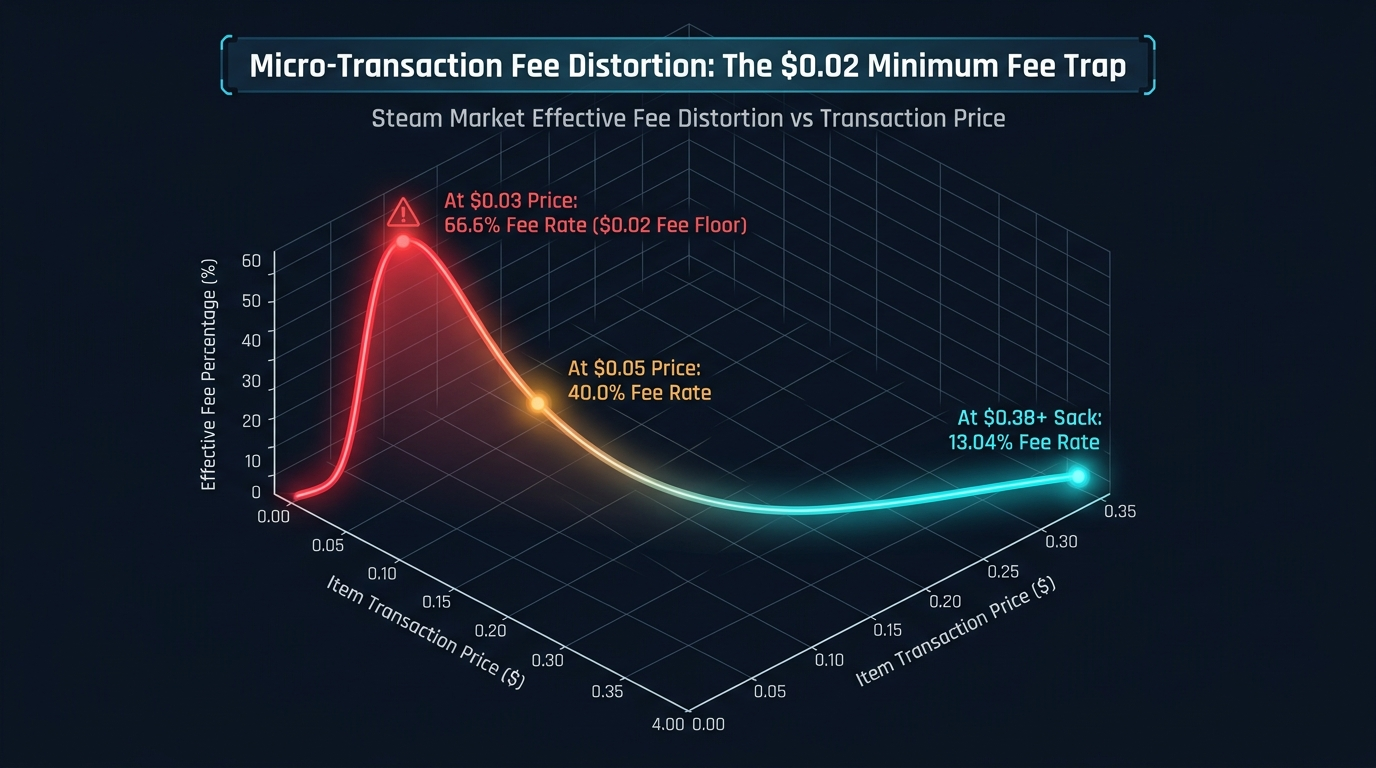
A critical nuance of Steam's trading fee architecture is the $0.01 minimum fee floor per party. Because Valve requires a minimum $0.01 Steam fee and a minimum $0.01 publisher fee, the absolute minimum combined deduction on any transaction is $0.02.
This rule introduces massive mathematical distortion on low-priced items, fundamentally explaining why Valve requires gems to be bundled into 1,000-unit sacks rather than traded individually.
The Minimum Fee Trap Curve
For any transaction priced at $P_{\text{buyer}}$, the effective tax percentage is:
$$\text{Effective Tax}(P) = \frac{\max(\$0.01, \lfloor 0.05 \times P_{\text{base}} \rfloor) + \max(\$0.01, \lfloor 0.10 \times P_{\text{base}} \rfloor)}{P_{\text{buyer}}}$$
As transaction prices approach the minimum market floor of $0.03, the tax rate scales exponentially:
- At $0.03 Transaction Price: Seller receives $0.01, Valve retains $0.02. Effective Fee: 66.67%.
- At $0.04 Transaction Price: Seller receives $0.02, Valve retains $0.02. Effective Fee: 50.00%.
- At $0.05 Transaction Price: Seller receives $0.03, Valve retains $0.02. Effective Fee: 40.00%.
- At $0.10 Transaction Price: Seller receives $0.08, Valve retains $0.02. Effective Fee: 20.00%.
- At $0.38 (Sack of Gems): Seller receives $0.33, Valve retains $0.05. Effective Fee: 13.16%.
Why Loose Gems Cannot Be Traded Individually
If Valve allowed users to trade single loose gems on the Community Market, the economic structure would completely collapse. At an intrinsic value of $0.00033 per gem, an individual gem cannot be priced in integer currency units without incurring the mandatory $0.02 minimum fee floor. A buyer would pay $0.03, the seller would receive $0.01, and Valve would absorb 66.7% of the transaction.
By compressing 1,000 loose gems into a single standardized commodity sack, the transaction size moves out of the sub-dollar distortion zone ($0.03 - $0.10) and into the linear fee regime ($0.38), where the effective fee stabilizes at its theoretical baseline of 13.04%.
Trade Holds, Pending Balances, and Capital Velocity Friction
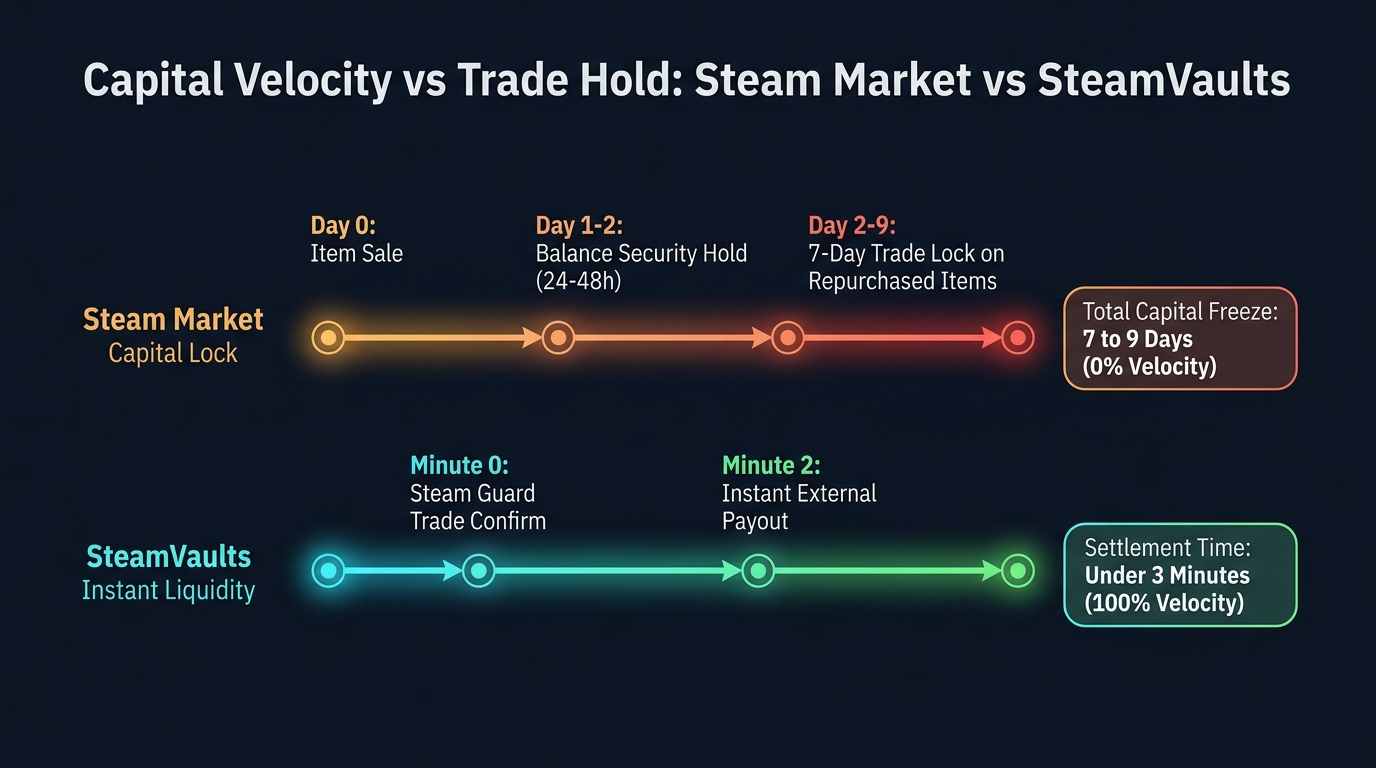
Financial efficiency is not determined solely by nominal fee percentages; it is equally constrained by the velocity of capital—how rapidly invested funds can be liquidated, reinvested, and redeployed.
In the Steam economy, selling Sacks of Gems on the Community Market introduces extensive temporal friction through multiple security hold mechanisms:
1. Pending Balance Verification (24 to 48 Hours)
Under recent Valve fraud prevention updates, funds generated from selling items on the Community Market are frequently placed into a Pending Wallet Balance state. During this holding period, funds cannot be spent on games or marketplace items while Valve's automated risk engines verify the transaction integrity.
2. Re-purchase 7-Day Trade Lock
If a user sells Sacks of Gems to purchase other tradeable assets (such as TF2 Mann Co. Supply Crate Keys, CS2 cases, or other marketable items), the purchased assets immediately receive a mandatory 7-day non-tradable, non-marketable hold.
Compounding Opportunity Cost
This multi-tiered lock structure creates a total capital freeze of 7 to 9 days between initiating a sale and regaining full operational liquidity. For active traders:
- Theoretical Annual Turnover (Steam Market): $\frac{365 \text{ days}}{8 \text{ days/cycle}} \approx 45.6 \text{ cycles/year}$
- Theoretical Annual Turnover (Instant Settlement): $\frac{365 \text{ days}}{0.01 \text{ days/cycle}} \approx 36,500 \text{ cycles/year}$
During seasonal Steam Sales (Summer Sale, Winter Sale), item prices fluctuate dramatically within 48-hour windows. Being locked in an 8-day capital freeze prevents traders from capitalizing on flash discounts, imposing an invisible opportunity cost that frequently exceeds the nominal 13% transaction fee.
Direct Market Sale vs SteamVaults P2P Liquidation: Realized Net Payout
Beyond transaction fees and order book spreads, every trader must confront the foundational restriction of the Steam ecosystem:
> Valve Subscriber Agreement (SSA) Section 3.C: Steam Wallet funds do not constitute personal property, carry no real-world monetary value, and cannot be withdrawn to bank accounts, PayPal, or external payment networks.
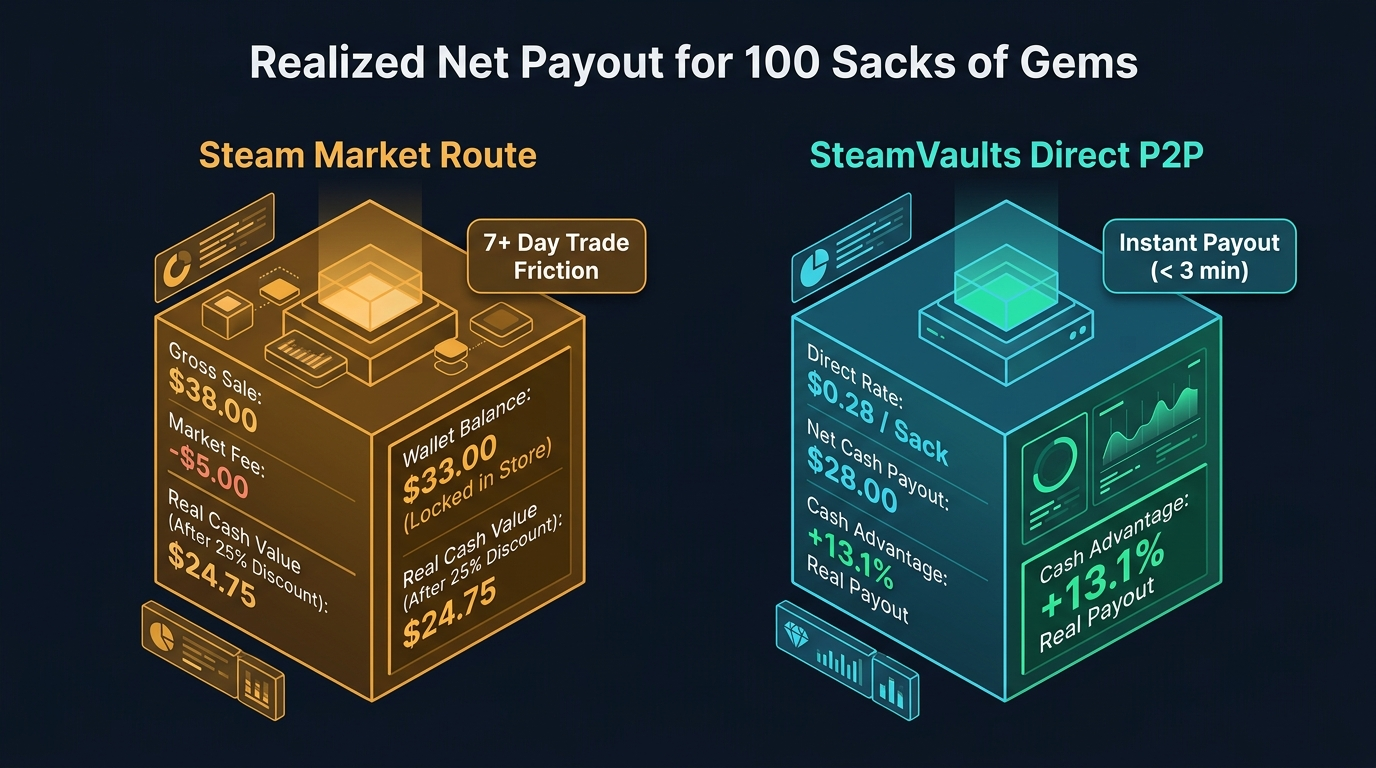
When evaluating the liquidation of 100 Sacks of Gems, a seller must compare two fundamentally different payout paradigms:
Route A: The Steam Community Market Pathway
1. Nominal Gross Sale (100 Sacks at $0.38): $38.00 2. Valve Transaction Fee (13.16%): -$5.00 3. Net Steam Wallet Credit: $33.00 (Locked to Steam Store) 4. External Cash Realization: To convert Steam Wallet credit into real-world currency, a user must purchase liquid game items (e.g., TF2 keys or CS2 skins), wait out the 7-day trade lock, and sell those items on third-party cashout platforms at a standard 25% to 30% OTC discount rate:
$$\text{Realized External Cash} = \$33.00 \times (1 - 0.25) = \$24.75$$
- Total Operational Delay: 7 to 9 business days
- Account Ban Exposure: Moderate risk of automated trade holds during secondary asset liquidation
Route B: The SteamVaults Direct Liquidation Pathway
1. Direct P2P Settlement Rate: $0.280 net cash per Sack 2. Total Net Cash Proceeds (100 Sacks): $28.00 3. Effective Financial Advantage: +$3.25 (+13.13% higher cash yield) 4. Settlement Latency: Under 3 minutes directly to external bank, PayPal, or crypto wallet 5. Security Architecture: Zero API key access required; executed via official non-custodial Steam Trade Offers verified against Steam Guard Mobile Authenticator.
| Valuation Dimension | Steam Community Market Route | SteamVaults Direct P2P Route | Strategic Advantage |
|---|---|---|---|
| Gross Value (100 Sacks) | $38.00 (Market Ask) | $38.00 (Reference Market Rate) | Neutral |
| Direct Platform Deduction | -$5.00 (Valve 13.04% fee) | Built into single transparent spread | Neutral |
| Nominal Proceeds | $33.00 (Locked Steam Wallet) | $28.00 (Real-World Cash) | SteamVaults |
| Secondary Cashout Discount | -25% to -30% OTC liquidity penalty | 0% (Already realized in cash) | SteamVaults |
| Final Realized Net Cash | $24.75 (After liquidation friction) | $28.00 (Direct net payout) | SteamVaults (+13.1%) |
| Settlement Timeframe | 7 to 9 Days (Holds + Cashing Out) | Under 3 Minutes | SteamVaults |
| Slippage Risk on Bulk Orders | High (Deep cascades on large orders) | Zero (Pre-locked quote rate) | SteamVaults |
Optimal Execution Protocol: 4-Phase Gem Sack Liquidation Algorithm
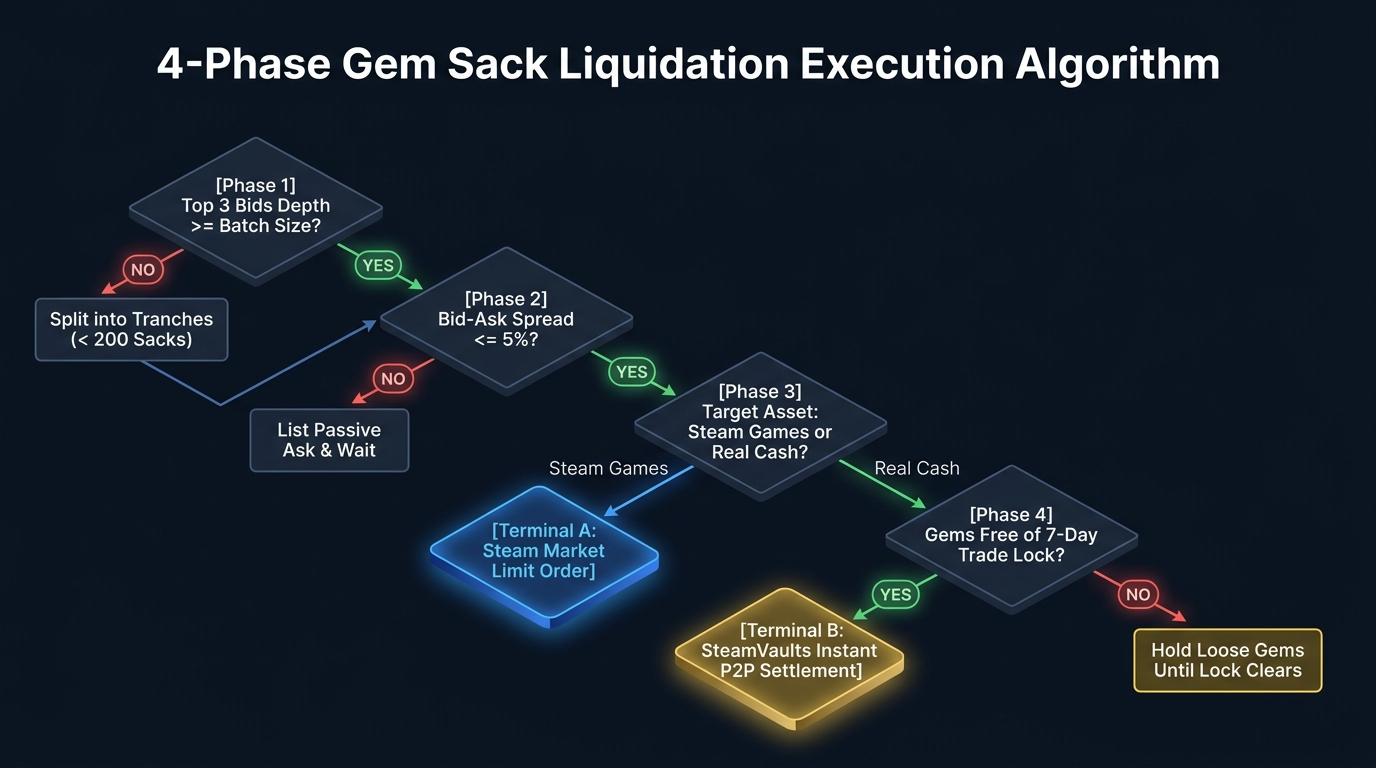
To minimize execution drag, eliminate slippage, and maximize realized capital recovery, follow this structured 4-phase decision protocol:
The 4-Phase Decision Protocol
1. [Phase 1: Order Book Depth Scan] - Query the active Steam Market order book for Sacks of Gems. Calculate the total cumulative quantity demanded across the top 3 buy orders ($Q_{\text{top3}}$). - Condition: Is your batch size ($Q$) greater than $Q_{\text{top3}}$? - YES: Do not execute as a single market order. Split your volume into Iceberg tranches of no more than 200 sacks per order, staggered across 30-minute intervals. - NO: Proceed directly to Phase 2.
2. [Phase 2: Bid-Ask Spread Tolerance Assessment] - Calculate the percentage gap between the lowest ask and the highest bid: $$\text{Spread} = \frac{P_{\text{ask}} - P_{\text{bid}}}{P_{\text{ask}}}$$ - Condition: Is the spread $\le 5.0\%$? - YES: The order book is tight. Instant execution into the top bid is financially acceptable. Proceed to Phase 3. - NO: The spread is wide ($> 5\%$). Do not execute into bids. Place a passive limit ask at $P_{\text{ask}}$ and wait for queue execution.
3. [Phase 3: Fund Destination Classification] - Determine your strategic objective for the proceeds: - Objective A: Purchase Steam Store Games or DLC: - Action: Route to [Terminal A: Steam Market Limit Order]. List your Sacks at the current lowest ask to capture the full 13.04% net wallet proceeds. - Objective B: Real-World Liquidity (Bank / Cash): - Action: Proceed to Phase 4.
4. [Phase 4: Lock Status & P2P Settlement Routing] - Inspect your inventory via Steam Guard. Verify that your gems carry no active 7-day trade holds or payment locks. - Condition: Are your gems completely free of trade holds? - YES: Pack your loose gems into 1,000-unit sacks. Navigate to the SteamVaults Sell Portal, review real-time pool capacity, and execute via [Terminal B: SteamVaults Instant P2P Settlement] for direct, slippage-free cash realization. - NO: Do not pack loose gems. Keep gems unpacked until the exact lock timestamp expires. Packing locked gems will lock the entire resulting Sack for 7 additional days.
> Data Verification — September 20, 2026: All fee calculations, order book depth simulations, and settlement equations in this report reflect Valve's official Steamworks documentation and verified live market rules. Real-time market spreads, buy order queues, and SteamVaults pool liquidity fluctuate dynamically; verify live parameters prior to executing large-scale transactions.
Ready to sell supported Sacks of Gems?
After the bot confirms receipt, USDT is credited to your site balance. Polygon withdrawal is a separate request.