


What Is a Steam Sack of Gems Worth? Booster Pack Crafting vs Market Sale
An empirical valuation of Steam Sacks of Gems: single-gem pricing math, booster pack expected value (EV) formulas, genre ROI variance, and optimal liquidation strategies.
I design SteamVaults pricing and inventory rules and write about the Steam Wallet, Community Market, item liquidity and trade constraints.
Article languages
On this page
- The Net Value of a Single Gem: Order Books and Fee Separation
- Mathematical Expected Value (EV) of Booster Packs: The 6,000/N Formula
- Empirical Profitability Across Game Genres (AAA vs Indie vs Anime)
- The Foil Card Trap: Profile Level Multipliers and Variance Risk
- Direct Market Sale vs Booster Pack Crafting: The 5 Pillar Decision Matrix
- The SteamVaults Liquidation Route: Escaping the Closed Wallet Trap
- The 5 Step Operational Decision Flowchart
When you hold several Sacks of Gems in your Steam inventory—or consider purchasing them on the Community Market to craft Booster Packs—the core economic dilemma is deceptively simple:
“Is it more profitable to liquidate this Sack of Gems directly on the Community Market, or should I craft and unwrap Booster Packs from select games?”
Steam discussion boards and social platforms frequently echo anecdotal success stories: “Craft booster packs for obscure anime visual novels for massive profits!” or “Pulling a single Foil card 10x your gem input!” Yet, practically none of these discussions account for Valve's 13.04% market fee (effective fee often exceeding 20% on sub-dollar cards), the order book bid-ask spread, the inverse badge set size formula ($6,000/N$), or the profile-level scaling of foil drop odds.
In reality, a Sack of Gems is a standardized, highly liquid industrial commodity within the Steam ecosystem. Blindly cracking booster packs without calculating the mathematical Expected Value (EV) almost always results in severe capital erosion due to compounding transaction fees and illiquid inventory traps.
This comprehensive guide breaks down the true financial value of Steam Gems in 2026. We examine the exact net pricing of a single gem, model the probabilistic returns of booster pack crafting across different game categories, analyze the heavy-tailed variance of foil cards, and outline the optimal routes to convert gem value into real-world liquidity.
The Net Value of a Single Gem: Order Books and Fee Separation
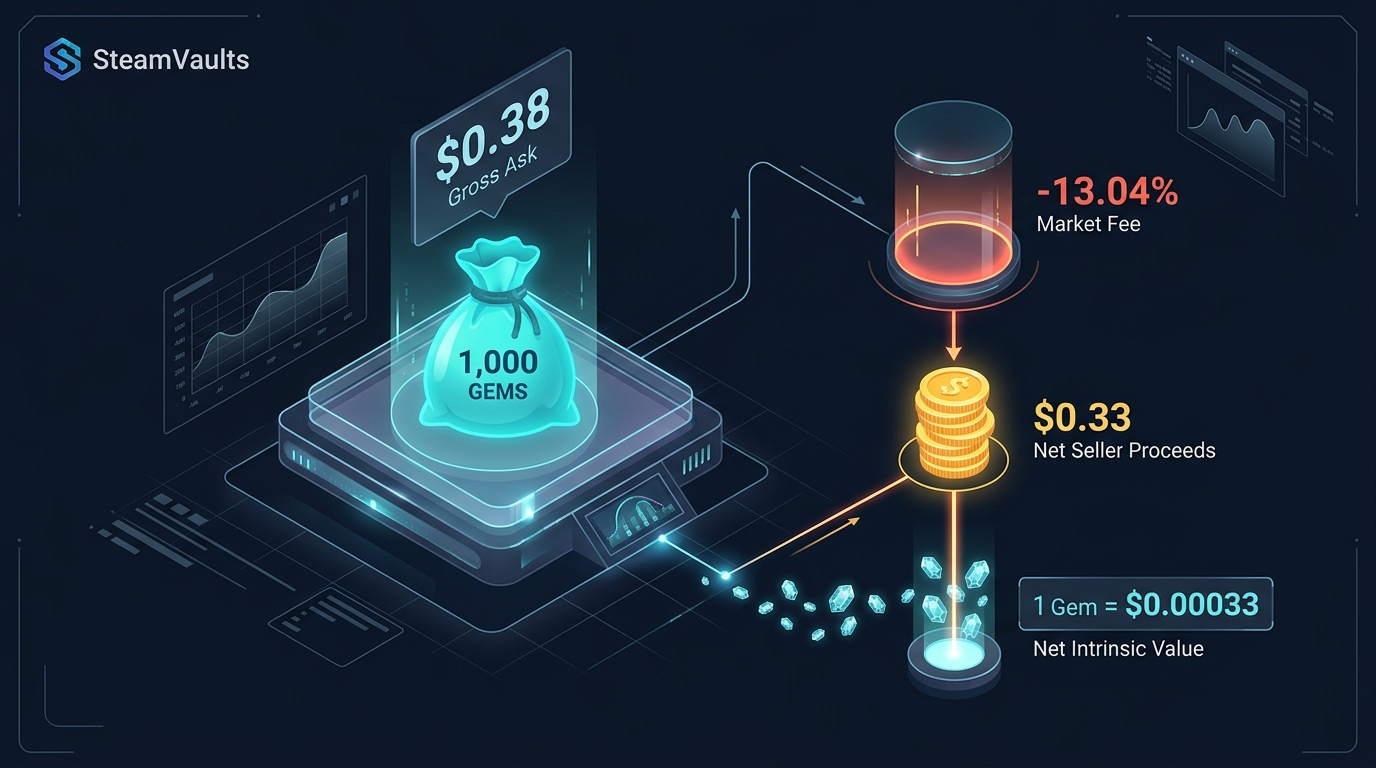
The most common valuation error players make is looking at the headline “Starting at” price on the Community Market and assuming that figure represents the cash value of their gems.
Suppose the lowest active sell listing (Lowest Ask) for a Sack of Gems on the Steam Community Market is $0.38. If you list your Sack at $0.38 and a buyer purchases it, you do not receive $0.38 in your Steam Wallet. Valve automatically deducts a 5% Steam transaction fee and a 10% game developer fee (retained by Valve for community items).
Separating Gross Buyer Price from Net Seller Payout
Valve calculates market fees based on the seller's base price ($P_{\text{base}}$):
- Buyer Pays: $P_{\text{buyer}} = P_{\text{base}} + \max(0.01, \lfloor 0.05 \times P_{\text{base}} \rfloor) + \max(0.01, \lfloor 0.10 \times P_{\text{base}} \rfloor)$
- Seller Receives: $P_{\text{seller}} = P_{\text{base}}$
When a Sack of Gems sells for $0.38 gross, the seller's net wallet deposit is approximately $0.33. Because one Sack contains exactly 1,000 gems, the net intrinsic wallet value of a single loose gem is:
$$V_{\text{gem, net}} = \frac{\$0.33}{1,000} = \$0.00033 \text{ per gem}$$
Conversely, if you do not own gems and need to acquire them to craft booster packs, you must pay the gross buyer price ($0.38). In that case, your input cost per gem is $0.00038.
| Valuation Tier | Sack (1,000 Gems) Price | Single Gem Value | Application & Decision Context |
|---|---|---|---|
| Market Purchase Cost (Ask) | $0.38 | $0.000380 | Input cost when buying Sacks on market to craft packs |
| Market Limit Sale Net (Ask) | $0.33 | $0.000330 | Net proceeds when listing patient sell order at lowest ask |
| Market Instant Liquidation (Bid) | $0.31 | $0.000310 | Net proceeds when selling instantly into highest buy order |
| SteamVaults Direct Settlement | Live Quote | $0.00028 - $0.00030 | Instant external fiat/crypto cashout bypassing wallet lockdown |
Order Book Spreads and Liquidation Slippage
Unlike CS2 weapon skins, which trade as unique non-fungible items, Sacks of Gems operate on a consolidated commodity order book.
If you require immediate wallet funds and click “Sell,” your order matches against the Highest Buy Order (Bid), typically sitting at $0.35 gross, which yields approximately $0.31 net. Selling instantly forfeits roughly 6% in liquidity spread compared to waiting at the ask.
Furthermore, if you attempt to liquidate 50 or 100 Sacks simultaneously, you will rapidly exhaust the top buy order tier, suffering market slippage down to $0.34 or $0.33 bids. Therefore, when evaluating whether crafting a booster pack is worth the cost, you must measure your gem cost against your true net opportunity cost ($0.31 to $0.33 per Sack), not the headline sticker price.
Mathematical Expected Value (EV) of Booster Packs: The 6,000/N Formula
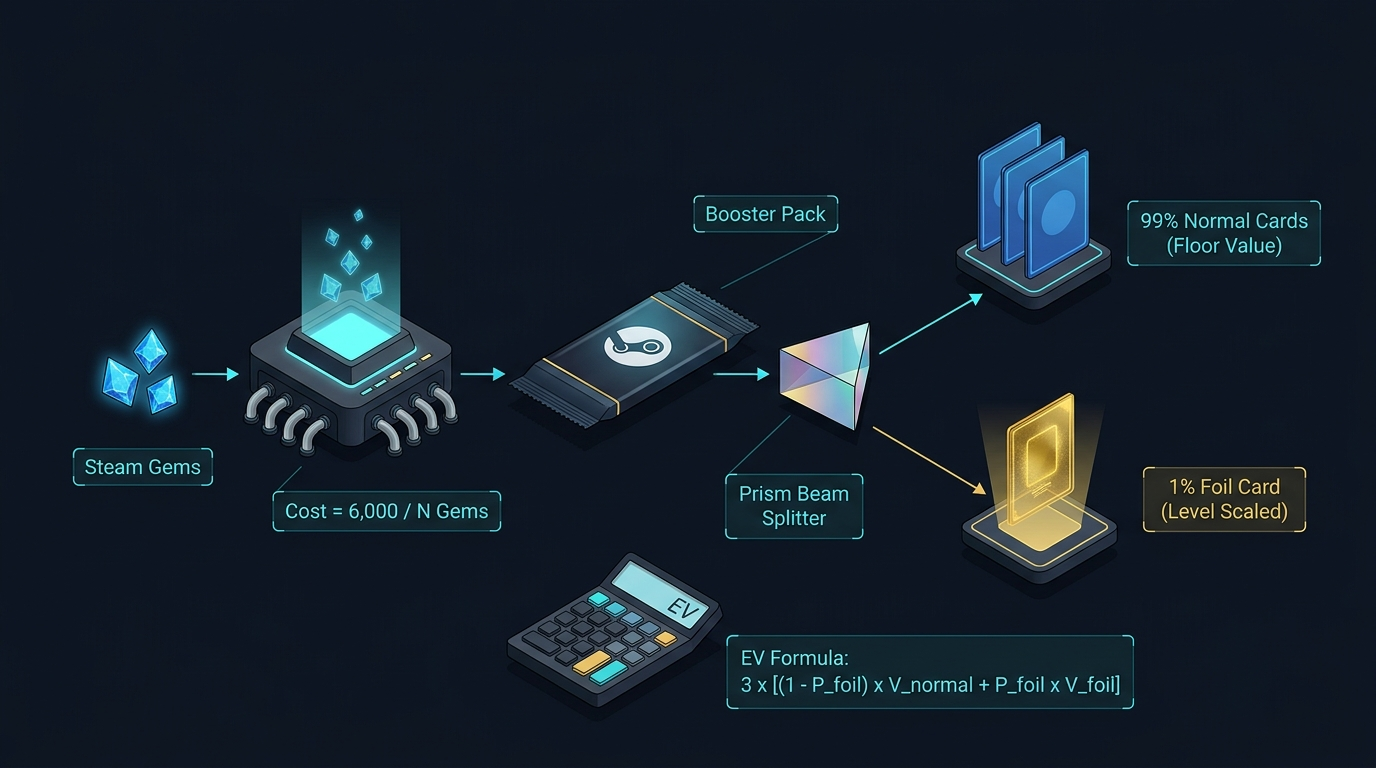
When you consume gems to craft a booster pack, what is your mathematical return? The answer is governed by Valve's inverse gem cost formula.
The Inverse Cost Formula: Gem Cost = 6,000 / N
For any game on Steam with trading card support, the gem cost to fabricate one booster pack is strictly inversely proportional to the total number of cards in that game's full badge set ($N$):
$$C_{\text{gems}}(N) = \frac{6,000}{N}$$
Because every booster pack drops exactly 3 trading cards, the break-even threshold per card varies dramatically depending on set size:
| Set Size ($N$) | Gem Cost per Pack | Sacks of Gems | Input Cost (at $0.33 / Sack) | Net Break-Even per Card |
|---|---|---|---|---|
| 5-Card Set | 1,200 Gems | 1.20 Sacks | $0.396 | $0.132 |
| 6-Card Set | 1,000 Gems | 1.00 Sack | $0.330 | $0.110 |
| 8-Card Set | 750 Gems | 0.75 Sacks | $0.248 | $0.083 |
| 10-Card Set | 600 Gems | 0.60 Sacks | $0.198 | $0.066 |
| 12-Card Set | 500 Gems | 0.50 Sacks | $0.165 | $0.055 |
| 15-Card Set | 400 Gems | 0.40 Sacks | $0.132 | $0.044 |
To break even on a 5-card badge set game, the 3 cards generated must sell for an average net payout of $0.132 each (roughly $0.16 buyer price). In contrast, a 15-card set requires only $0.044 net per card ($0.06 buyer price).
The General Expected Value Equation
The formal expected net return equation for crafting a booster pack is:
$$\mathbb{E}[\text{Return}] = \sum_{k=1}^{3} \left[ (1 - p_{\text{foil}}) \cdot \overline{V}{\text{normal, net}} + p{\text{foil}} \cdot \overline{V}{\text{foil, net}} \right] - C{\text{gems}}(N) \times V_{\text{gem}}$$
Where:
- $p_{\text{foil}}$ is the probability of a card rolling as Foil (baseline 1% + profile level bonus).
- $\overline{V}_{\text{normal, net}}$ is the average net market proceeds across all $N$ normal cards in the set.
- $\overline{V}_{\text{foil, net}}$ is the average net market proceeds across all $N$ foil cards.
- $C_{\text{gems}}(N) \times V_{\text{gem}}$ is the opportunity cost of the gems consumed.
If $\mathbb{E}[\text{Return}] > 0$, crafting is theoretically profitable. However, empirical market conditions make positive EV opportunities rare and heavily constrained.
Empirical Profitability Across Game Genres (AAA vs Indie vs Anime)
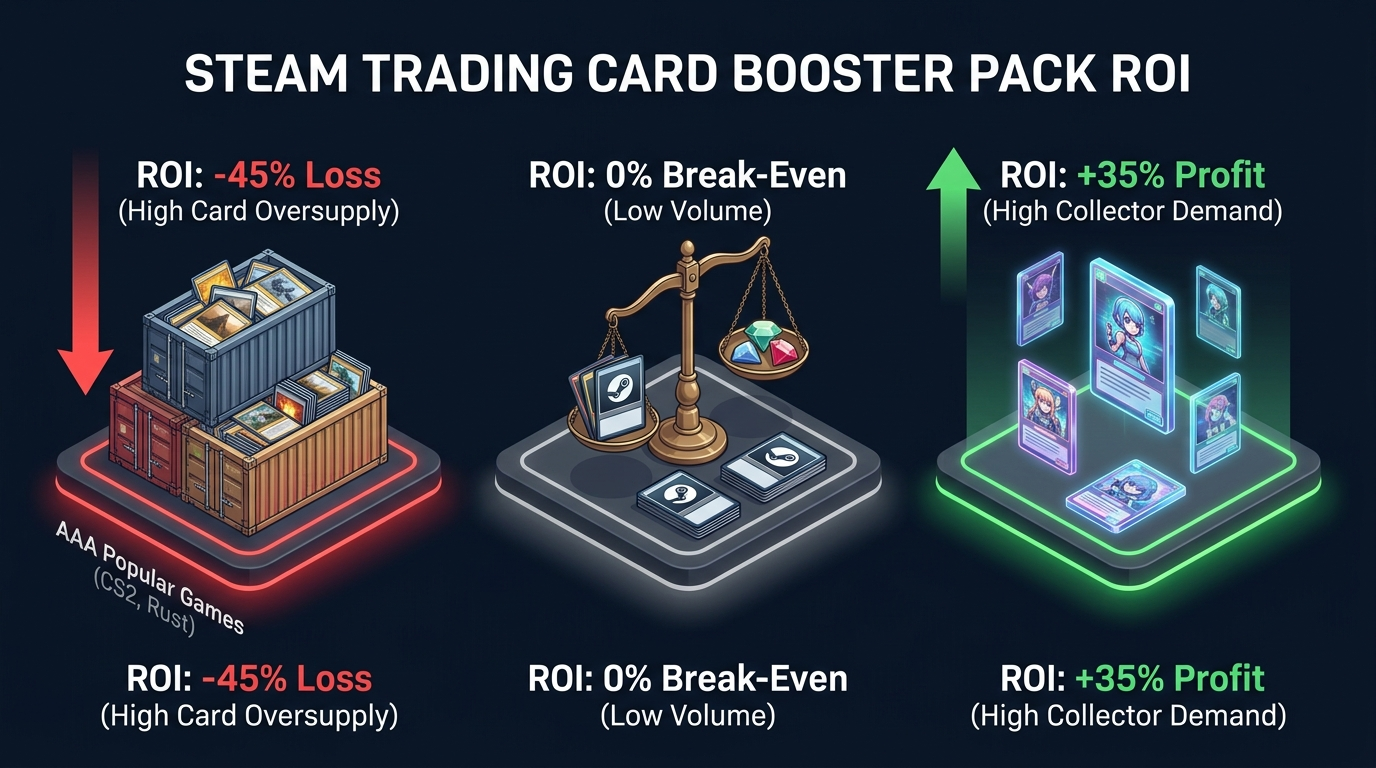
Analyzing trading card market data across thousands of Steam titles reveals that booster pack expected values cluster into three distinct regimes:
1. AAA Mega-Popular Titles (CS2, Rust, Dota 2, Terraria)
- Badge Set Size: Typically 5 to 8 cards
- Market Liquidity: Tens of thousands of cards traded daily
- Average Card Price: $0.03 to $0.05 gross ($0.01 to $0.02 net)
- Crafting Result: Guaranteed Catastrophic Loss (ROI: -45% to -65%)
Because millions of players actively play these games and receive card drops, supply vastly exceeds badge completion demand. Normal cards trade near the absolute market floor. Spending 1,200 gems ($0.40) to generate three $0.03 cards (yielding $0.01 net each, or $0.03 total) guarantees an immediate -92% loss. Crafting booster packs for major mainstream titles is financial suicide.
2. Standard Mid-Tier Indie Titles
- Badge Set Size: Typically 6 to 10 cards
- Market Liquidity: Moderate (10 to 50 sales per day)
- Average Card Price: $0.07 to $0.12 gross ($0.05 to $0.09 net)
- Crafting Result: Mild Loss to Neutral (ROI: -15% to +5%)
For mid-tier titles with controlled player bases, card prices hover near break-even levels. An 8-card game costing 750 gems ($0.25) might yield three cards averaging $0.07 net ($0.21 total), resulting in a minor loss of $0.04. Unless you happen to pull an expensive card from the set, crafting packs here rarely beats simply selling the Sack of Gems.
3. Niche Anime Visual Novels and Delisted Cult Classics
- Badge Set Size: Typically 5 to 6 cards
- Market Liquidity: Extremely Low (1 to 5 sales weekly)
- Average Card Price: $0.25 to $0.80 gross ($0.20 to $0.68 net), with foils reaching $10 to $30+
- Crafting Result: High Theoretical EV (ROI: +20% to +50%), but Trapped by Liquidity Constraints
Games with high-demand collector profile backgrounds, emoticons, or waifu badges often exhibit normal card prices well above $0.30. In these titles, spending 1,200 gems ($0.40) to yield cards worth $0.90 net appears to generate a consistent $0.50 profit per craft.
However, two major barriers prevent players from scaling this: 1. The 24-Hour Cooldown Limit: Valve restricts each Steam account to crafting exactly one booster pack per game every 24 hours. You cannot craft 100 packs to build meaningful scale. 2. Order Book Thinness: A card listed at $0.50 might have buy orders at only $0.10. Selling three cards at listed ask prices can take several weeks or months. Your capital remains locked in illiquid digital inventory.
The Foil Card Trap: Profile Level Multipliers and Variance Risk
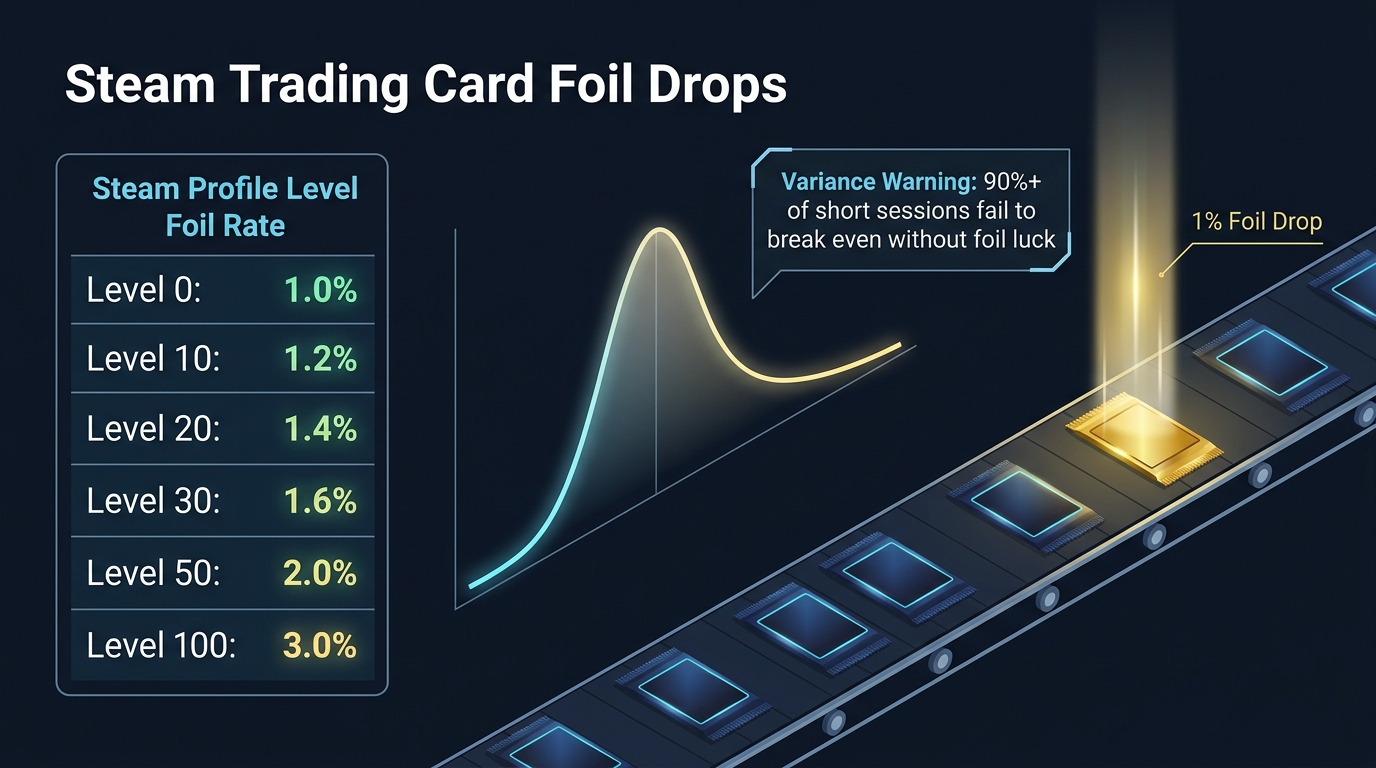
Many booster pack calculators show positive expected values solely because they factor in expensive Foil cards. While foil cards do command substantial prices, relying on foil drops introduces extreme statistical variance.
The Profile Level Foil Formula
Valve's official documentation states that the baseline probability of any card rolling as a Foil is 1% (0.01). For every 10 Steam profile levels attained, this baseline probability increases by a linear +20%:
$$p_{\text{foil}}(L) = 0.01 \times \left( 1 + 0.20 \times \left\lfloor \frac{L}{10} \right\rfloor \right)$$
- Level 0 – 9: 1.00% (Chance of at least 1 foil in a 3-card pack: 2.97%)
- Level 10 – 19: 1.20% (Chance per pack: 3.56%)
- Level 50 – 59: 2.00% (Chance per pack: 5.88%)
- Level 100 – 109: 3.00% (Chance per pack: 8.73%)
- Level 200: 5.00% (Chance per pack: 14.26%)
Even for a dedicated Level 50 Steam account, the probability of seeing a foil card in any given booster pack is less than 6%. On average, you must craft 17 consecutive booster packs (requiring 17,000 to 20,400 gems, or $5.50 to $6.70 in cost) just to see a single foil card.
Monte Carlo Simulation: Why 90% of Short Sessions Lose Money
Simulating 10,000 runs of 10-pack crafting sessions illustrates the harsh reality of fat-tailed distributions:
- Over 90% of sessions yield zero foil cards, resulting in an average return of only 45% to 65% of gem input cost.
- A tiny 2% minority hits multiple foil drops, skewing the mathematical mean upward.
Unless you operate an industrial automated bot network crafting thousands of packs daily to invoke the Law of Large Numbers, casual individual crafting exposes your bankroll to high downside variance.
Direct Market Sale vs Booster Pack Crafting: The 5-Pillar Decision Matrix
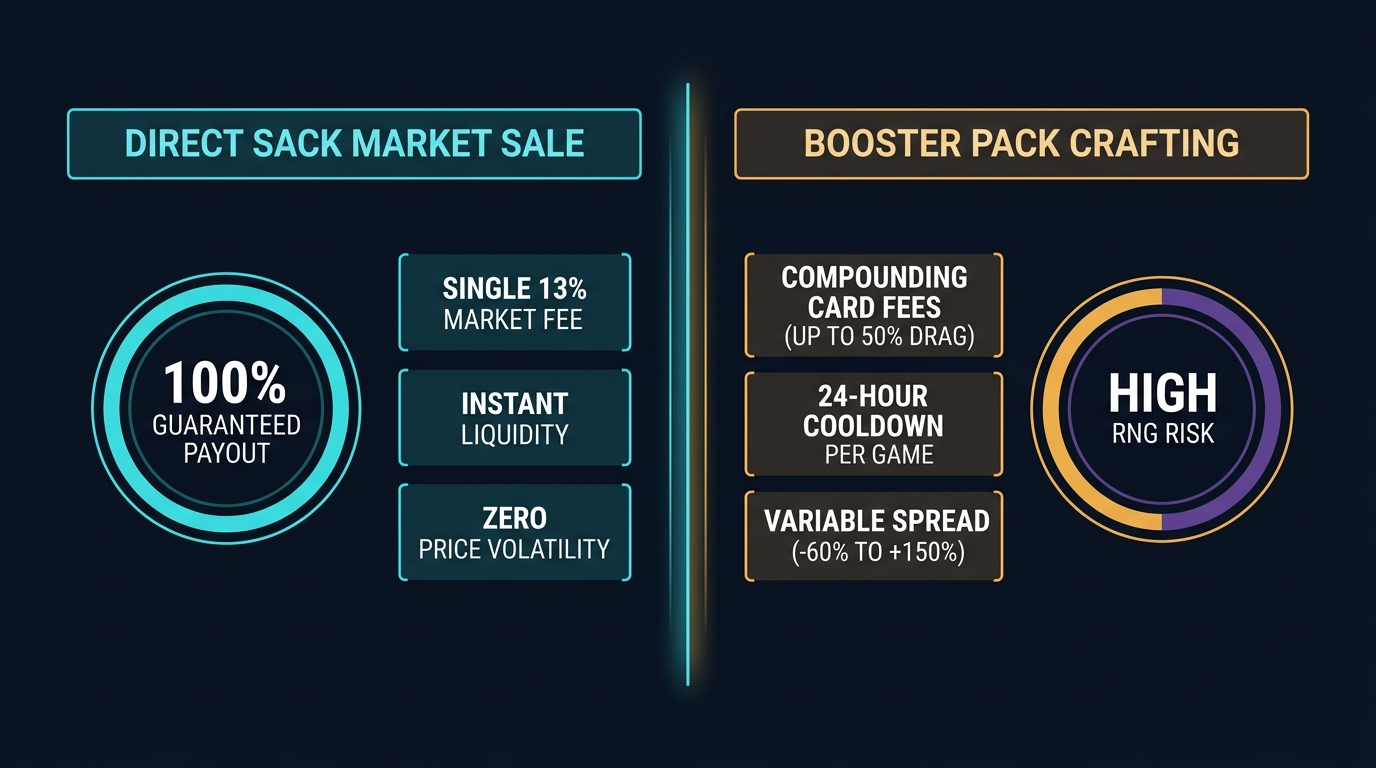
To evaluate which liquidation strategy fits your specific situation, compare the two approaches across five core dimensions:
| Metric | Direct Sack Market Sale | Booster Pack Crafting | Superior Strategy |
|---|---|---|---|
| 1. Capital Liquidity | Instant (Seconds)<br>Execute immediately against live buy orders | Very Slow (Days to Weeks)<br>Must list and wait for 3 separate cards to sell | Direct Sack Sale |
| 2. Fee Compound Penalty | Single 13% Fee<br>Incurred once on the whole commodity unit | Triple Micro-Fees (20% to 50% Drag)<br>Each card incurs a separate minimum fee floor | Direct Sack Sale |
| 3. Execution Risk (RNG) | Zero Variance<br>Guaranteed predetermined wallet funds | Severe Variance<br>Outcomes depend heavily on RNG card distribution | Direct Sack Sale |
| 4. Operational Scalability | Unlimited<br>Liquidate hundreds of sacks in one transaction | Capped at 1 Pack per Game per 24 Hours<br>High management overhead across multiple titles | Direct Sack Sale |
| 5. Theoretical Upside | Capped at 0%<br>Market price fixed by commodity supply | +30% to +200% on Rare Foil Outliers<br>Potential jackpot on high-value niche drops | Booster Crafting |
The Sub-Dollar Fee Drag Disaster
A critical hidden cost of crafting is the minimum fee floor.
When selling a Sack of Gems for $0.38, Valve deducts $0.05 total (13.1% fee). But if your booster pack drops three low-tier cards that sell for $0.05 each, Valve's mandatory $0.01 Steam fee floor and $0.01 game fee floor mean $0.02 is deducted from every single $0.05 sale. Your effective fee rate jumps to 40%, leaving you with just $0.03 net per card ($0.09 total). What was once a $0.33 asset is decimated by sub-dollar fee friction.
The SteamVaults Liquidation Route: Escaping the Closed Wallet Trap
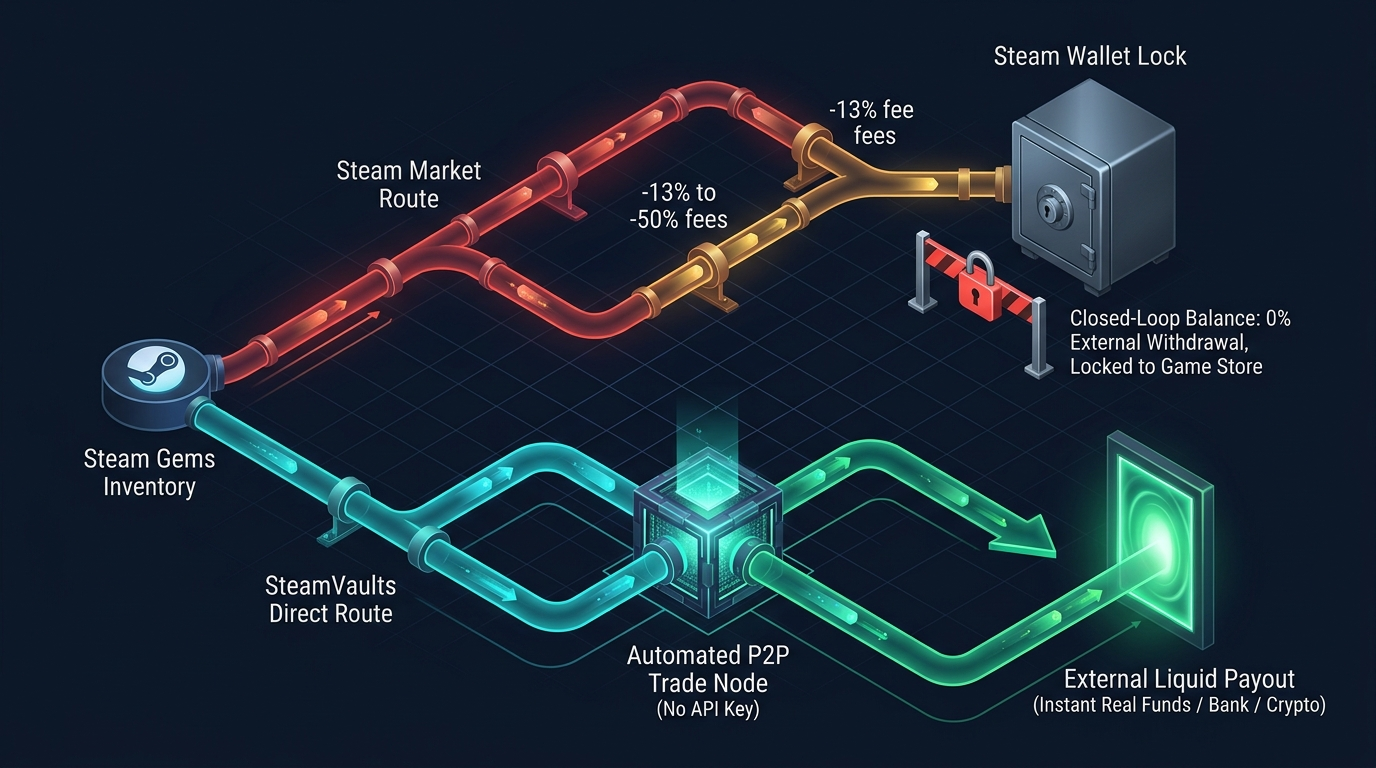
Whether you sell Sacks of Gems on the Community Market or craft booster packs to sell cards, you inevitably run into Valve's fundamental ecosystem boundary:
Steam Wallet funds are closed-loop digital credits. Valve does not provide any mechanism to withdraw wallet balances to a bank account, credit card, or PayPal.
Once your gems become Steam Wallet funds, they can only be used to purchase Steam store games or other digital items. Furthermore, external secondary markets routinely discount Steam Wallet credit by 25% to 30% against real fiat currency.
Community Market Route vs SteamVaults Direct Settlement
SteamVaults was designed specifically to eliminate closed-wallet entrapment by treating the Sack of Gems as a standardized, fungible trade commodity:
| Feature | Steam Community Market | SteamVaults Direct Settlement |
|---|---|---|
| Settlement Payout | Locked Steam Wallet Credit<br>Zero legal external withdrawal capability | Liquid External Funds (Fiat / Crypto)<br>Immediate transfer to personal bank or external wallet |
| Transaction Fees | 13.04% to 50% compound fee drag | Transparent single platform spread |
| Execution Speed | Dependent on market buy order matching | Automated Trade Bot execution in seconds |
| Trade Lock Exposure | Market proceeds can face temporary balance holds | Automated P2P inventory swap with immediate ledger credit |
| Account Safety | Safe, but capital remains trapped | 100% safe via official Steam Trade Offers with zero API key access |
By exchanging clean, unrestricted Sacks of Gems directly through SteamVaults, you bypass both the booster pack RNG gambling trap and the closed-loop Steam wallet lock, capturing true liquid value efficiently.
The 5-Step Operational Decision Flowchart
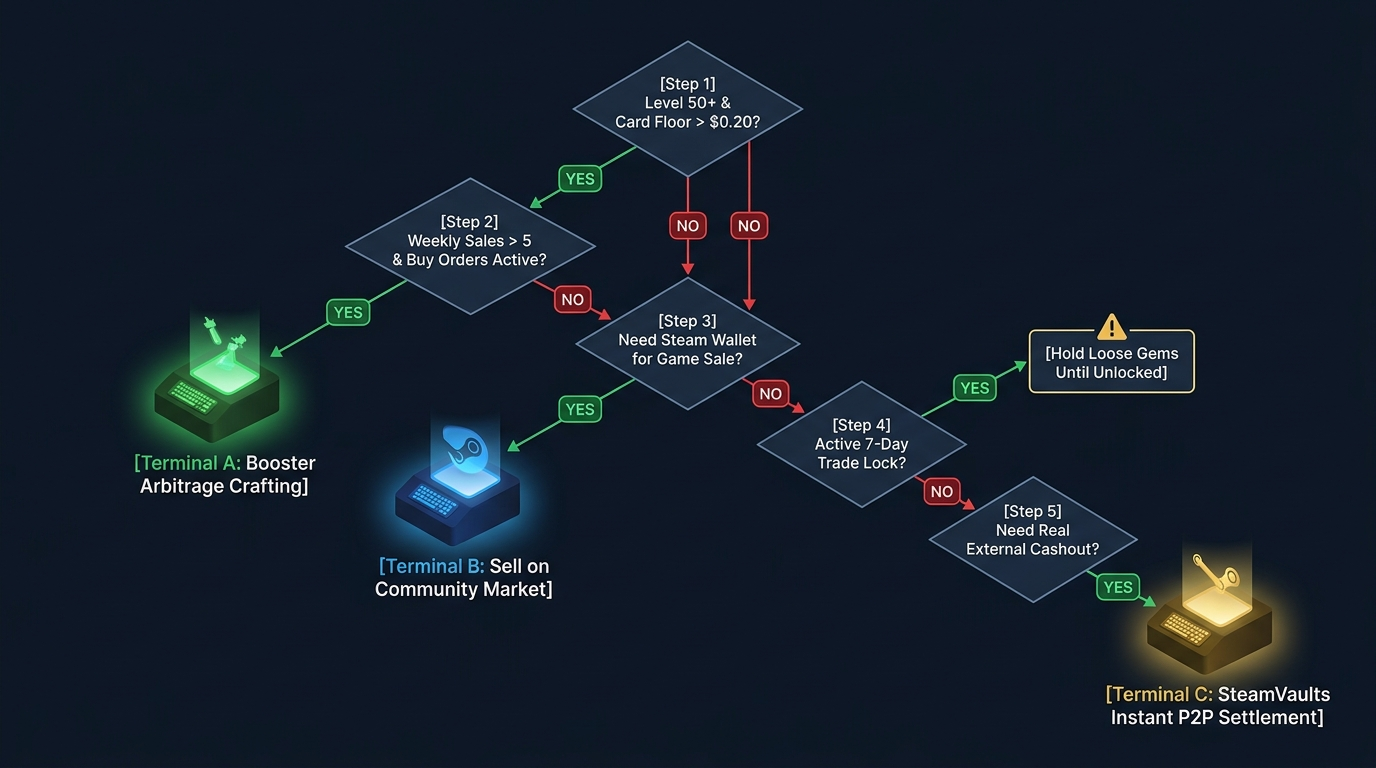
Before making any decision regarding the gems in your inventory, follow this 5-step operational protocol:
Step-by-Step Decision Protocol
1. [Step 1] Is your Steam profile Level 50+ AND does the target game's card floor exceed $0.20 net? - No: Do not craft booster packs. Expected value is negative. Proceed to Step 3. - Yes: Proceed to Step 2.
2. [Step 2] Does the game have at least 5 verified card sales per week with Buy Orders above $0.15? - No: Halt crafting. Cards will become trapped as illiquid inventory. Proceed to Step 3. - Yes: Execute Booster Crafting Arbitrage. Craft one pack every 24 hours. Immediately list standard cards and hold foils for patient collectors.
3. [Step 3] Do you need funds to purchase upcoming games during a Steam Sale? - Yes: Pack your gems into Sacks and list them on the Steam Community Market at the lowest ask, or sell into the top buy order if funds are needed immediately. - No: Proceed to Step 4.
4. [Step 4] Do your gems carry an active 7-day trade hold or payment lock? - Yes: Keep your gems loose until the exact expiration timestamp passes. Packing them prematurely will lock the entire Sack for 7 days. - No: Proceed to Step 5.
5. [Step 5] Do you require liquid, real-world funds rather than locked Steam store credit? - Yes: Check the live intake capacity on the SteamVaults Sell Page and transfer clean Sacks of Gems for immediate settled payout without market fee erosion.
> Source boundary — checked September 20, 2026: Fee rates and booster pack formulas were verified against Valve's official Steamworks documentation and Community Market transaction mechanics. Live market quotes, order book depth, and SteamVaults pool capacity fluctuate in real time. Always inspect live conditions before executing transactions.
Ready to sell supported Sacks of Gems?
After the bot confirms receipt, USDT is credited to your site balance. Polygon withdrawal is a separate request.