


A Steam Market price and a cash quote are different values. A lower cash quote does not by itself mean that one service kept the whole gap. Compare four numbers under the same conditions: the Market amount a buyer pays, the seller's proceeds after Steam and game fees, an external cash-market value, and the platform's final quote after its stated terms.
Steam Wallet balance remains usable buying power inside Steam, but it is not cash you can withdraw one for one. Start with what the Steam Community Market price means and how Steam Market fees work; use which item best suits a Steam Wallet cash-out only after you understand those limits.
> Fact review — August 24, 2026: We rechecked Valve’s Wallet and Market documentation, the current pricing source, the Sack of Gems product page, and the public product APIs. Operation-level availability flags and item-level catalog inventory answer different questions. An enabled route does not prove that Sack inventory or an executable quote exists. If the catalog reports Sack of Gems as OUT_OF_STOCK or poolHave: 0, there is no executable Sack buy quote at that moment. A visible API reference price is not enough. Current availability and the executable amount must be confirmed by a fresh time-limited quote on the transaction screen.
The Steam Wallet number is not fake
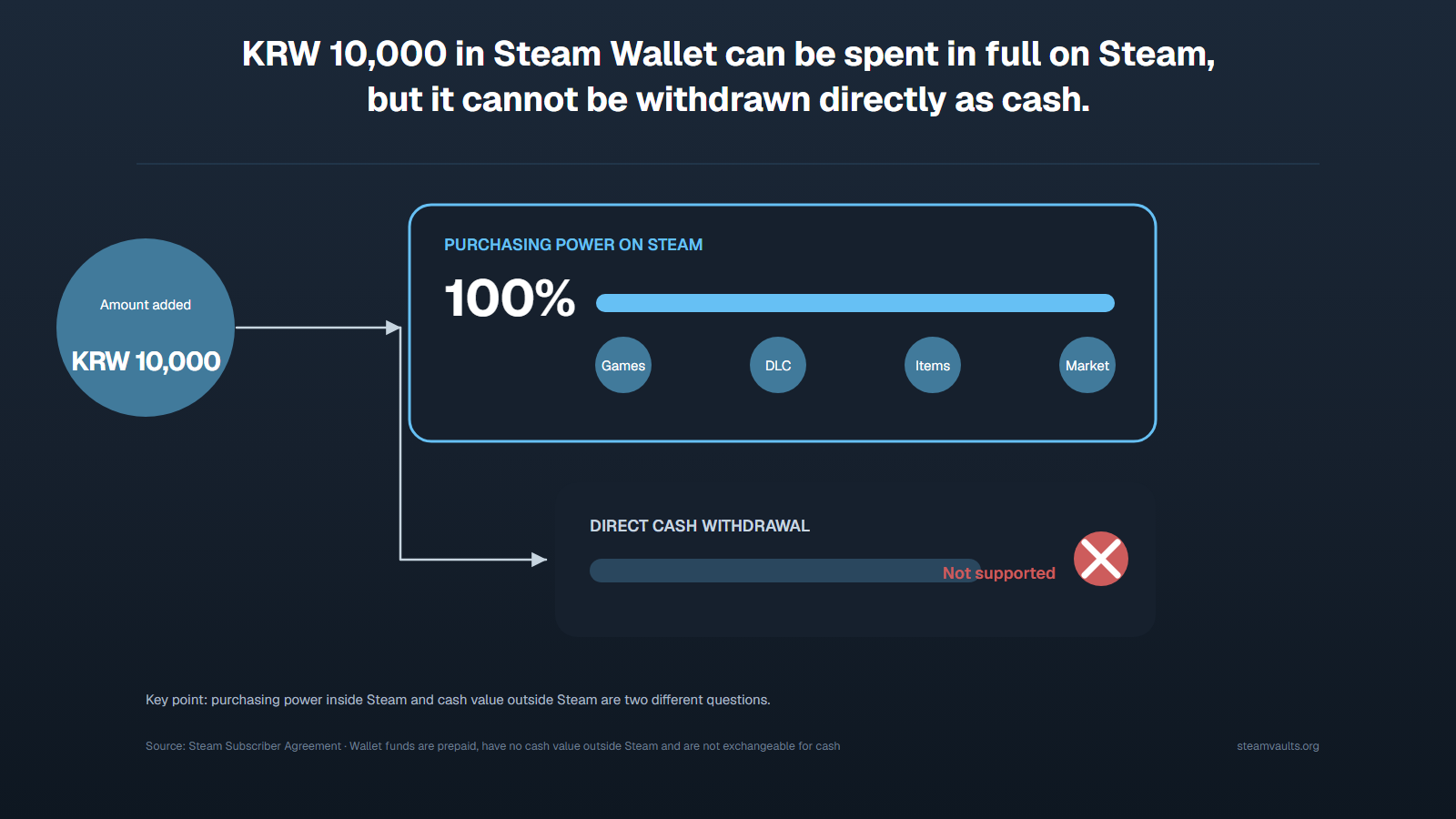
Purchasing power inside Steam and cash value outside Steam answer two different questions.
Where the balance can be used changes what the number means
Steam Wallet funds are not meaningless points. If you add $100, you have $100 of purchasing power inside Steam. You can buy games and DLC or purchase items on the Community Market. If you already expect to spend that amount on Steam, converting it into something else may make no sense at all.
This is why saying “Steam balance is worth less than cash” without context is incomplete. Value depends on what you intend to do with it. Inside Steam, the displayed amount is what you can spend. The difference appears only when you want that value to cross Steam’s boundary.
The Steam Subscriber Agreement describes Wallet funds as prepaid balance, not a bank account or payment instrument. It also says those funds have no cash value outside Steam and are not exchangeable for cash. The Community Market is not a cash marketplace either. When an item sells there, the seller receives Steam Wallet funds rather than money that can be sent to a bank.
That is where the user’s experience and the legal character of the balance separate. To someone who still wants games, $100 is genuinely useful as $100. To someone with nothing left to buy, it is $100 with a closed exit. The purchasing power has not disappeared, yet the owner has fewer choices. Once cash-out becomes the goal, the balance can suddenly feel like “my money trapped inside Steam.”
I do not think that feeling comes from stupidity or carelessness. You put ordinary money in, and the interface displays an ordinary currency amount. Someone who has never needed the Market may discover the withdrawal restriction only when they actually try to take money out. The system does not teach that boundary at the moment most people first see the balance.
Recovering a small balance can mean learning an entire market
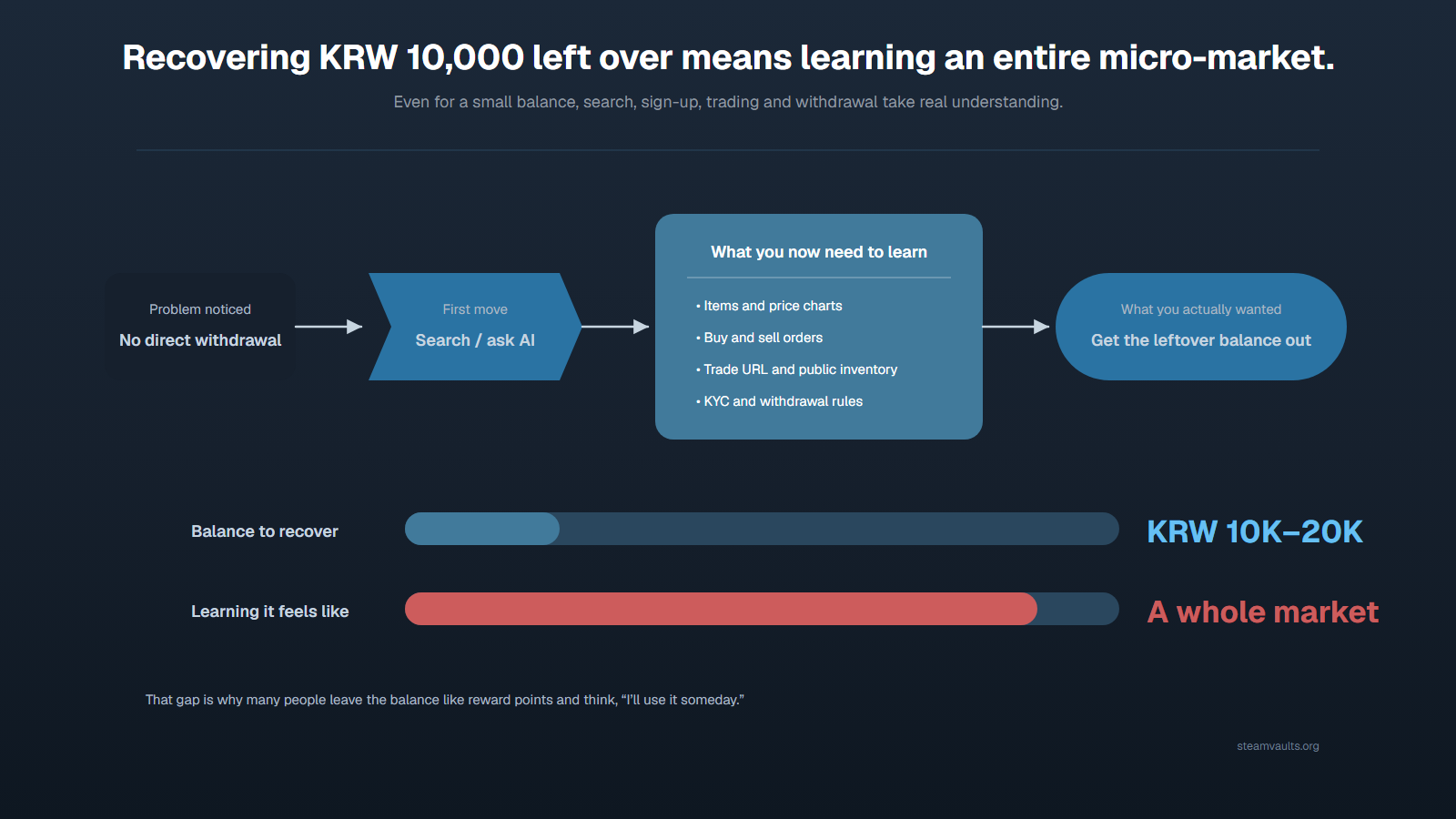
The leftover amount may be small, but the market you are asked to learn is not.
The natural next step after discovering there is no direct withdrawal is a search. Most people do not begin with a sophisticated plan. They type “cash out Steam balance” into Google or another search engine, or ask an AI assistant what can be done. That is how I began looking into it too.
The answers rarely resemble a normal withdrawal guide. They lead to external item marketplaces, peer-to-peer deals, gifting, and item-trade methods. Open one marketplace and you may see hundreds of skins, price graphs, buy and sell orders, Trade URLs, public-inventory requirements, KYC, and withdrawal conditions. You went in looking for one exit and were handed a small trading desk to operate.
Experienced traders may find that interface ordinary. The average player did not arrive because they wanted to become a trader. They only wanted to decide what to do with a leftover balance. When they cannot tell which item to choose, which displayed price matters, or even whether the site is trustworthy, being asked to register and verify their identity creates a very high first step.
The balance eventually gets treated like unused loyalty credit
This is where many people stop. The leftover amount may be $10 or $20. It feels wasteful, but not large enough to justify several evenings of research. “I will buy another game someday” or “I can use it in the next sale” becomes the easier answer. The balance starts behaving like airline miles or store points: usable in theory, postponed in practice.
That is a rational response. If recovering a small amount requires learning an unfamiliar market, comparing services, calculating fees, and negotiating with strangers, the opportunity cost can exceed the value recovered. The money still exists, but the work needed to move it makes doing nothing feel more efficient.
For someone trading a $1,000 or $2,000 skin, a few percentage points deserve careful study. For an ordinary player handling a modest balance, demanding the same expertise is disproportionate. The user is not failing to understand the system; the system is asking too much knowledge for a small job.
Several prices are hidden between $30 and $24
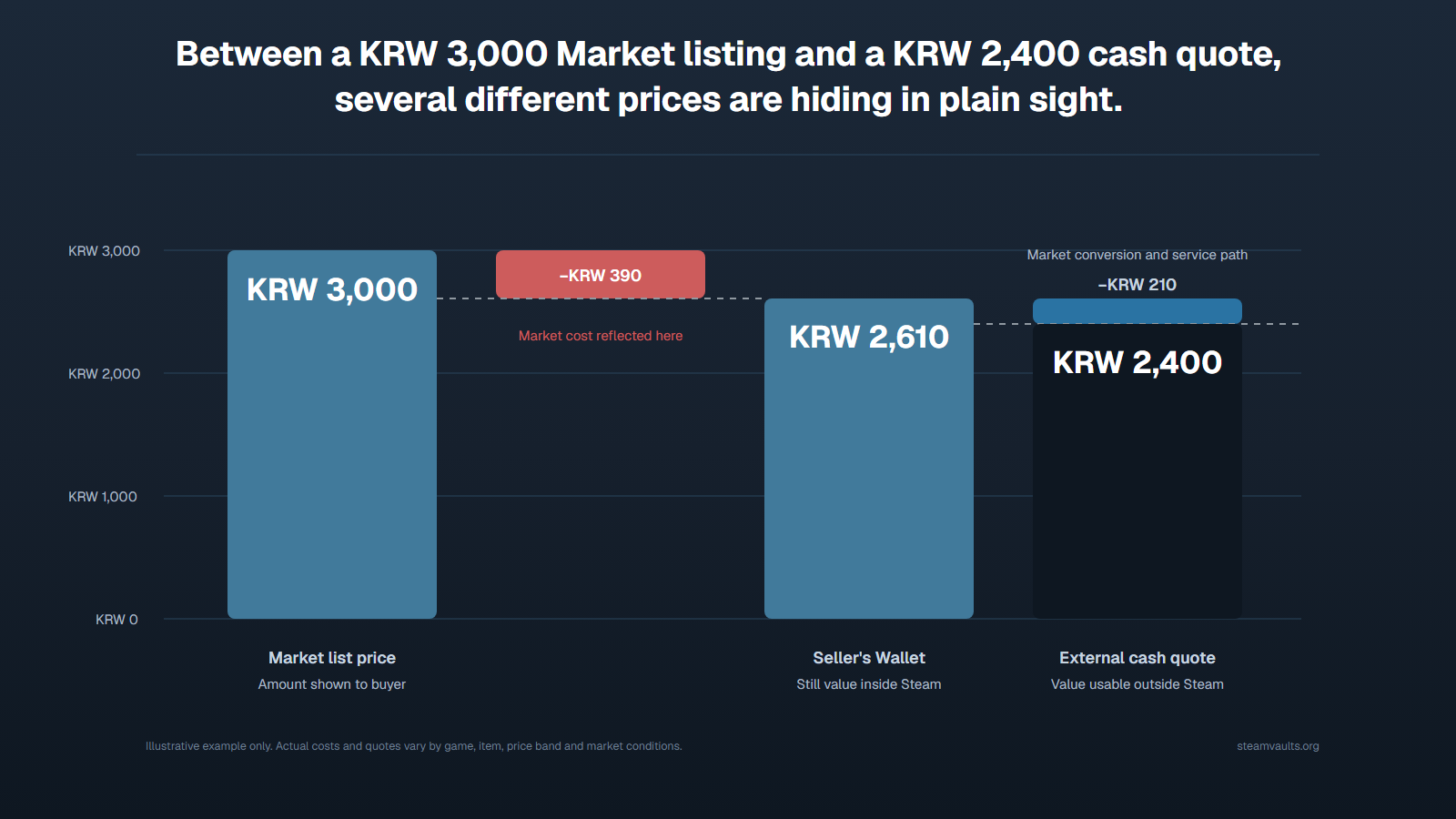
This is an explanatory example. Actual Market costs and outside quotes vary by item, price point, and market conditions.
Return to the easiest misunderstanding. If Steam displays $30 and an outside service offers $24 in cash, the eye sees a six-dollar difference, or 20%. Without more context, it is easy to believe the service keeps the entire 20%.
The missing part is everything in the middle.
Even the Market page contains more than one price
Steam distinguishes the amount the buyer pays from the amount the seller receives. The lowest sell listing is different from the highest buy order, and a historical price on the graph does not guarantee what you can sell for right now. All of these figures concern the same item, but each one answers a different question.
Steam’s Community Market FAQ and Subscriber Agreement explain that applicable transaction fees are shown before completion. The sell interface likewise separates buyer payment from seller proceeds. With items from Valve games such as TF2, users often encounter a difference around 13–15%, but that should not be treated as a permanent formula for every game, item, and price tier. Game-specific fees, minimum charges, and rounding can matter, and Valve can change the terms. The actual confirmation screen is the final source for a particular sale.
So the first reduction may happen before any outside platform is involved. An item shown to buyers at $30 does not necessarily place $30 in the seller’s Wallet. And those proceeds are still Wallet funds. For a cash comparison, the better starting point is the seller’s net Wallet proceeds after Steam’s displayed costs, not merely the largest number on the listing page.
Wallet value and cash value are formed in different markets
The next distinction is where the value can be spent. Wallet funds buy games and items inside Steam. Cash or cash-like settlement obtained outside Steam can be used elsewhere. The labels may both use dollars, euros, or won, but their permitted uses and exit routes are different.
The restriction itself is enough to create a second price. Steam Wallet purchasing power can be used only inside Steam, while cash settlement can be used elsewhere. An outside buyer therefore prices not just the item but the demand, waiting time, costs, and risk involved in turning it into value usable outside Steam. The two prices answer different use cases; no analogy is needed to make them comparable.
An outside cash price is not calculated by subtracting one fixed fee from a Steam listing. It also depends on where the item is actually trading for cash, whether a buyer is available, how quickly the item can move, and how much price risk exists. A Steam Market increase does not guarantee that the outside market moves at the same time or by the same percentage.
Calling the entire six-dollar gap a “platform fee” is therefore inaccurate. It can combine the difference between buyer payment and seller proceeds on Steam, the market discount for moving restricted value outside Steam, and the operating cost of the transaction method. The outside platform’s own margin is only one part.
None of this excuses a bad quote. A service cannot invoke “market differences” while hiding the final proceeds or adding a surprise charge at the last step. Why a gap exists and whether the quoted price is transparent are separate questions.
Difficulty is not the user's fault
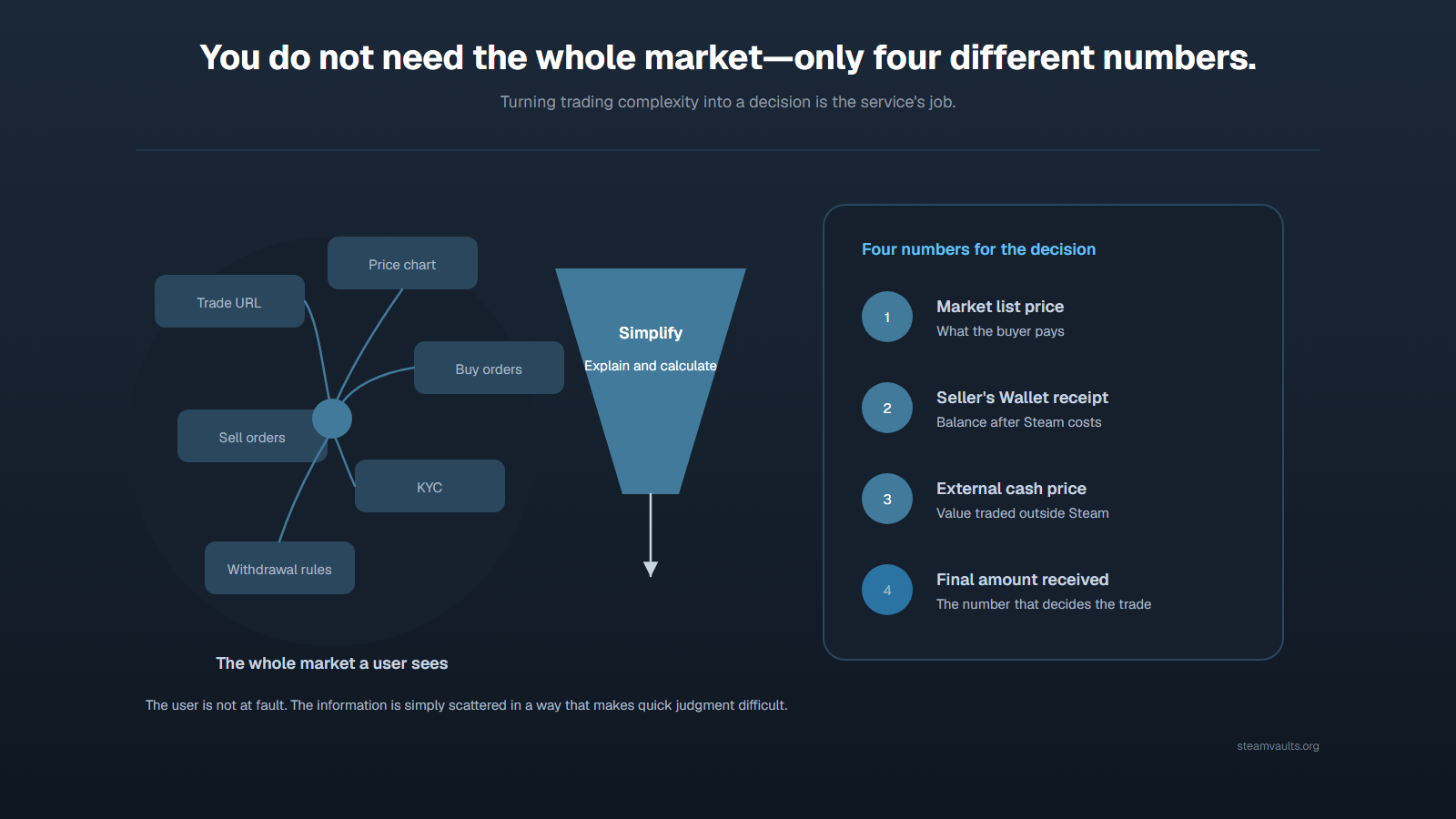
A system should organize the numbers needed for a decision instead of blaming the user for its complexity.
Four numbers are enough to make the first decision
I tend to keep investigating when something does not make sense. I compared what buyers pay on Steam with what sellers receive, then compared an outside site’s headline price with its final settlement. Only after going through that process could I separate an external cash price from a platform’s own cost.
Most players should not have to go that far. They use Steam to play games, not to master order books, price charts, and outside-market liquidity. Nobody taught them this system, and they have no obligation to study it.
The real failure is the explanation. The Community Market already resembles a compact financial market: buyer and seller amounts, orders, and charts all coexist. Add an outside cash transaction, and the entry barrier rises again.
My goal with this article is not to turn readers into professional traders. Separating four figures is enough for many decisions: the visible Steam Market price, the seller’s net Wallet proceeds after Steam costs, the outside market’s cash value, and the service’s final quote. Once those numbers stop being treated as one number, it becomes much harder to assume that a platform keeps everything in between.
Part of the price difference buys back your time
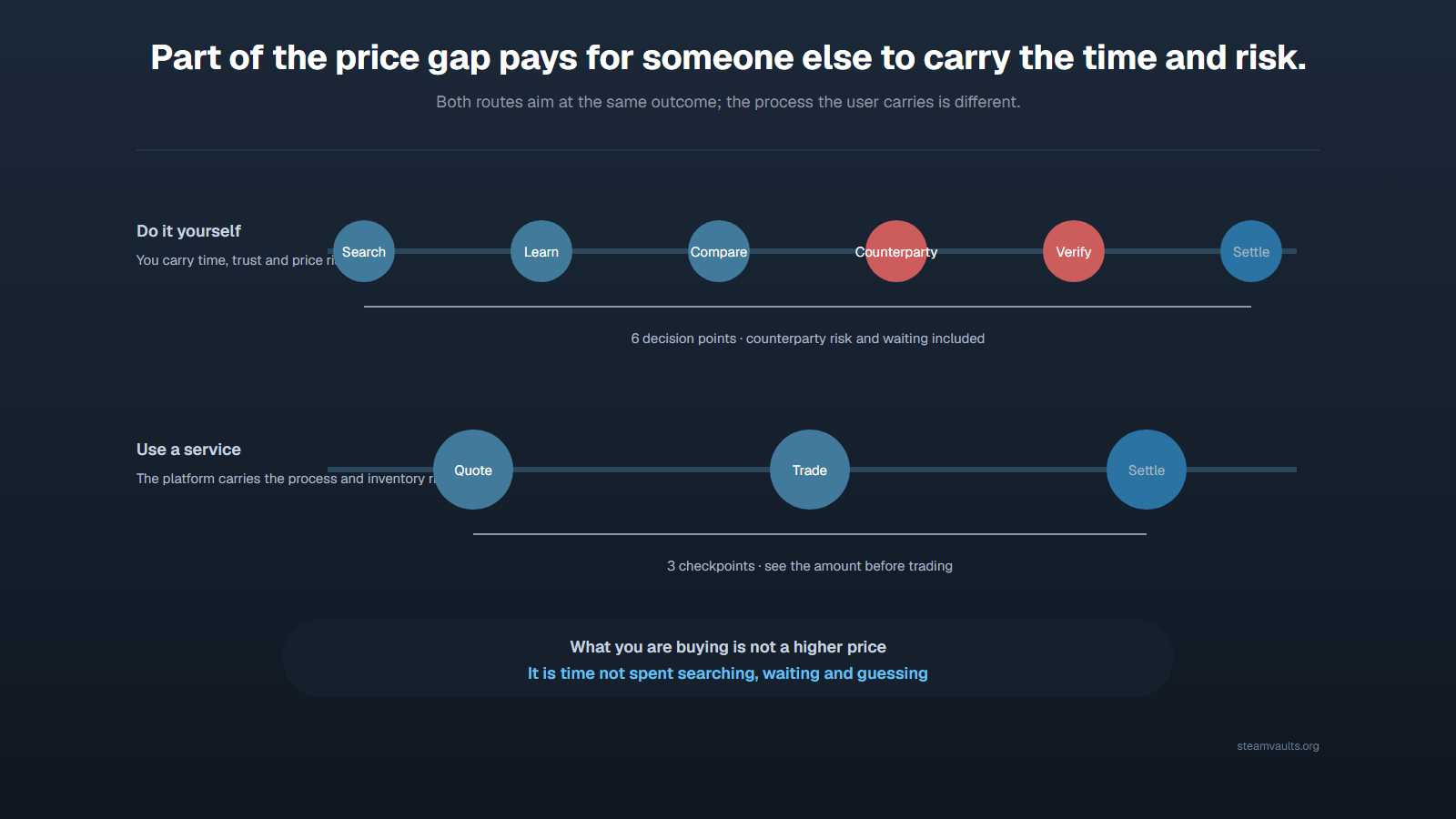
Part of the gap can pay for avoiding research, waiting, trust checks, and direct exposure to transaction risk.
Doing it yourself costs more than a visible fee
Understanding the gap does not make a lower payout painless. People naturally focus on their own result. A 5% cost can feel excessive, while 1–2% may feel tolerable. Sensitivity to a percentage is not irrational when it directly reduces what you receive for your item.
Still, my view of outside trading services changed. When a service handles a process that I could perform myself, I am not only giving up money. I may be buying back time.
Doing it alone means learning which item to use, comparing prices, finding a counterparty, agreeing on terms, and deciding whether the other person can be trusted. In a peer-to-peer deal, both sides may argue about who sends first. The user carries the fraud risk. Even a marketplace can require registration, KYC, listing, waiting for a buyer, and checking withdrawal limits.
Some people enjoy this work. If trading itself is the activity or the amount is large, spending time for a better price can be the right decision. Someone trying to recover a modest balance has a different calculation. There is real value in seeing a quote, avoiding a stranger, and completing a transaction without learning an entire ecosystem.
I do not expect users to enjoy paying for that convenience. I do want them to see what work and waiting they handed over, rather than leaving with only the feeling that money vanished. The experience I want is closer to: “I moved value that had been stuck, and I saved the time I would have spent figuring it out.”
Operating the platform changed how I view the spread
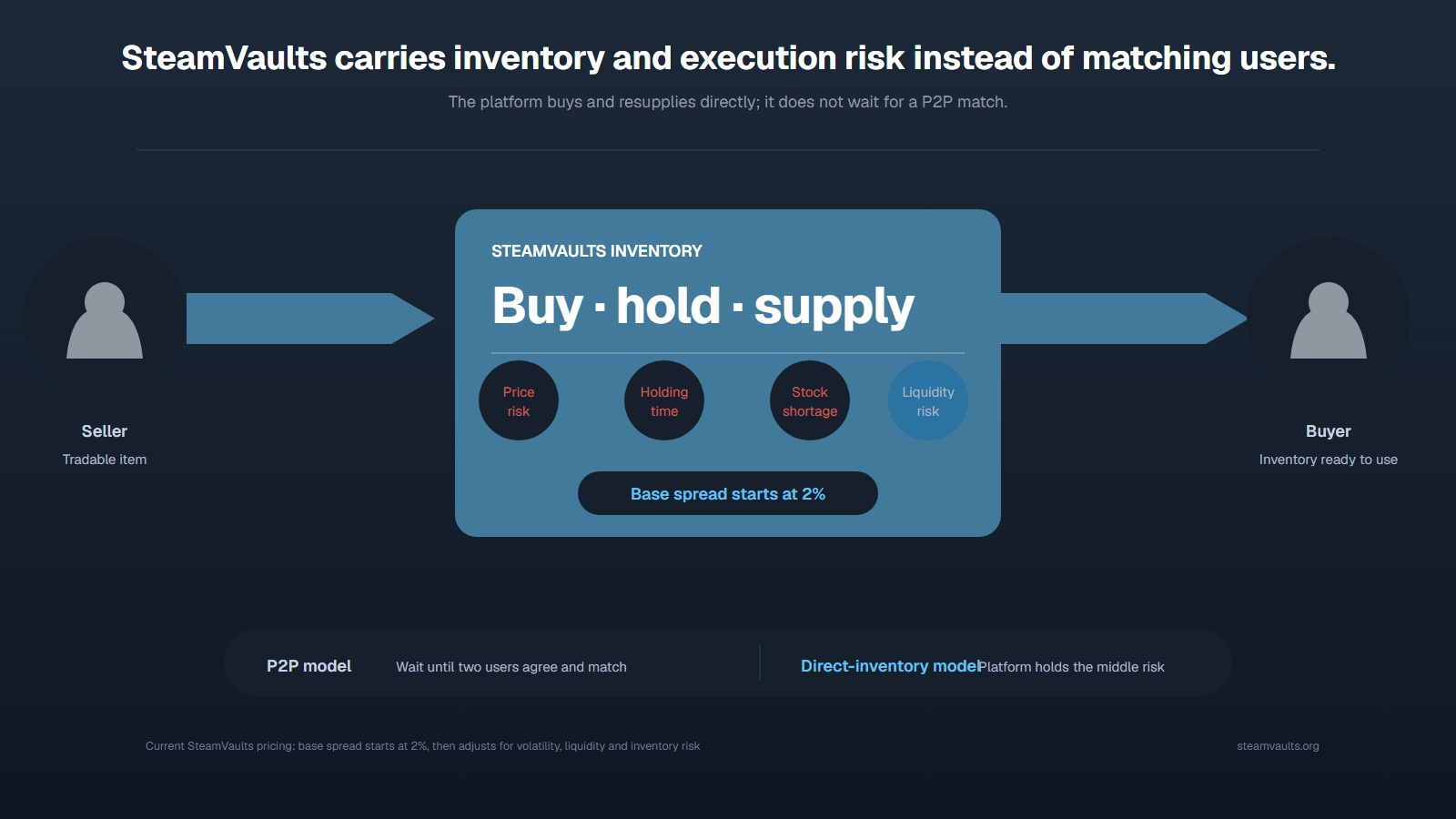
SteamVaults is not a P2P notice board that finds another user; it holds inventory and carries the risk between the two sides.
A low spread still leaves inventory risk with the platform
As a user, I naturally looked first at selling high and buying low. Looking at the same quote from the operating side forced me to consider what happens after the platform buys the item.
SteamVaults was not designed as a P2P board that matches two users and waits for them to agree. When a user sells a supported item, the platform receives and holds it as inventory. When another user needs that item, the platform supplies it from inventory. Users do not wait for a matching stranger, but the inventory and price risk remain with us.
There is no guarantee that an item we buy will sell immediately. Its market price can fall while we hold it, or buyer demand can arrive while inventory is depleted. If Steam or a market-data source is unavailable, quotes may need to pause. A simple user experience is possible only if the platform absorbs these calculations instead of asking the user to manage them every time.
In this inventory model, revenue comes from the difference between the platform’s bid and ask. That spread is not the full gap between a Steam listing and cash value, and the old description of a “2% base spread” is not the current money-moving rule for Sack of Gems.
The current Sack pricing path requires a fresh outside cash bid and ask, then places the SteamVaults pair inside that corridor. Its item-level width is absolute: the ask is the bid plus US$0.01 per Sack. Because Sack of Gems is a sub-dollar item, the percentage represented by one cent moves with the price. Calling it a fixed 2% would therefore be misleading. Missing, stale, crossed, or too-narrow source prices stop a new quote instead of triggering a fallback percentage.
Steam Market price and exact Market-fee math remain reference and anomaly checks; they no longer set the Sack cash bid through a fixed conversion ratio. Inventory and verified cost reserves can also make a buy quote unavailable even while an indicative price is visible. A separate withdrawal or network charge is not part of the spread and must be shown separately before confirmation.
The total gap between a Steam listing and cash value is not the same thing as the SteamVaults spread. The broader market difference appears before our quote, when Steam-denominated purchasing power is valued in a cash market. Our spread is the narrower difference around that cash-market reference between what the platform buys for and sells for. A quote that looks 30% below a Steam display price does not mean the platform keeps 30%.
I want to keep the spread as narrow as we reasonably can. I do not frame that as charity. If a smaller gap allows more people to trade and lets inventory circulate in both directions, it benefits the business too. Better terms for users and a sustainable platform do not always sit on opposite sides.
There are limits. When inventory becomes one-sided or prices move sharply, quotes have to change. It is more honest to show the updated number and explain it than to promise a fixed price until the service suddenly stops. The principle I want to preserve is not that every price will remain unchanged forever, but that we will not widen the buy–sell difference merely to maximize short-term revenue.
Explaining the market can serve users and grow the business
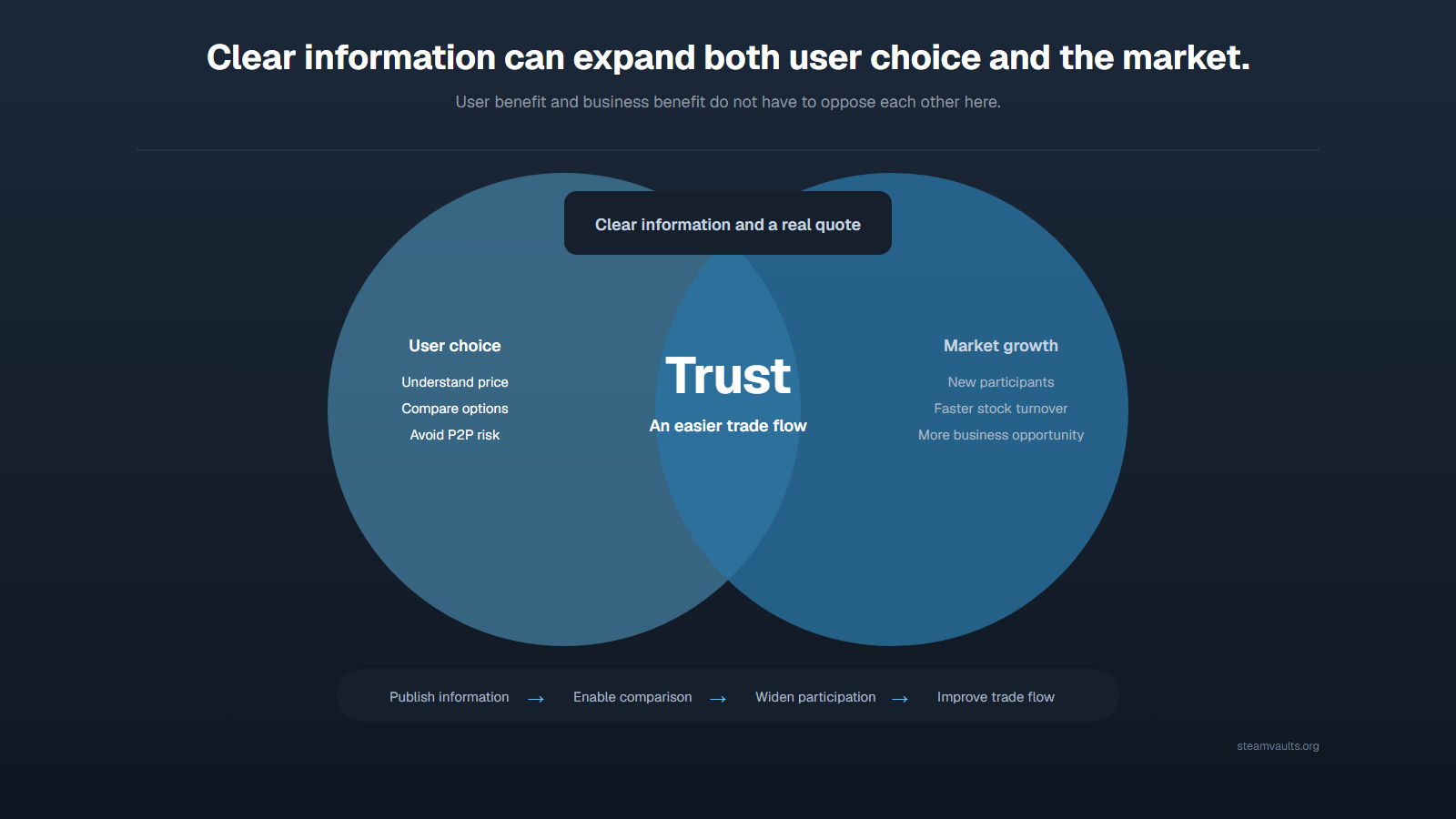
Giving users better information can widen the market. Public benefit and business benefit do not have to conflict.
Better information makes price comparison stricter, not weaker
This market has long favored people who already know its vocabulary. Someone who understands Trade URLs, liquid items, and the distinction between Steam and cash prices has several options. Someone who does not may abandon the search, leave the balance untouched, or accept the fraud and trust problems of gifting and direct trades.
Making the information easier also expands the market. If ordinary users understand the process and decide to participate, SteamVaults gains a business opportunity. I have no reason to hide that fact behind the language of public service. More useful information can lead to more transactions and revenue for us.
I also do not believe that broader knowledge harms everyone already in the market. Competitors may appear and similar services may be built. Even so, when people who previously stayed outside because of complexity can enter, the total market can grow. Sharing a larger market is not necessarily worse than protecting a method known only to a small group.
That is why I write educational articles. The purpose is not to persuade readers to accept any quote. A user who understands how the gap is formed is better able to reject an excessive one. That may create more demanding customers for the platform, but I believe it produces a healthier market over time.
A good quote is not the biggest headline number
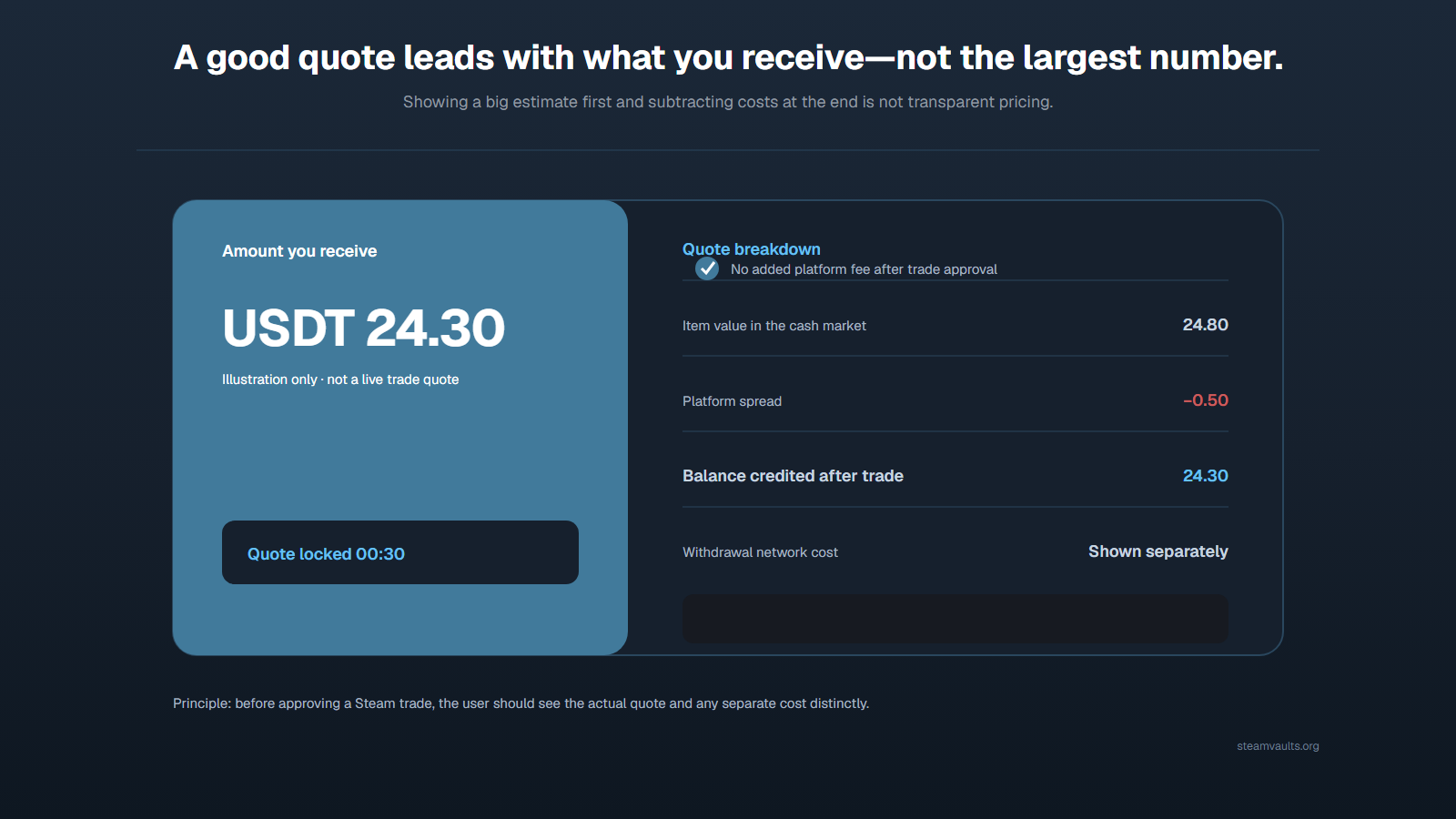
This is an explanatory mock quote, not a live offer. It shows the principle that final proceeds and separate costs should be visible before approval.
The final amount belongs at the top
I dislike the pattern of advertising the largest possible number and subtracting costs one by one during checkout. A user does not need a promotional maximum. They need to know what they will actually receive if they trade now. For a top-up, the first question is how much they pay and how much Steam Wallet value the item can produce.
Even a percentage should represent a calculation that has already been completed. It should help the user estimate cash value after the relevant Market costs, or Wallet value after selling the purchased item. If the final quote changes, the user should be able to see why and choose again before agreeing.
It is acceptable for someone to decline after seeing the quote. A relationship built on a clear number is worth more than one transaction won by hiding an unfavorable detail. If the name SteamVaults is meant to evoke a vault, trust in the displayed number has to come before convenience.
A lower cash price does not mean the whole difference was taken
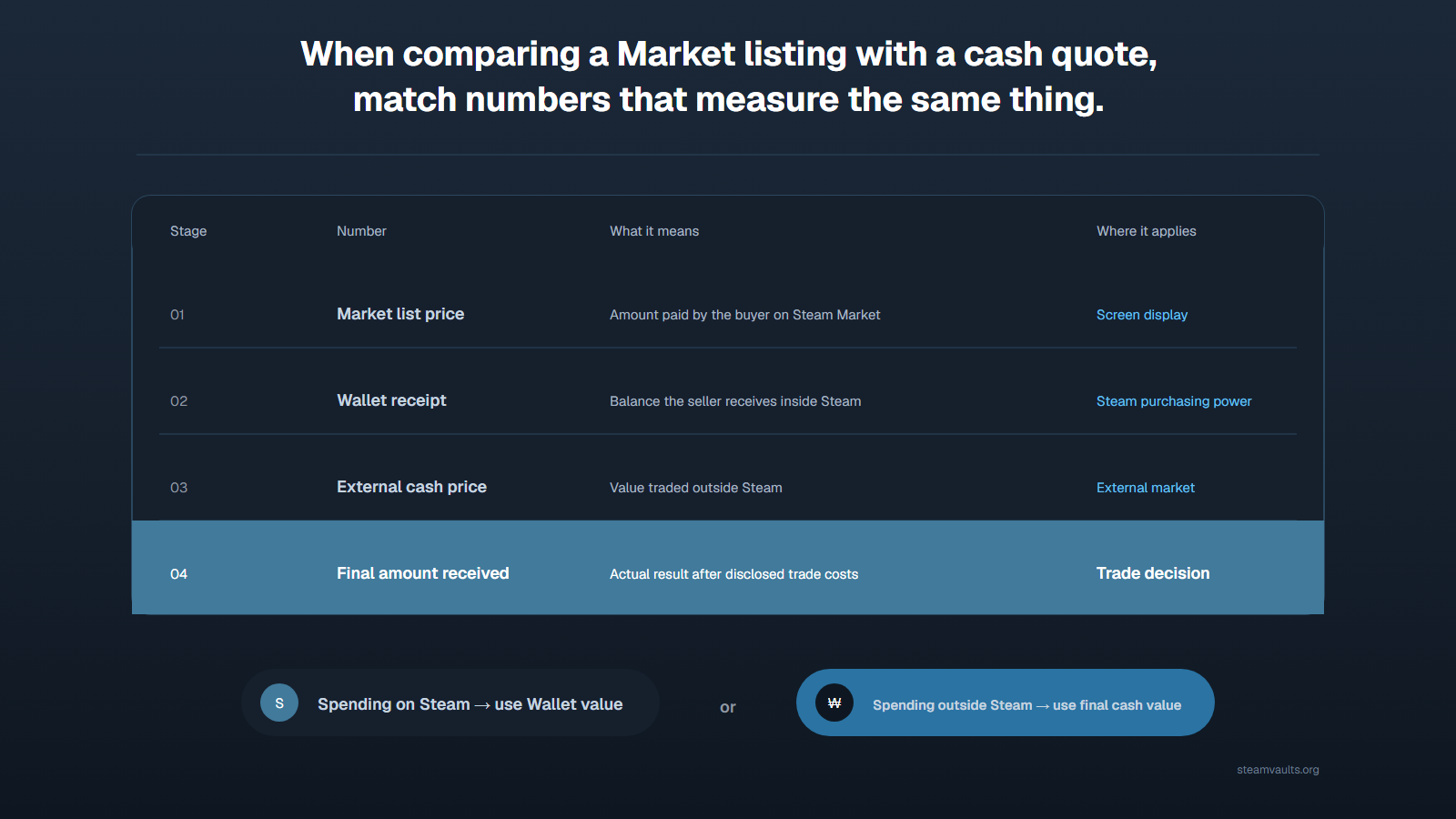
First identify what each number measures, then choose according to whether the value will be used inside or outside Steam.
Compare numbers that describe the same conditions
Before calling the whole difference a fee, write down these six entries:
- the same item and the quantity being compared;
- the Steam buyer total and the seller’s net Wallet proceeds;
- the outside cash bid that can take the full quantity at the same time;
- the platform’s final amount after its own spread;
- any separate withdrawal or network cost and minimum;
- the tradable date and quote expiry.
If one row is missing, the comparison is unfinished. A headline listing price and a final cash amount are not like-for-like numbers.
The Steam Market price and an outside cash price do not differ because one of them is fake. The Market price belongs to a market settled in Steam Wallet funds. The cash price belongs to a market converting that value into something usable beyond Steam. The gap looks dramatic when figures created under different conditions are placed side by side.
That difference affects the user’s result and should never be dismissed as nothing. It is also not accurate to call the entire amount a platform fee. Steam transaction costs, the restricted use of Wallet funds, waiting time, inventory and price risk, and the service of completing the process can all overlap.
If I could give my earlier self one rule, it would be: do not judge the trade by the largest number on the Market page. Check whether it is the buyer’s payment or the seller’s proceeds, and whether the proceeds are Wallet funds or money usable outside Steam. On an outside service, look at the final amount you receive and any separately stated costs.
That is enough for many users. Recovering a small balance should not require becoming a professional trader. You only need to know what you are giving up and what you are getting in return. One person may spend more time finding a better counterparty; another may accept a known gap to hand the complexity to a service.
That choice is what I want SteamVaults to provide. After a trade, I want the user to think, “There was hardly any process, and I was able to move value that had been stuck.” I also want the price difference to be understandable enough that the remaining feeling is not simply that money disappeared, but that time and complexity were deliberately exchanged for a service.
SteamVaults is an independent third-party service and is not affiliated with Valve or Steam. It does not directly withdraw Steam Wallet funds or bypass Valve restrictions. It quotes only supported tradable items. Prices and availability can change with market and inventory conditions, so the live quote shown before a transaction is the number that matters.