


What Is a Steam Sack of Gems? 1,000 Gems, Uses and Restrictions
An in-depth analysis of Steam Gems: the 2014 auction exploit, booster pack math, the true cost of item recycling, trade lock inheritance, and commodity fee mechanics.
I design SteamVaults pricing and inventory rules and write about the Steam Wallet, Community Market, item liquidity and trade constraints.
Article languages
On this page
- A Thousand Loose Gems Are Just Clutter Until You Pack Them
- Grinding Inventory Items: The Math Nobody Tells You
- Booster Packs: The Only Real Reason Gems Exist
- Packing and Unpacking: The Trade Lock Poison Pill
- The Market Fee on Sacks: Why Small Numbers Lie
- Why SteamVaults Trades Sacks Instead of Skins or Keys
- Five Questions to Answer Before You Press "Make Gems"
Once a Steam library grows into hundreds of games and the inventory accumulates years of indie game trading cards, emoticons, and profile backgrounds, almost every user discovers a curious blue link on their item details screen: “Turn into Gems...”
Most people click it casually. You grind an emoticon or two from a bundle game you played for 30 minutes in 2018, and suddenly you are left staring at 14 or 28 loose gems in your inventory. You cannot sell 14 gems on the Community Market. You cannot send them as a serious trade offer to a friend without them wondering why you sent pocket dust. And unless you have thousands of them, you cannot even craft a single booster pack.
The Steam Gem economy is not just an inventory recycling feature. It is a carefully engineered deflationary currency designed by Valve in 2014 to mop up surplus digital items, operating on a strict two-tier architecture: account-bound loose gems and standardized, market-tradable “Sacks of Gems” (1,000 units each). This guide breaks down the historical origins of the system, the hidden financial loss of grinding marketable items, the inverse booster pack creation formula, the technical mechanics of trade-lock inheritance, and why SteamVaults selected the Sack of Gems as its primary trade commodity over volatile game skins.
A Thousand Loose Gems Are Just Clutter Until You Pack Them
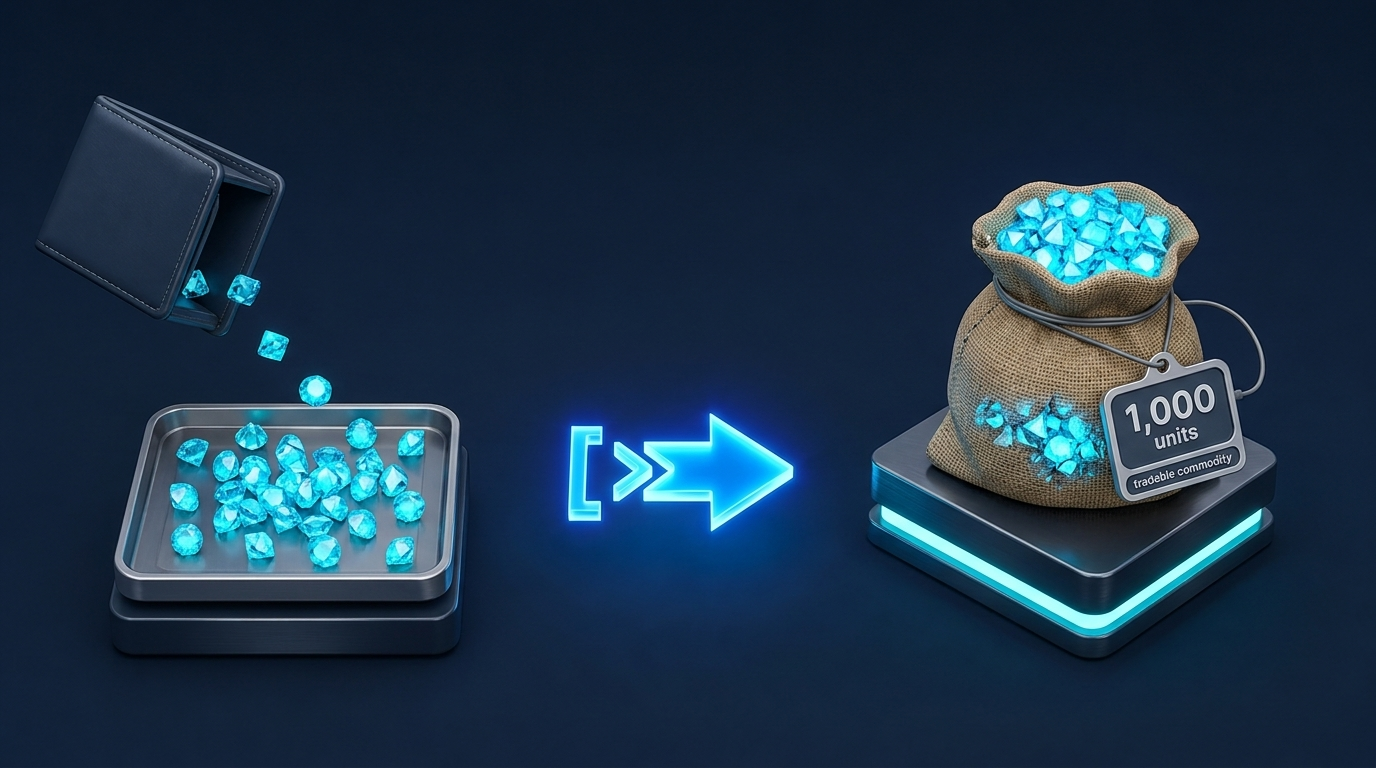
Whether you hold 1 loose gem or 999 loose gems in your inventory, from the perspective of the Steam Community Market and external P2P trading platforms, your balance is effectively zero. Valve does not provide an order book for individual gems. You will never find a market listing for “1 Gem” or “100 Gems.”
The 2014 Holiday Auction exploit and why Valve enforced 1,000-unit sacks
Understanding this unusual restriction requires looking back to December 2014. Heading into the annual Winter Holiday Sale, Valve launched the “Steam Holiday Auction,” allowing users to recycle unwanted items into gems and use those gems to place bids on approximately 200,000 full game copies.
Within hours of launch, a critical duplication exploit surfaced. By sending asynchronous, parallel requests to the item recycling web endpoint, malicious actors discovered that the backend consumed a single item while minting dozens of times its gem yield. Trillions of duplicated gems flooded the Community Market. Valve was forced to take the unprecedented step of shutting down the entire auction system, rolling back market transactions, and deleting duplicated gem stacks.
When the system was re-introduced, Valve implemented the strict 1,000-unit compression architecture: 1. Database and traffic protection: Preventing over 100 million active users from flooding the market database with micro-listings priced at fractions of a cent ($0.0003). 2. Asset commoditization: Restricting loose gems to internal account crafting points, while elevating only the compressed 1,000-count “Sack of Gems” (AppID 753, ContextID 6) into an independent, trade-eligible commodity.
Consequently, any quantity below 1,000 gems remains locked within your account's closed loop. If you have 980 gems, you must either grind more items to reach 1,000 or leave them indefinitely for internal booster pack crafting.
Grinding Inventory Items: The Math Nobody Tells You

The “Turn into Gems” button feels like finding money in the pocket of an old jacket. However, for more than 85% of tradable items across Steam, pressing that button incinerates between 35% and 80% of the item's true market value.
Gem conversion yield tiers and net payout comparison
Steam's item-to-gem conversion rate does not track live market prices. It is hardcoded based on the base game's trading card set size and the item's internal rarity tier:
| Item Category | Rarity Tier | Gem Yield | Gem Cash Value (at $0.36 / Sack) | Net Market Return (at $0.03 floor price) | Value Difference |
|---|---|---|---|---|---|
| Standard Trading Card | Common | 10 to 20 gems | $0.0036 to $0.0072 | $0.0100 | -28% to -64% loss |
| Foil Trading Card | Foil | 60 to 100 gems | $0.0216 to $0.0360 | $0.10 to $1.50+ | -75% to -98% severe loss |
| Standard Emoticon | Common | 10 to 20 gems | $0.0036 to $0.0072 | $0.0100 | -28% to -64% loss |
| Profile Background | Rare | 80 to 100 gems | $0.0288 to $0.0360 | $0.05 to $0.50+ | -30% to -90% loss |
Assume a Sack of Gems (1,000 units) trades on the Community Market for approximately $0.36 net after Steam transaction fees:
- 1,000 gems = ~$0.36
- 1 gem = ~$0.00036
- Grinding a 20-gem emoticon gives you $0.0072 in real gem value.
However, if you list that same 20-gem emoticon on the Community Market at the lowest possible gross price of $0.03, after Steam and developer fees are subtracted, you receive $0.0100 (one full cent) deposited into your Steam Wallet. By grinding it, you destroyed nearly 30% of your net payout. Across an inventory cleanup of 100 items, that difference represents real wallet funds thrown away. Grinding a foil card is an even worse mistake: destroying a collectible worth several dollars for 3 cents worth of gems.
When does grinding items actually make financial sense?
Grinding items is rational under only two specific conditions: 1. Untradable / Non-marketable promotional items: Profile backgrounds or emoticons earned from point shop purchases or event badges that cannot be traded or sold on the market, but retain the “gem-eligible” flag. Grinding is the only path to monetize their dead inventory footprint. 2. Dead catalog oversupply: Items from discontinued or obscure games where over 50,000 listings sit at the $0.03 minimum with zero buy orders over the past six months. Since these will never sell on the market, converting them into 10 to 20 liquid gems is an immediate efficiency gain.
Booster Packs: The Only Real Reason Gems Exist
If grinding items is mathematically inefficient for most players, why does a massive secondary market for Sacks of Gems exist? Why do buyers purchase thousands of sacks every single day?
The entire demand side of the gem economy is anchored to one specific tool: the Booster Pack Creator (steamcommunity.com/tradingcards/boostercreator/).
Valve's inverse gem cost formula for booster packs
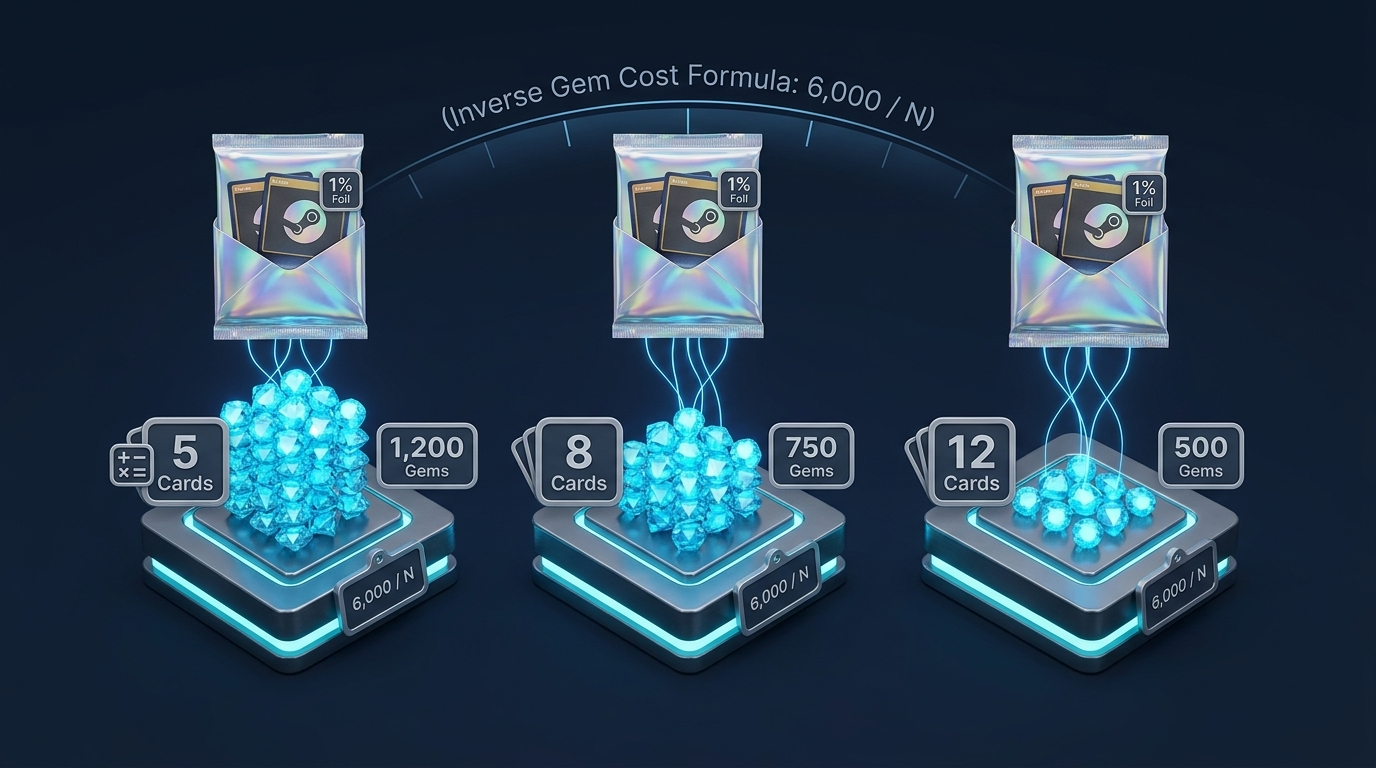
The gem cost required to generate a booster pack (which always contains 3 random trading cards) is determined by an exact mathematical formula tied to the total number of cards in that game's badge set:
$$ ext{Gem Cost} = rac{6,000}{ ext{Total Cards in Set}}$$
- 5-card badge set: $6,000 \div 5 =$ 1,200 gems
- 6-card badge set: $6,000 \div 6 =$ 1,000 gems
- 8-card badge set: $6,000 \div 8 =$ 750 gems
- 10-card badge set: $6,000 \div 10 =$ 600 gems
- 12-card badge set: $6,000 \div 12 =$ 500 gems
- 15-card badge set: $6,000 \div 15 =$ 400 gems
Every booster pack carries a baseline 1% chance of dropping foil cards. This probability scales upwards by +20% for every 10 Steam profile levels (a level 50 account receives a 2% foil drop rate).
Level-up services, arbitrage, and seasonal price cycles
This formula fuels three major economic activities: 1. Automated level-up bots: Services that supply full card sets to users looking to boost their Steam profile level. Instead of purchasing individual cards on the market, bot operators stockpile Sacks of Gems during low-demand months and craft packs daily as cooldowns expire. 2. High-tier card arbitrage: For specific visual novel or niche anime games where foil cards sell for $15 to $30 or profile backgrounds trade above $5, spending 1,200 gems ($0.45 cost) to roll 3 cards has a strongly positive mathematical expected value. 3. Seasonal pricing volatility: During the major Steam Summer and Winter sales, badge crafting spikes because Valve awards special sale trading cards for every badge crafted. As a result, Sack of Gems prices regularly surge by 20% to 35% heading into sales, before drifting downward during spring and autumn.
Packing and Unpacking: The Trade Lock Poison Pill
Once you reach 1,000 loose gems, creating a Sack takes two clicks: right-click the gem stack in your inventory and select “Make into a Sack of Gems.” Reversing it is equally simple: right-click the Sack and select “Unpack.”
Behind this simple UI lies one of Steam's most punishing asset state inheritance systems.
How a single restricted gem contaminates the entire thousand
The Steam inventory backend tracks the acquisition provenance and trade restriction attributes (market_tradable_restriction, trade_hold) for every asset slice in your account.
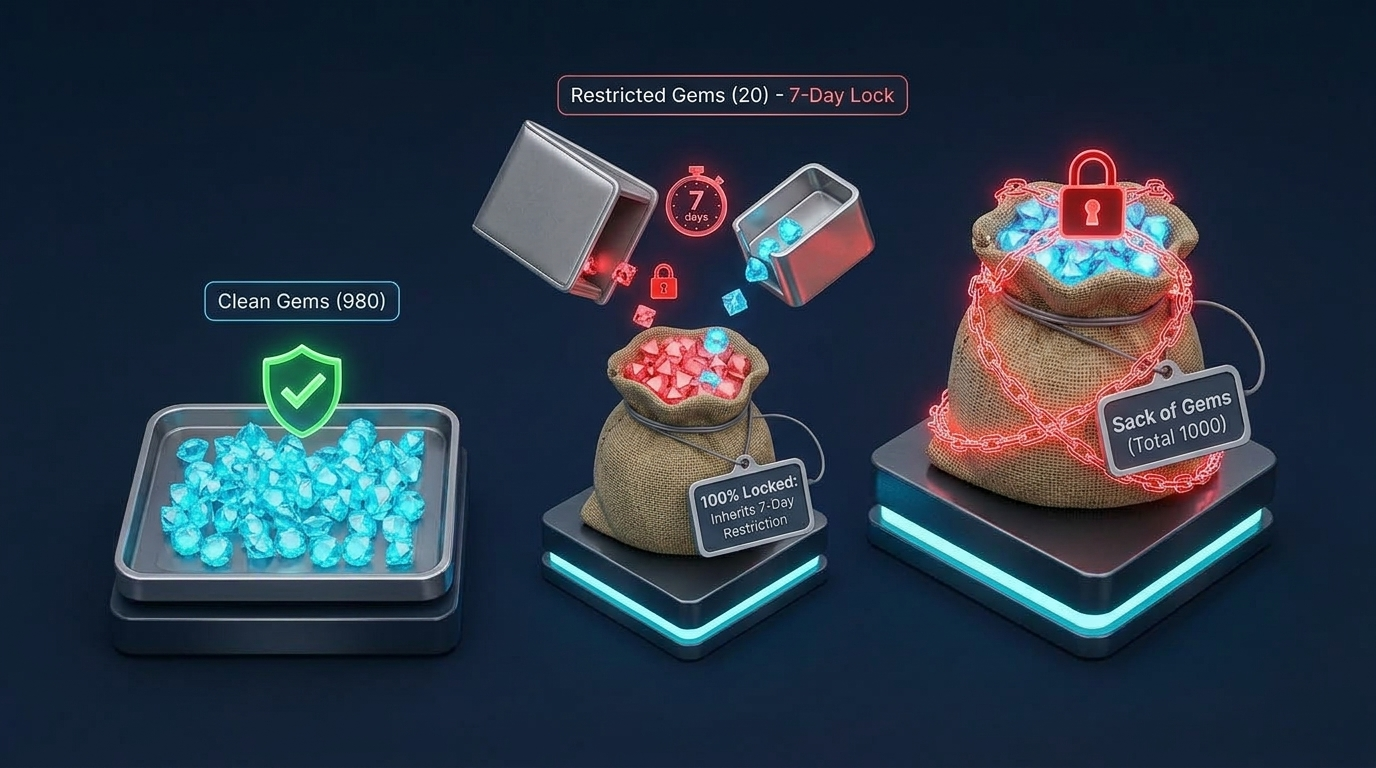
Suppose your inventory contains:
- 980 clean gems held for months without any restrictions.
- 20 gems obtained by grinding an emoticon purchased on the Community Market two days ago (holding an active 7-day trade cooldown, with 5 days remaining).
When you execute “Make into a Sack of Gems,” the backend merges all 1,000 units into a single inventory asset and executes a maximum-timestamp function:
$$ ext{Sack Unlock Timestamp} = \max( ext{Timestamps of All Constituent Gems})$$
Even though 98% of your gems were completely unrestricted, the entire 1,000-gem Sack immediately inherits the 5-day trade and market lock.
Unpacking the Sack does not fix the mistake. Once merged, the restriction propagates across the entire newly unpacked 1,000-gem pool. If you then mix those 1,000 gems with another stack of clean gems, you risk chaining the cooldown across your entire inventory.
Verification protocol before compressing gems
If you intend to trade your Sacks of Gems or liquidate them through external services, follow these precautions before packing: 1. Review your purchase history for any market transactions over the past 7 days. 2. Check if any recently traded items carried trade hold tags before grinding them. 3. In your Steam inventory browser, click the loose gem stack and verify that no red warning text reading Tradable after: [Date] appears in the description card.
The Market Fee on Sacks: Why Small Numbers Lie
Because a Sack of Gems is a high-volume commodity trading below $1.00, Steam's fee calculation behaves very differently from trades involving high-value CS2 skins.
The 1-cent floor and effective fee distortion
Valve's Community Market fee structure consists of two independent components:
- Steam Transaction Fee: 5% of the seller's base price
- Game-Specific Fee (Valve): 10% of the seller's base price
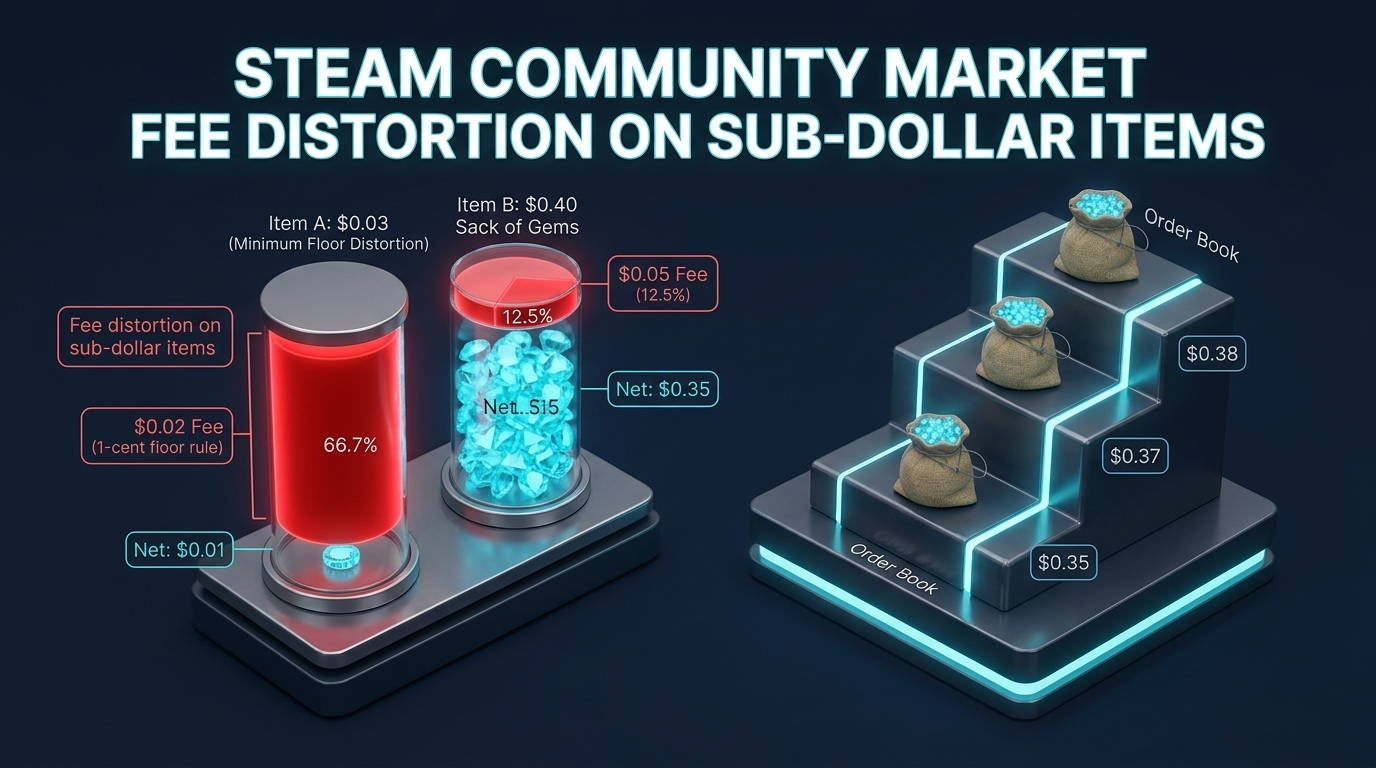
While commonly cited as a flat 15%, Valve's billing engine enforces a mandatory rule: each fee component has an absolute floor of $0.01 (1 cent).
On sub-dollar assets, this 1-cent floor significantly distorts the effective fee percentage:
| Buyer Pays | Seller Receives | Steam Fee (5%) | Valve Fee (10%) | Total Fee | Effective Fee % |
|---|---|---|---|---|---|
| $0.03 | $0.01 | $0.01 (Floor) | $0.01 (Floor) | $0.02 | 66.7% |
| $0.10 | $0.08 | $0.01 (Floor) | $0.01 (Floor) | $0.02 | 20.0% |
| $0.25 | $0.21 | $0.01 (Floor) | $0.03 | $0.04 | 16.0% |
| $0.35 | $0.31 | $0.01 | $0.03 | $0.04 | 11.4% |
| $1.00 | $0.87 | $0.04 | $0.09 | $0.13 | 13.0% |
When Sack prices sit around $0.35, the combined fee is roughly 11.4% to 12.5%. But if market dips push prices toward $0.20, the 1-cent floor pushes the effective tax rate past 15%.
Order book depth and market slippage
Sacks of Gems trade via unified commodity order books rather than individual seller showcases.
The price displayed on the front page (e.g., “Starting at $0.38”) is the lowest active sell order. If you want instant liquidity, you cannot sell at that price. You must fulfill existing Buy Orders, which typically sit 1 to 3 cents below the lowest sell listing.
Furthermore, selling 50 or 100 Sacks at once quickly exhausts the highest buy order tier, forcing subsequent units into lower bids. Calculating your expected wallet recovery by multiplying your quantity by the headline price will consistently overestimate your real proceeds.
Why SteamVaults Trades Sacks Instead of Skins or Keys
Throughout Steam's history, the dominant trading currency has evolved. From 2012 to 2020, Team Fortress 2 Mann Co. Supply Crate Keys served as the community's de facto liquid currency due to their fixed store price ($2.49) and lack of immediate trade holds.
When Valve extended 7-day cooldowns to TF2 items, the trading landscape fragmented. When designing SteamVaults, the decision to use Sacks of Gems as the sole core trading asset was driven by engineering and risk principles: absolute fungibility.
Eliminating appraisal risk and valuation black boxes
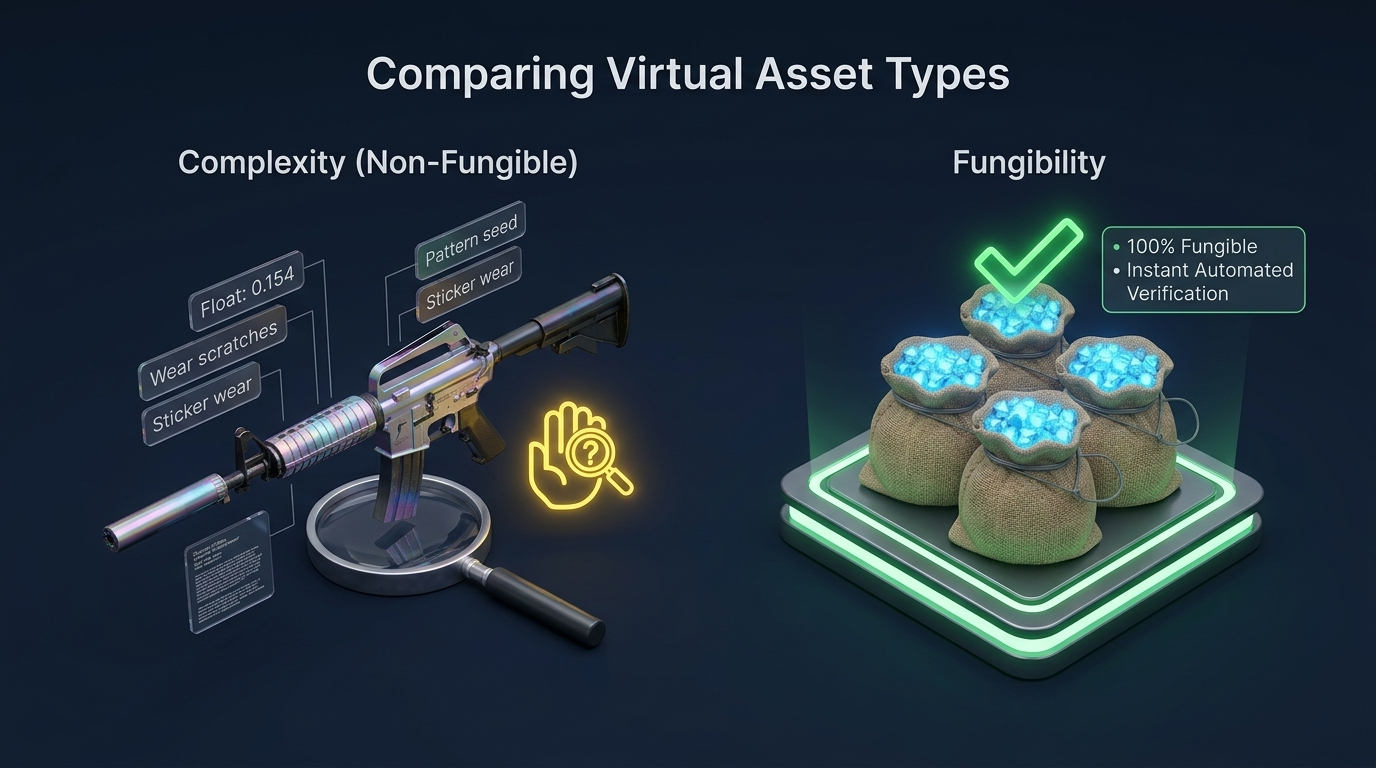
Game skins in Counter-Strike 2 or Dota 2 possess non-fungible properties that make automated settlement hazardous:
- Float values: Two identical “AK-47 | Redline (Field-Tested)” skins can vary in market value by 30% or more depending on whether the float is 0.151 or 0.369.
- Stickers and patterns: Rare applied stickers or Case Hardened blue gem pattern seeds multiply prices exponentially.
Automating skin trades requires fragile heuristic appraisal algorithms. If the algorithm errs, the platform either overpays for low-tier patterns or underpays users, creating frustration and financial risk.
A Sack of Gems completely eliminates this problem:
- Sack A from User 1 is 100% physically and legally identical to Sack B from User 2.
- There are no floats, no pattern seeds, no wear percentages, and no stickers.
- An automated trade bot can inspect a trade offer, verify that the asset ID matches catalog 753 (Sack of Gems), and execute balance settlement in milliseconds without human appraisal error.
Balanced pool capacity and bidirectional liquidity
Standardization also protects inventory solvency. SteamVaults balances incoming sell orders against outgoing top-up demand through explicit operational limits (poolHave, poolMax).
Instead of accumulating illiquid skin inventories that depreciate during game meta shifts, focusing on a single fungible commodity ensures that intake capacity directly reflects actual demand, providing users with transparent, predictable execution.
Five Questions to Answer Before You Press "Make Gems"
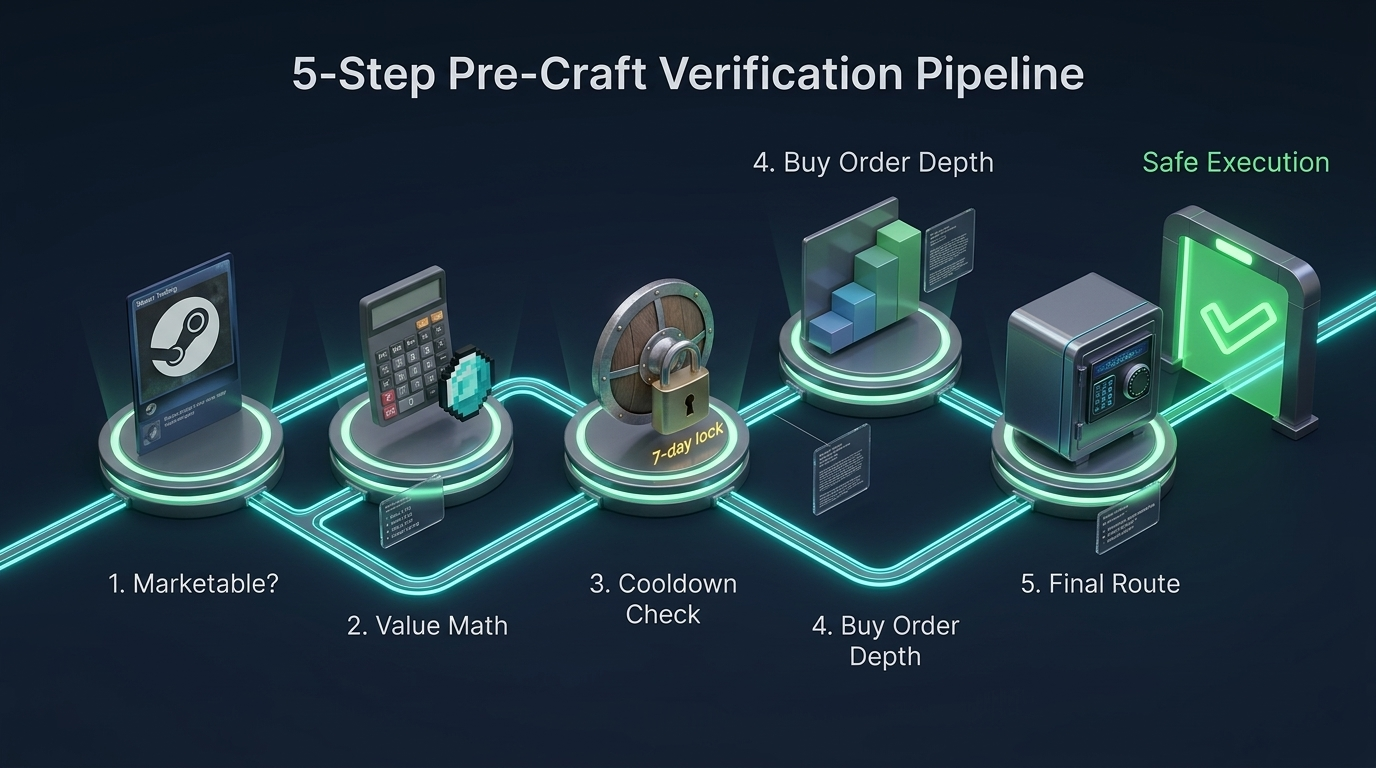
Before grinding your inventory items or executing gem trades on the market, take 30 seconds to work through this 5-point verification checklist:
The 30-second inventory preservation protocol
1. Are the items marketable? If an item is untradable and unmarketable, grinding it into gems is often your only recovery option. But if it can be sold on the Community Market, check its floor price first. If it can clear at $0.03, market listing yields more net value than grinding. 2. Did you calculate the net recovery ratio? Multiply the gem yield by $0.00036 and compare that directly against the net market payout (at least $0.01). If the market payout is higher, do not click the grind button. 3. Are any recently acquired items in your gem pool? Check your purchase history. Grinding even one item bought on the market within the last 7 days will contaminate your entire 1,000-gem Sack with an active trade hold. 4. Did you check the highest live Buy Order? Never estimate your liquidation value using the lowest sell listing. Check the highest buy order in the order book, and account for order depth slippage if liquidating more than 20 Sacks. 5. Is your end goal crafting or cashing out? If your goal is crafting badges through the Booster Pack Creator, keep your gems loose. If your goal is transferring value externally via SteamVaults, keep your gems packed in clean, unrestricted Sacks of Gems.
Ready to sell supported Sacks of Gems?
After the bot confirms receipt, USDT is credited to your site balance. Polygon withdrawal is a separate request.