
I dislike the habit of reading a Steam inventory as if it were only a price list.
A Game Can Leave Before Its Inventory Does
Uninstalling a game and deciding what to do with what remains from it look like neighboring tasks on a screen. They are not the same decision. One is about what I want on my computer right now. The other asks me to reopen a part of an account I may not have looked at for a long time and decide what it means to me. It is easy to collapse the two: I no longer play the game, so I should clear out the rest. I think that neat sentence skips over most of the actual question.
A long-used Steam account is rarely full of treasures. More often, it holds ordinary remnants: cards from a game I played briefly, an old profile item, an entry whose origin is no longer obvious at a glance. Together, they resemble a cluttered storeroom. Even that metaphor is too thin. The inventory is not just a pile of objects; it is evidence that different ways of using an account have piled up in the same place. There were periods when the game itself mattered, periods when the profile did, and periods when I simply added games to a library without thinking much further. Nostalgia is too convenient a label for all of it. Most of it is simply still there. The difficulty is that simply still there is not always simple to resolve.
When people say inventory value, the word usually becomes price almost immediately. Price matters, but it is not the only thing hidden inside that word. A visible Market price is one thing. What I know about the game is another. Then comes the awkward part: whether I want the item in my account at all. That last question can sound unserious beside a number. It still belongs to the decision. The account is mine, and I am the one who has to live with either an uncluttered list or the awareness that I made a choice too quickly.
Advice that treats an untouched inventory as a minor character flaw is no better. Of course, someone may leave it alone because they do not care. There is no need to turn every delay into a meaningful act. But a person who has never really explored the inventory may not even know what they are looking at, let alone what deserves a decision. Not playing a game can mean several things: it is not installed, I do not expect to launch it soon, or my interest in it is truly over. Those are different claims. Freeing disk space does not require the last one. Deciding whether an item stays in an inventory sometimes does.
An old card can bring a game title back to mind one day and be nothing more than a small image in a list the next. Calling every leftover item a memory gives keeping it a false dignity. Calling it useless ends the conversation just as quickly. Neither reaction proves anything about how much I cared. Keeping it does not make me more devoted. Clearing it does not mean I treated the game lightly. There is no prize for choosing the more sentimental side.
I do not need to preserve every item. I just do not want to rush a decision because a list makes it look overdue. Once every inventory decision becomes a test of whether I am keeping only what has value, I have already made the list more important than it needs to be.
Save files deserve a separate thought here. Leaving a card in my inventory does not preserve my progress in the game. If I might continue on another device, it is worth checking the Cloud records and keeping separate save copies. Choosing to uninstall need not mean choosing to give up the save as well.
Steam Is Not One Way of Playing
What makes me uneasy is how quickly an inventory discussion shrinks to the question of how much something is worth. Price is useful. It is not a verdict. Looking at a price first and allowing that price to finish the decision are two different habits. Skip that distinction and the inventory stops being information; it becomes a list designed to make the owner feel late.
Some people buy games and play them. Some enjoy changing a profile, looking through card sets, or opening an inventory now and then to see what has accumulated around older games. None of those uses proves more seriousness than the others. Frequency is not affection, and familiarity with a feature is not a measure of whether someone is using Steam properly. Advice about inventories gets shallow when it forgets this. Telling someone to clear a feature they do not use confuses not using it today with having no reason to look at it at all.
There is no correct number of Steam features to use. A person who buys and plays games is already using the platform well enough for their own purpose. Someone else may enjoy the quieter layer around the games: the profile, the cards, the small inventory changes that would not matter to anyone else. Treating the number of features someone touches as a score for attachment or competence is a blunt way to talk about people.
That is why I resist the language of proper management. An inventory exists inside an account that was probably opened to play games. Market and card features are routes a person can choose from that screen. They are not a track every user is required to follow.
The distinction sounds obvious in the abstract. It is much easier to lose once a list starts looking like a list of missed opportunities.
When a Price Starts Looking Like an Answer
A market-related label beside an inventory item creates a pleasingly simple set of questions. Can it be listed? What amount is visible? Is that enough reason to keep it, or not enough? A visible number feels decisive. It is not.
That feeling can survive even after the number has been checked. Sometimes the amount is visible and I still do not know what I want to do. Sometimes I check the amount and still do not know what I want to do. I have learned a fact about the item, not reached a decision about it. Not knowing a price and knowing a price without having a judgment are different kinds of uncertainty.
Steam's Community Market FAQ describes the functional boundary: eligible inventory items can be listed from the Inventory or the Community Market, and Community Market transactions use the Steam Wallet. That tells me what the system is set up to allow. It does not tell me that today is the day I ought to make use of it.
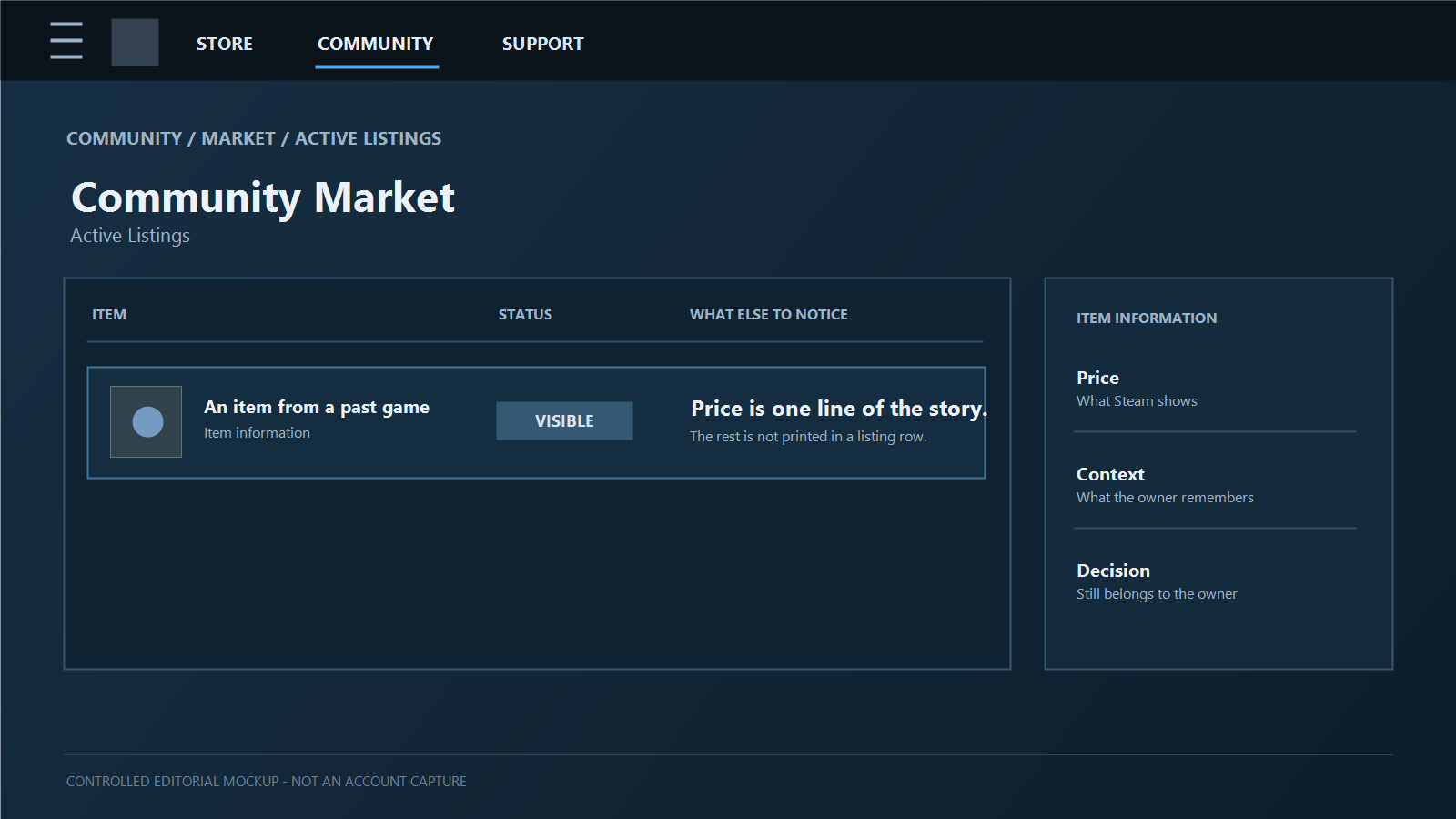
That may be a modest distinction, but I want to keep it intact. Official documentation can explain an available feature, the kind of item it covers, and the route through the interface. It cannot supply the part that belongs to the person looking at the screen: what should I do with this information? The FAQ tells me what the feature allows. It cannot decide whether I should use it.
The unanswered part does not require a grand philosophy. I might want to know what the item is, which game it came from, whether I have any connection to that game left, whether opening the item again feels tiresome, or whether leaving it alone would bother me at all. Those questions do not fit into a single Market line. They are inconvenient for that reason. I suspect that inconvenience is one reason inventories sit untouched for so long.
Often, I check a price because I do not want to get an item wrong and regret it later. The unease can come from not understanding the item, from dismissing it too soon, or from wondering whether the number on the screen is pretending to describe the whole thing. That is not automatically greed. More often, it is just the discomfort of not knowing.
That discomfort can grow when Steam feels unfamiliar. An account can hold cards, profile-related elements, an inventory, and a Market in close proximity. Someone may notice a single item and suddenly feel that they need to understand the entire platform before touching it. A price becomes the easiest handle because it looks like something solid. I would not make fun of that instinct. I only object to the next move: treating the tiredness that follows as a lack of decisiveness.
Numbers can make judgment worse when I keep returning to them in order to escape uncertainty. They answer one question while quietly pushing the others out of view. If I only ask whether keeping an item is inefficient, I may stop asking which game it belongs to, whether I still care about that game, or whether the item is actually meaningless to me. A quick answer may be useful. It can still be the wrong question.
So I distrust any account of inventory value that speaks as though it has found the single correct answer. A visible amount, another person's collecting preference, and the private feeling attached to a game occupy different layers. Put them in one sentence and the reader is left with less clarity, not more. Price, another person’s collecting preference, and my own connection to a game are not the same thing. I do not want to pretend they are.
Even the word clearing out carries more confidence than I have. It sounds as if the unnecessary things have already identified themselves and the only task left is to remove them. Often I cannot know that at a glance. For someone who only plays games, cards and profile-related items may feel like loose attachments. For someone who enjoys a set or a profile, they may be a quiet continuation outside the game. The same screen begins from different premises.
That is why a casual remark such as you still have not sold this can say far too much. Perhaps the price has not been checked. Perhaps it has and I simply do not care. Perhaps I want to understand the item first. The visible delay is the same; the reason behind it is not. It is enough to begin by admitting that.
Cards Are a Small Game Beside the Game
Trading Cards make the difference especially visible. Taken alone, a card is a small image. It is not required to launch a game. For some people, that makes it an obvious thing to move on from. For some people, that is reason enough to move on from it.
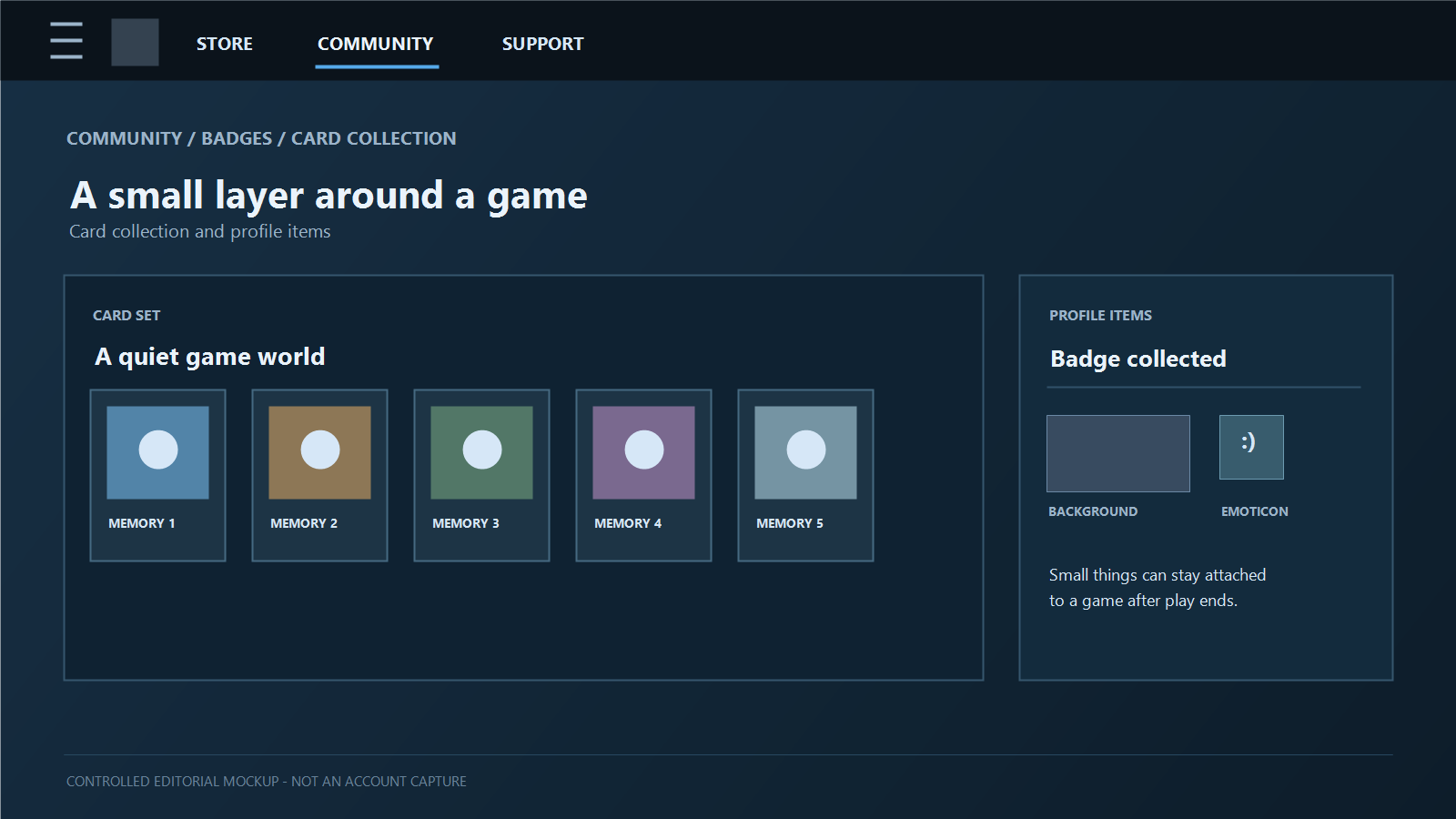
The card system is not entirely separate from playing, though. Steam's Trading Cards FAQ says that participating games can award collectible cards through play, and that card sets connect with badges and profile-customization items. It is better understood as part of a system that can continue alongside a game.
Collecting cards, making badges, and changing a profile can feel like a small game that keeps moving beside the main one. For one player, this is the small game after the game. For another, it is nothing at all. The trouble starts when one use is treated as the normal one and the other as a failure of judgment.
Cards do not need an inflated status, either. A single card cannot stand in for an entire game, and its presence does not prove I will return to that game. Feelings about games are less orderly than that. I may never launch an old favorite again. I may feel unexpectedly curious about an image from a game I barely remember. There is no need to force that inconsistency into a cleaner story.
The word useful becomes empty when no one says useful for what. A card may have a place for someone who enjoys working on a profile and no place for someone who never looks beyond a library. One person likes completing a set; another finds a card-drop notice annoying. A platform that leaves room for those different reactions cannot demand that every inventory be judged by one standard.
This is part of why Steam can feel complicated. It is not only a matter of menus. A single feature can have different reasons for existing in different people's use of an account. People may press the same button to buy and launch a game, then look at everything around that game in entirely different ways. One looks for profile elements, one checks where a card came from, and one never opens the inventory again. Calling one person more advanced and the other less knowledgeable misses the point.
Neither calculation nor sentiment explains every card that remains. An item can be understood, eligible for listing, and still not be something I want to deal with today. I may have no plan to play a game again and still want to know where a card came from. Those are not malfunctions in the way someone uses the platform.
The modest appeal of cards, to me, is not that they make a collection impressive. It is that they let another set of rules sit quietly beside a game I played. Finishing the game does not have to finish interest in everything attached to it on the same day. Finishing a game does not make every feature attached to it finish on the same day. A leftover set does not prove a deep relationship with a game.
I would rather ask what game a card came from before declaring what it is worth. That question will not always produce a warm feeling. It can lead nowhere. It still makes the item a little less abstract.
I Do Not Need to Learn Steam All at Once
Steam does not have one finished form of use. Some people are satisfied with buying games and playing them. Others spend time with profiles. Some look at cards but have no interest in the Community Market. Different order does not mean defective use.
The pressure begins when an unfamiliar feature turns into an exam. An inventory may contain many entries and labels, and the first question is often not what to do but what, exactly, is on the screen. The predictable answer is to learn everything at once: understand the Market, understand cards, understand profiles, understand every adjacent rule. I think that instruction sends people farther away. A person can open a window because one item is unfamiliar and leave feeling as though they need to understand the whole platform before they are allowed to close it.
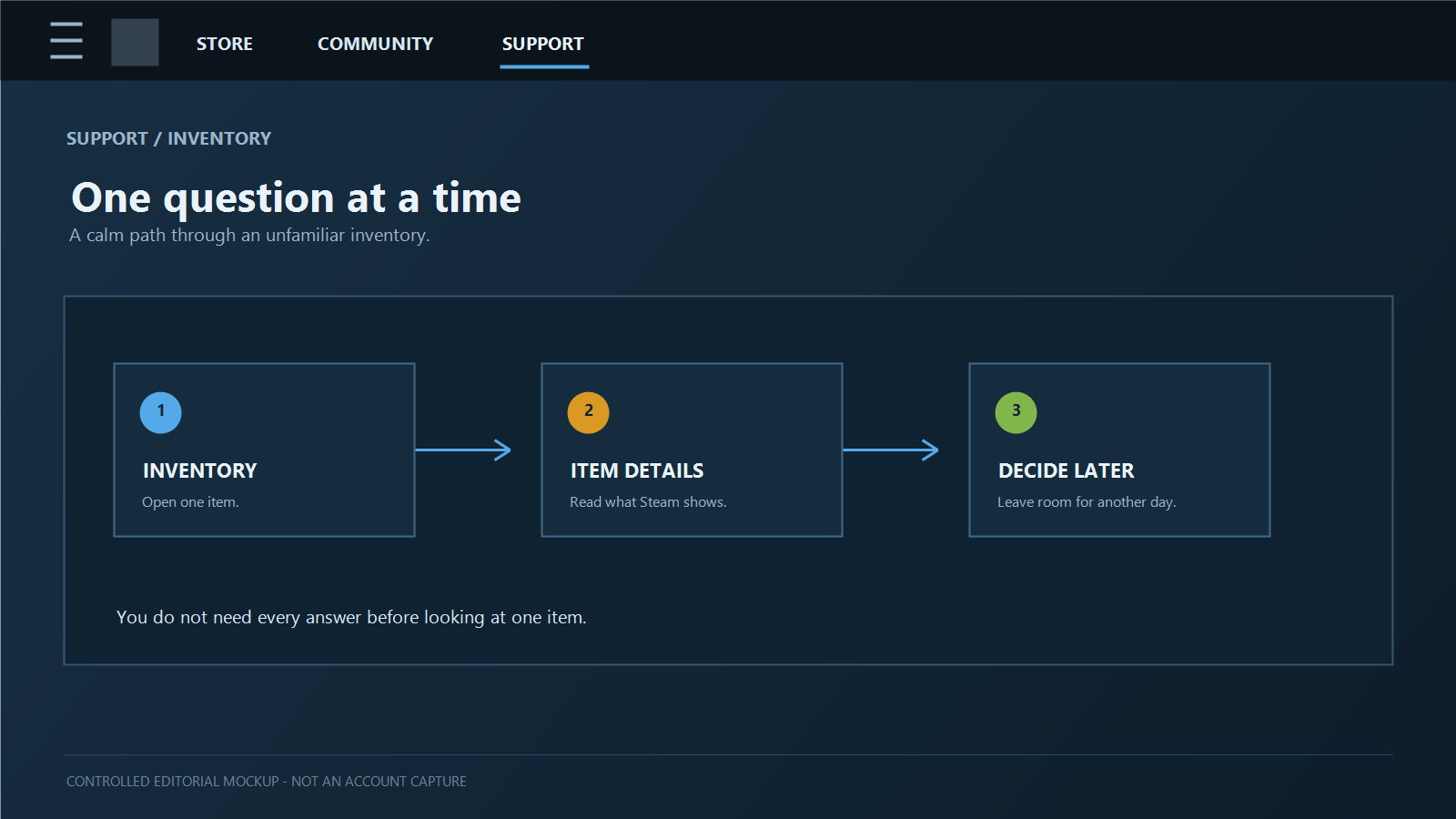
If today's question is where a card came from, that one question is enough. If I only want to know whether an item falls within the Market's stated scope, I can read that part of the official guidance and stop there. A complete theory of badges is not a prerequisite for ignoring a profile. On another day, curiosity about a card set may be a perfectly good place to begin. The order of learning should come from the question in front of me, not from a manual pretending that every feature deserves equal urgency.
There is a difference between following one question far enough to understand it and trying to process every possible question in a single sitting. The first can lead somewhere. The second tends to leave exhaustion behind. A person sees an unfamiliar item, asks what it is, and then immediately piles on every larger question about the Market, cards, and what might happen later. Trying to answer every adjacent question at once usually leaves me more tired than informed.
Taking one thing at a time is not an excuse to refuse useful information. Sometimes it is sensible to check something before deciding. The important distinction is between the thing that needs checking now and the fantasy that I must know everything before I am allowed to decide anything. Not knowing an inventory item's value can mean several things. I may not know its visible price. I may not know what cards are for. I may not know whether I care about keeping it. Fold those into one vague failure of judgment and the next step becomes impossible to see.
The questions lead to different kinds of information. A price question calls for price information. A question about where a card came from calls for the game context and the card system. A question about whether the item should remain in my account reaches beyond the screen. Other people can help with the first two. They cannot honestly claim the authority to complete the third for me.
That limit makes guidance more useful, not less. Checking which game something came from and deciding whether to leave it alone are separable tasks. Learning that a listing function exists and wanting to use it are also separate. Knowing that cards can connect to profile items does not create an obligation to care about a profile. A crowded screen can erase these distinctions, which is why Steam can feel harder than it needs to. The answer is not to memorize every menu. It can be as small as choosing one question and looking at it properly.
What Is Still There When I Say I Am Clearing Out
On a day when an old inventory feels like clutter, clearing it may be exactly the right thing to do. I may clear an old inventory. What I resist is being told that a visible price is sufficient reason. It is easier to make a decision when I have at least separated what I have checked, what I do not know, and what I simply do not care about.
Most of these decisions are small. I do not need to give every item a biography, read every hesitation as a feeling, or turn a list of leftovers into a record of a life. The decision is usually small, which may be why it is so often made without words.
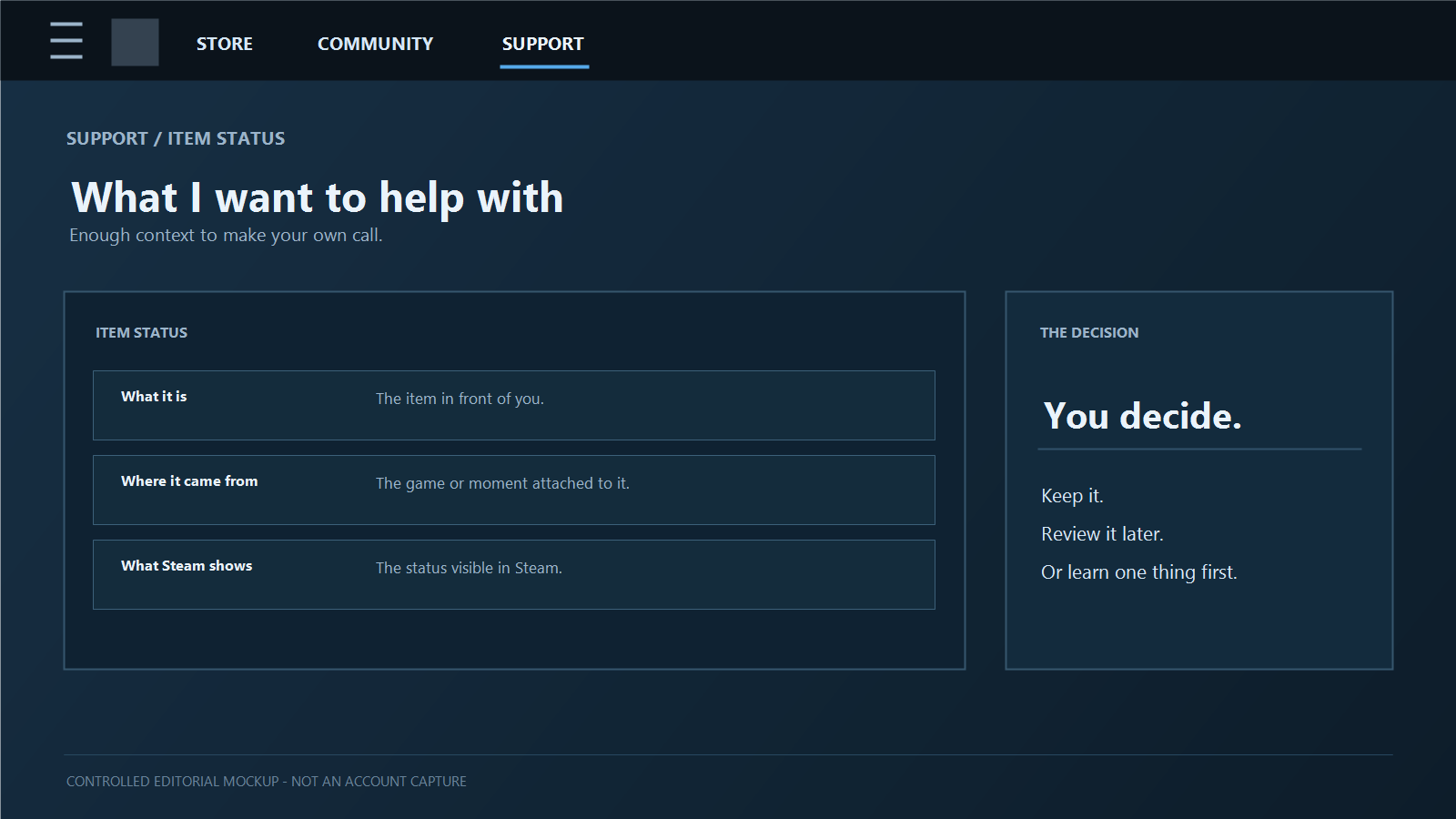
Leaving an inventory as it is does not mean avoiding judgment. For someone else, sorting unused items may be the most comfortable choice. My own standard can change as my interest changes. Looking again later does not turn the earlier choice into a failure. Looking again later does not make the earlier choice a failure.
One thing is clear to me: the speed at which I leave a game and the speed at which I decide about its inventory do not have to match. Once I notice that gap, I have room to ask what I do not yet know before I let a price answer in my place. On some days I may not answer even that. Closing the inventory window can be the whole decision for the day.
A price is a fact. It is not the explanation.
Scope note — The factual statements about Trading Cards, badges and profile-customization items, and Community Market functionality are based on the official Steam FAQs linked above. The rest of this essay is opinion, not a claim about price or future value.