


One card missing: should you make a booster pack?
Compare crafting a Steam booster with Gems and buying the cards you actually need. Includes a dated USD price sample, duplicates, foil cards, leftover Gems, and a practical spending limit.
Article languages
On this page
There's one empty slot on your badge page. You could buy that card, but you've also got some unused Gems in your inventory. A booster pack contains three cards. Making one might seem like a better deal than buying a single card, especially if you can sell whatever you don't need.
The catch is that you need a particular card. A pack's Gem cost tells you what you'll spend, not whether it will fill that slot. Comparing one card with three leaves out the part that matters for finishing the badge.
I'd price the missing card first, then decide whether opening a pack is something I want to pay for as well. Keeping those budgets separate makes it easier to stop if the first pack doesn't contain what I need.
We also collected actual Steam price responses for this article. At 13:58 Korean time on September 5, 2026, we requested prices for three booster packs and a Sack of Gems, once each, using the same US-dollar settings. The figures below come with their limitations. This wasn't a long-term profit study, and we didn't open packs to measure their odds.
Start with the missing names, not your card count
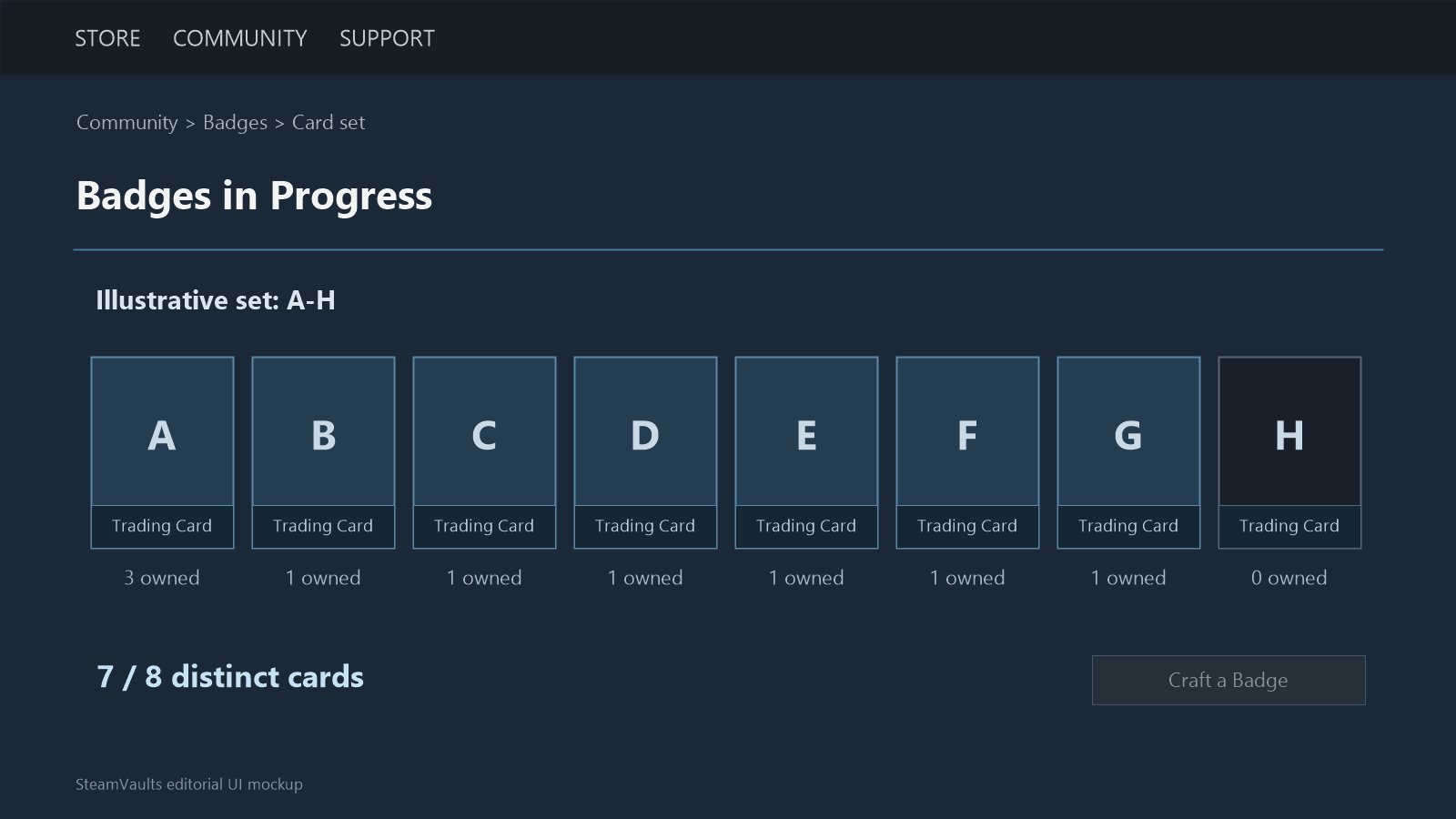
Open the badge on your Steam Badges page and check its owned and missing cards, as described in the Steam Trading Cards FAQ. Count the missing names, not everything in your inventory: spare copies of one card won't fill another card's slot.
Consider an imaginary set with eight different cards, A through H. These aren't real card names or the results of an opening experiment. They're a way to keep track of quantities. Suppose you have three copies of A, one each of B through G, and no H. You own nine cards, more than the eight a complete set requires.
You still can't make the badge without H. Another A would bring your total to ten without closing the gap.
Writing down what you need makes it easier to evaluate a pack price. If H is the only missing card, the starting point is the amount at which you can actually buy H. It isn't the average price of the cards you already own, or the price of the cheapest card from that game. It must be the right name and the right standard or foil version.
If several names are missing, record the quantity needed for each. For one more complete set, you need one card for each empty slot. If you want two sets, count the spare copies you already have as well. Two copies of A and one of B mean the second set needs another B, not another A. If you don't intend to make further badge levels, you needn't assign every spare copy the same usefulness.
Choose the number of sets before comparing prices. You can decide to collect three after spotting a cheap pack, but record that as a bigger project—not a saving on the single set you originally wanted.
If you're still trying to establish whether more cards can drop, you're one step earlier. The article on regular card drops and booster-pack eligibility explains how to check that status. Here we're looking at a deliberate purchase or use of materials, not a pack you might receive by waiting.
What “three cards” leaves out
Valve's FAQ says a booster contains three trading cards. The official Team Fortress 2 booster listing also describes three cards and the possibility of a foil version replacing each one. That tells us about the contents' number and type. It doesn't promise to select three different cards missing from your badge.
Buying a pack therefore doesn't establish how many packs it will take to find your last card. The official sources we inspected didn't document card-specific opening probabilities, independent draws, equal weighting, or protection against cards you already own. An eight-card set isn't enough evidence to assign each card a one-in-eight probability.
An equal-likelihood, independent-draw model would let us calculate a probability for the missing card. We couldn't verify those assumptions against a Valve opening rule, so we haven't published that calculation as Steam's odds.
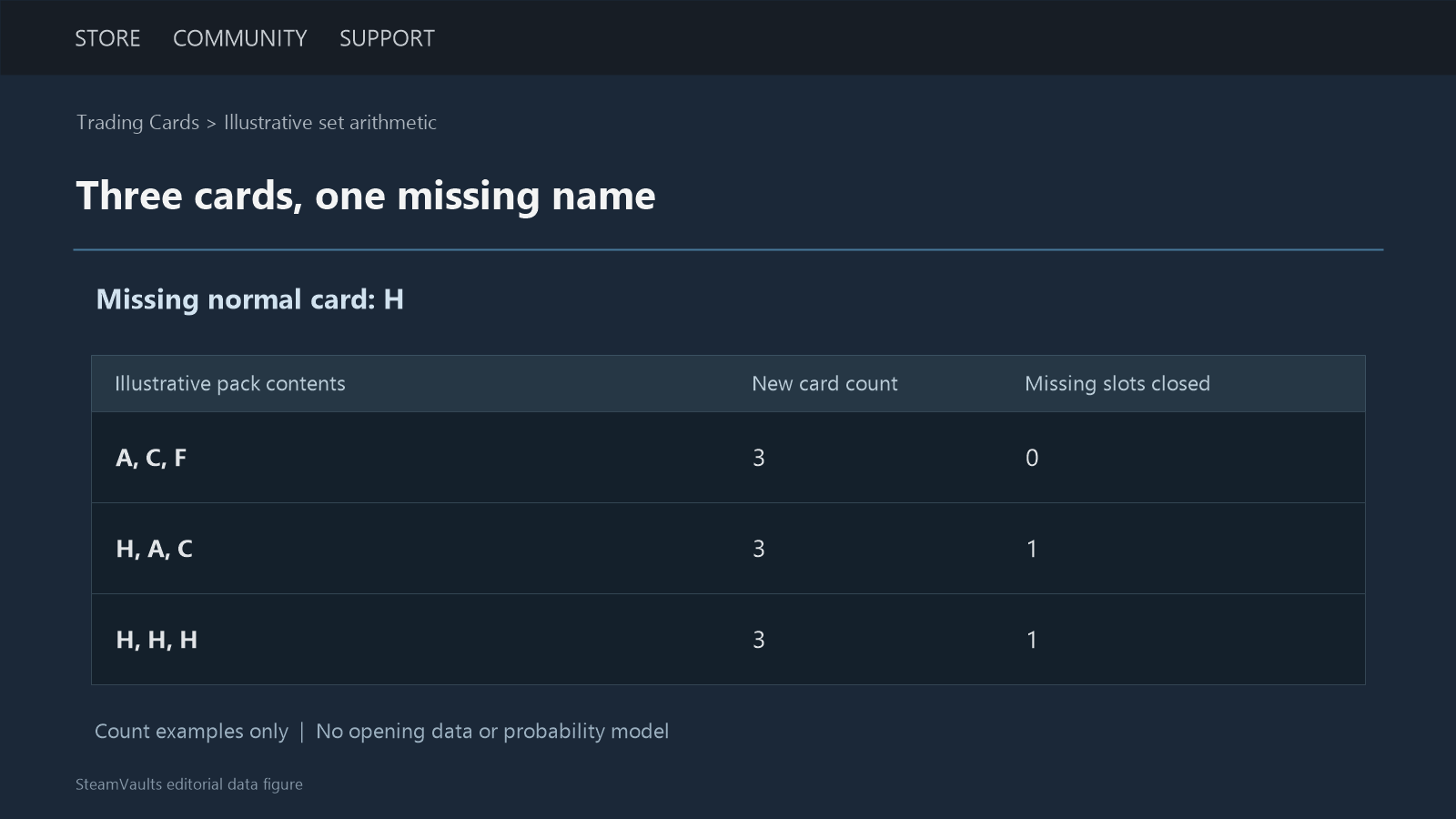
We can still state the counting limits: three cards can close at most three different missing slots, or at most one if only one is empty. If all three are cards you already own, none of the gaps closes. This says nothing about how often those outcomes occur.
Return to the imaginary set where only H is missing. An illustrative result of A, C and F adds three cards without providing H. H, A and C closes one slot and leaves two spare cards. Even an assumed result with several copies of H doesn't turn that single missing slot into two or three slots completed for this badge. None of these examples is a record of pack openings or evidence about the frequency of a combination.
Track foil cards separately from the standard set. A foil version doesn't fill the standard card's slot, even if you're pleased to receive it. If you plan to sell it, check its current eligibility and the proceeds you'd receive. Don't subtract a hoped-for foil sale from the cost before opening.
Games don't all require the same number of card types, either. Steamworks' developer instructions specify between 5 and 15 cards in a set. A statement such as “one pack gives you half a set” cannot cover every game. Even with equally sized sets, the cards you already hold can make a pack useful in different ways.
A new collector looking for varied artwork may be happy with three unspecified cards. Someone waiting for one name needs a more targeted comparison. The right purchase depends on which result you want.
Actual pack prices still don't settle the question
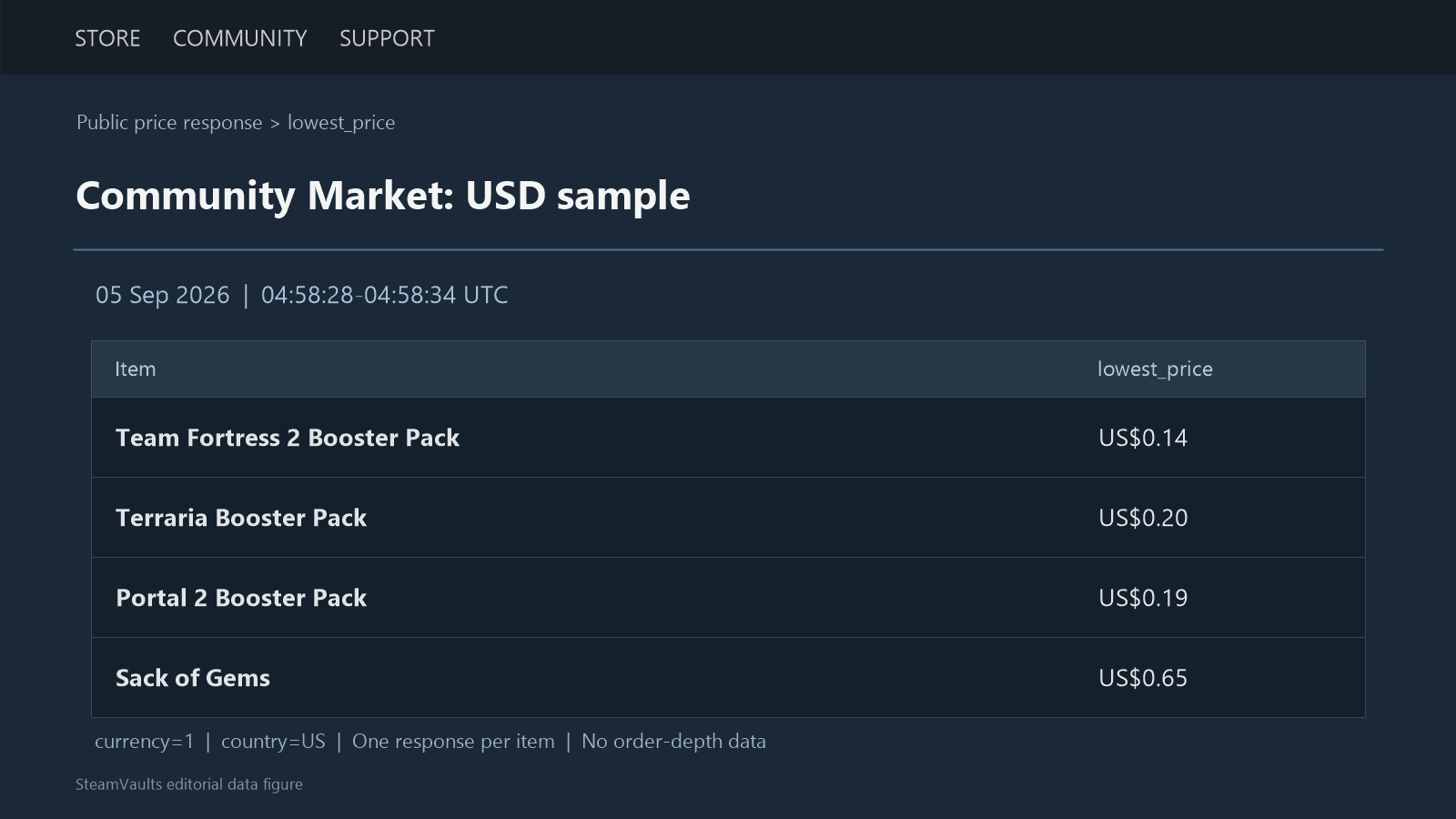
We started by checking prices. These public Steam price indicators were requested under matching conditions: US dollars, with the country parameter set to US. They aren't prices read from a Korean account or converted from a won checkout.
| Item requested | Lowest price in the response |
|---|---|
| Team Fortress 2 Booster Pack | US$0.14 |
| Terraria Booster Pack | US$0.20 |
| Portal 2 Booster Pack | US$0.19 |
| Sack of Gems | US$0.65 |
The requests were made on September 5, 2026, from 04:58:28 to 04:58:34 UTC—13:58:28 to 13:58:34 in Korea. All four returned successfully. The table reproduces their lowest_price fields.
We omitted the responses' volume and median-price fields because this check didn't establish their aggregation periods.
The items were the official Market entries for Team Fortress 2, Terraria, Portal 2, and Sack of Gems. We queried each once and executed no trades. Public responses can be briefly cached; the retrieval time isn't the creation time of every underlying listing. Check the Market again for prices when you're reading this.
These packs had different displayed price indicators at the time checked. That doesn't rank their crafting profitability. We didn't inspect account-specific Gem requirements, open the packs or collect simultaneous buy and sell prices for every individual card. Those gaps prevent a supported profit-percentage calculation.
The Team Fortress 2 pack's US$0.14 divided by three is approximately US$0.0467 per card. That's an average across the three cards received, not a price at which you can buy your missing card. If it doesn't appear, you still need to acquire it.
Track spending against the missing slot instead. A pack without H adds cost without acquiring H. Its other cards may be enjoyable or useful for another set, but record that separately from the goal of buying H cheaply.
The lowest-price response also gives no quantity available at that price. Multiplying it by ten doesn't establish the cost of ten packs. Check availability and the checkout total, especially for a larger batch; this sample supplies no quantity-at-price data.
Making a pack from Gems isn't the only way to obtain one. If a ready-made booster is listed on the Market, its purchase price is another comparison. That gives you three routes: buy the specific cards, buy a pack, or make a pack using Gems. The last two differ in how you pay for them. Neither means the card you want has been secured before you open the pack.
Gems already in your inventory still have a use
When your existing Gems cover the craft, you avoid a new Wallet payment but consume materials you could have used for another pack. I wouldn't automatically enter zero as their cost just because they came from clearing an inventory.
Nor would I treat every loose Gem as immediately spendable money. Check whether the amount can be sold, packed into a Sack or traded in its current state. Using a small balance with no convenient alternative may suit you; its alternative use isn't a guaranteed cash value. Start with the game and requirement shown in your own Booster Pack Creator.
We couldn't inspect the account-specific display while preparing this article. That is why there's no game-by-game crafting-price table or list claimed to apply to all accounts here. An amount in an old discussion isn't a verified quote from your current screen.
Valve's archived 2014 Holiday Auction page documents the Gem-to-booster function. The auction ended in 2014; we use this historical page for background, not current crafting conditions. Check available games and usable materials on your current account screen.
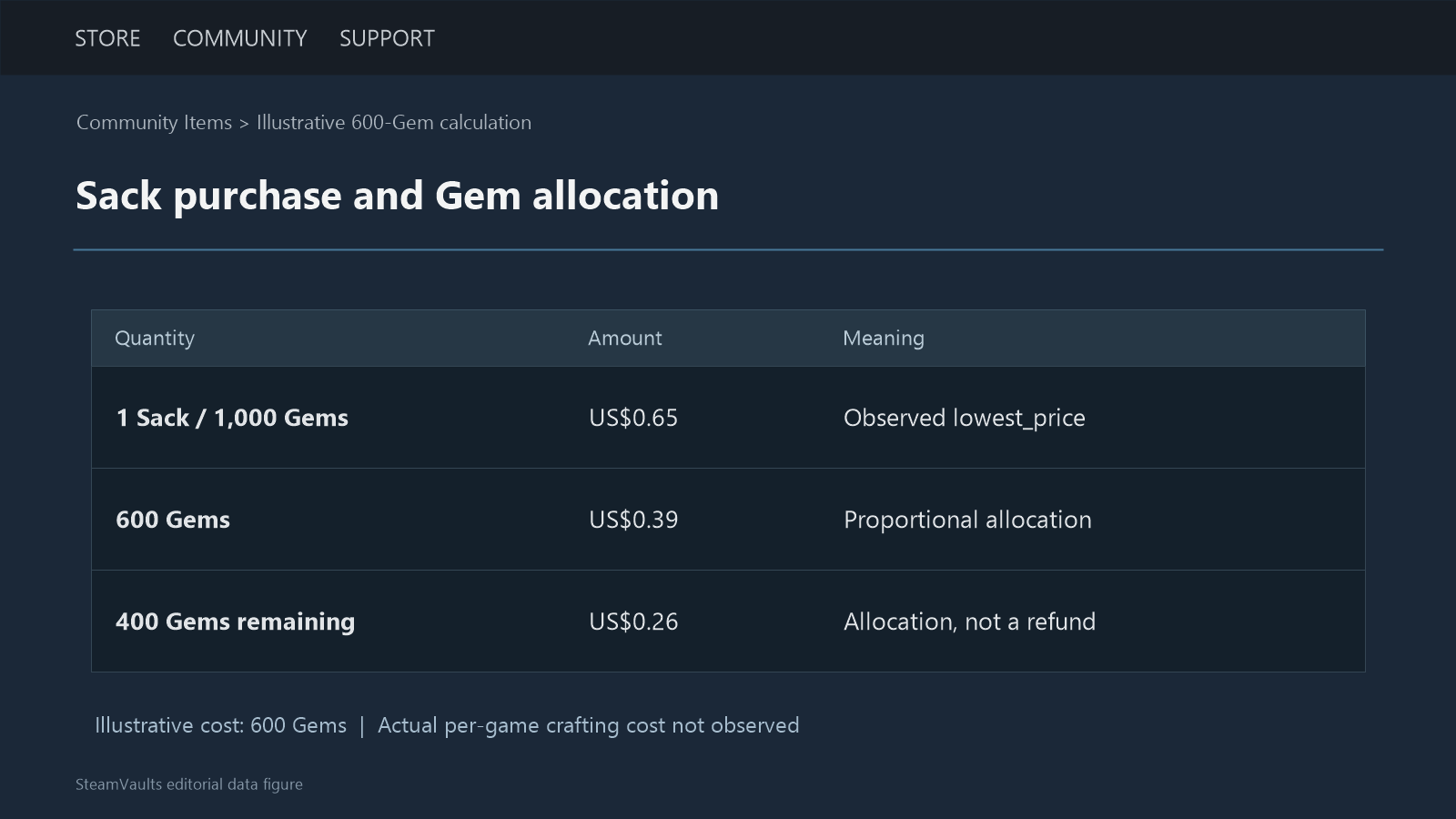
Suppose a game's creator screen asks for 600 Gems. This is a hypothetical requirement chosen for the calculation, not an observed crafting cost for any of the three sampled games. A Sack contains 1,000 Gems, as the official listing states. At the sampled US$0.65 Sack price, the share of that cost allocated to 600 Gems is 600 ÷ 1,000 × US$0.65 = US$0.39.
If you start with no Gems, however, this doesn't mean buying 60% of a Sack for US$0.39. In this example you buy a whole Sack for US$0.65, spend 600 Gems and retain 400. The US$0.65 paid and the US$0.39 allocated to this pack are different figures. The remaining Gems' proportional US$0.26 isn't money returned to you. It's an accounting share assigned to materials still in your inventory.
For the Wallet outlay today, use the whole purchase amount. For material use across several packs, the proportional allocation can help. If you only want one pack and have no use for the leftovers, subtracting their allocated value won't describe the money you had to spend.
Suppose instead that you already have 650 Gems and spend 600 on this hypothetical pack. You need no additional Sack. Nothing leaves your Wallet for that operation, and 50 Gems remain. You still used 600 Gems. “No additional payment” is accurate; “nothing spent” omits the materials. Depending on what you're trying to conserve, it can be worth recording both.
Count extra Sacks from the shortfall, not the pack's full requirement. If the example requires 600 Gems and you hold 100, you're 500 short. Adding one 1,000-Gem Sack and then crafting leaves 500 Gems. Ignoring your existing balance and assigning a whole new Sack to every pack can overstate the cost across repeated crafts. This is material arithmetic, not a formula that overrides the creator's restrictions or determines which Gems your account can use.
If separate Gem stacks or packing are the problem, use the article on Gems and Sacks. Converting more cards while trying to solve that problem changes the materials you're supposed to be comparing. Establish what can be made with the available materials before recording the cost.
Planning to sell duplicates isn't a refund
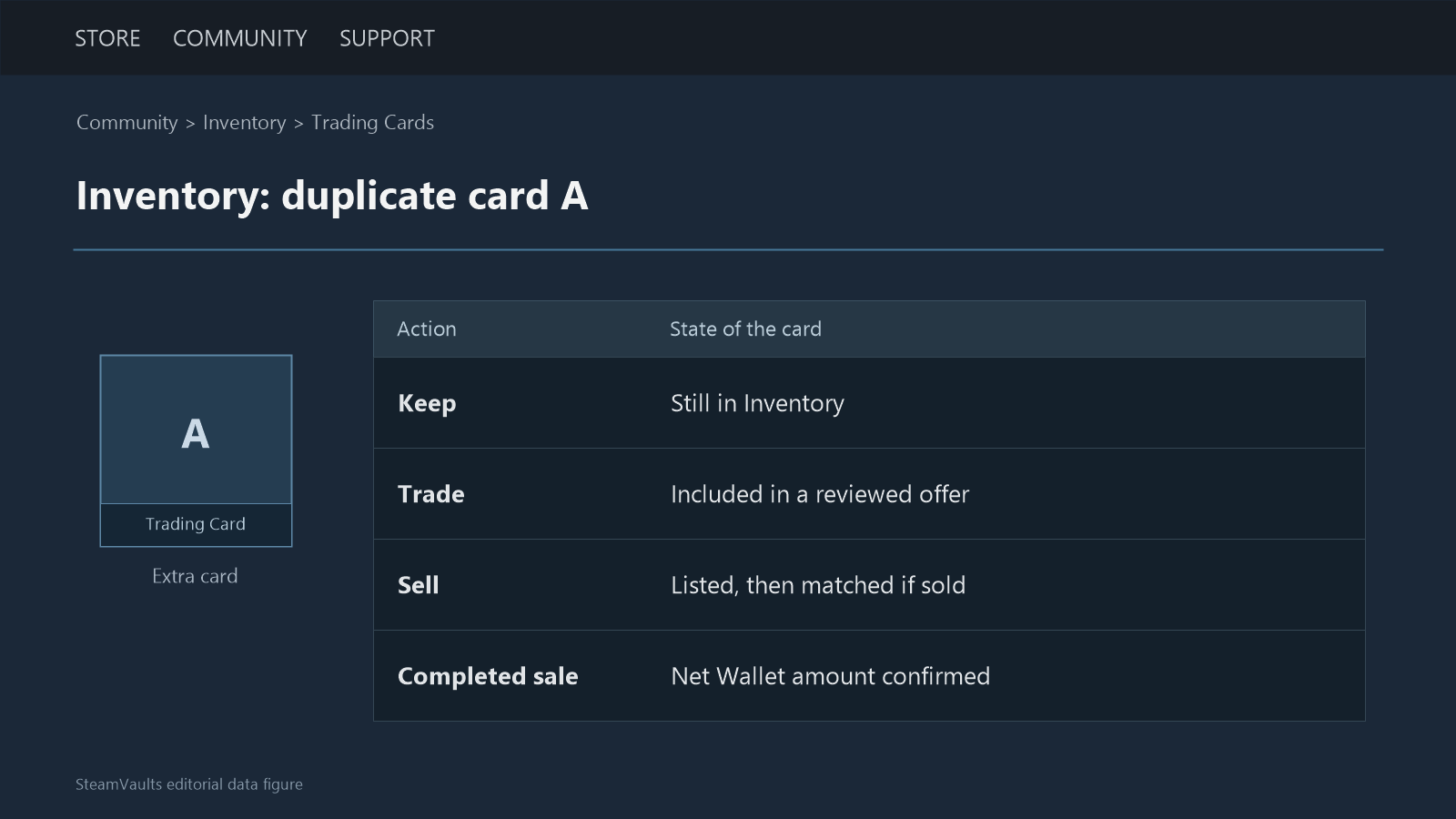
Before subtracting “I'll sell the spares” from your budget, remember what's unknown: which cards you'll get, their selling eligibility, their sale prices and the wait for a buyer. The material cost is definite; those proceeds aren't.
After opening, assess the cards you actually received. Check for the missing names first, then separate cards for this set from the spares. You can keep spares for another set you intend to make. Trading cards you and a friend each need is another option. If you have no use for them and no suitable trade, Market selling may be a route. In none of those cases does receiving the cards automatically undo what you spent.
If you sell, check whose price you're reading. The buyer's full payment isn't the amount added to your Wallet. Our Market guide's explanation of buyer payment and seller proceeds covers that distinction. For this decision, check what you'd receive and count money in your settled costs only once the sale has completed.
A listed but unsold card remains inventory. If your cost estimate depends on waiting for a high selling price, it isn't an immediate-sale estimate. That wait matters when you chose packs to finish a badge quickly; someone happy to wait can make a different choice.
A trade also requires a match. Swapping a spare C with a friend who has A can work well when both want what the other offers. An equal number of cards won't make a trade happen if the other person doesn't need yours. Seeing a friend who owns your missing card doesn't establish their agreement or terms, either. Some people enjoy arranging these exchanges. Others just want a small inventory task finished.
Sorting packs, managing listings and finding partners may not be worth a small saving on one card. You don't need an hourly-rate calculation: decide whether you enjoy those tasks or just want the badge finished.
If you've crafted a pack but haven't opened it, you have another decision left. Owning the pack isn't the same as owning its contents. Check whether that item can currently be traded or sold, then decide whether to keep or open it. You aren't obliged to follow the goal you had when you crafted it. If the cards no longer interest you, having already spent the Gems isn't a reason by itself to continue to opening.
It's also worth checking whether you still want to make the badge. If you wouldn't use it on your profile, you can choose not to spend on the final card at all. The article on whether to use a complete card set for a badge addresses that next decision separately.
What if nobody is selling the card?
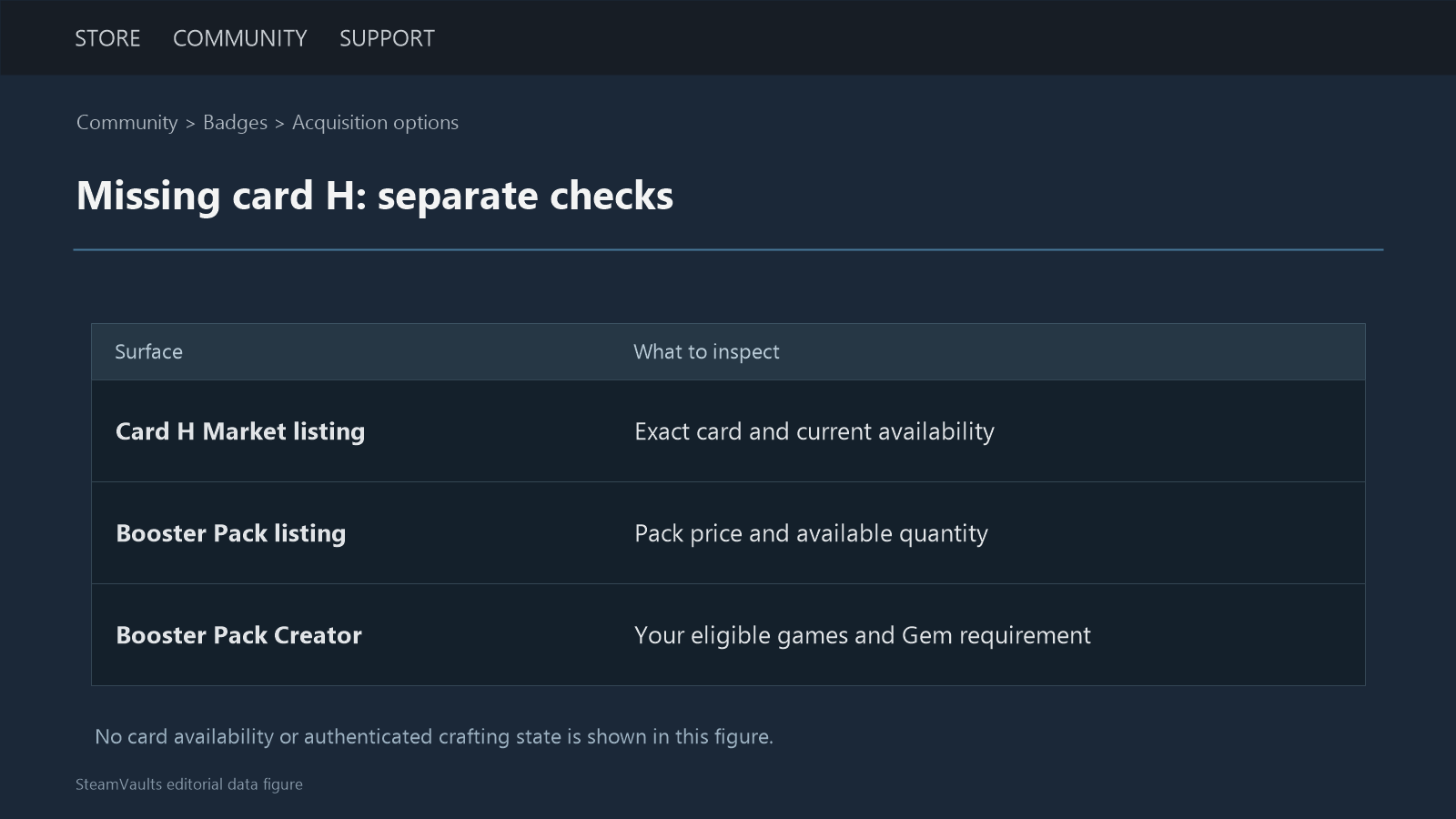
Checking a specific card first doesn't mean one will always be for sale. With no sellers, or with an item that rarely changes hands, a price comparison can't finish the job. A single expensive listing can also make buying immediately unattractive. Crafting then becomes a question of which route is available to attempt, not simply which price is lower.
An empty search result alone isn't enough to declare the card unobtainable. Start with its exact name on the badge page, and distinguish standard from foil. Check that searching a translated card name or just the game title hasn't led you to the wrong results. Reading the search correctly doesn't create inventory, though. If there is still no seller, that's the state you have to work with.
Check separately whether your current creator screen offers the game. An absent Market card doesn't automatically create a crafting option. Nor does the Market's stock establish what your account may craft. We didn't inspect a logged-in account's list, so this article cannot guarantee that any particular game is available to everyone. If you can't establish the displayed conditions, leave that route's cost out of the comparison rather than guess.
When crafting is available and directly buying the card is difficult, trying packs within a limited budget can be a reasonable choice. Set the stopping point before opening. A card having been hard to find for a long time doesn't guarantee that several more packs will solve the problem. Scarcity may give you a reason to try; it doesn't supply an upper bound on what completing the set will cost.
If the booster itself is listed, compare its purchase price with the crafting route. Neither route guarantees the original card. You can also stop without buying a pack if you might arrange a direct trade or prefer to check the Market later. A hobby without an immediate deadline doesn't require a decision today.
A blocked creator screen isn't a reason to send Gems to a stranger who promises to craft for you. Trading for a card whose identity is known differs from sending materials first and waiting for an unresolved outcome. Filling a small gap needn't become a transaction that also depends on an unfamiliar person's promise.
Choose the limit before you open anything
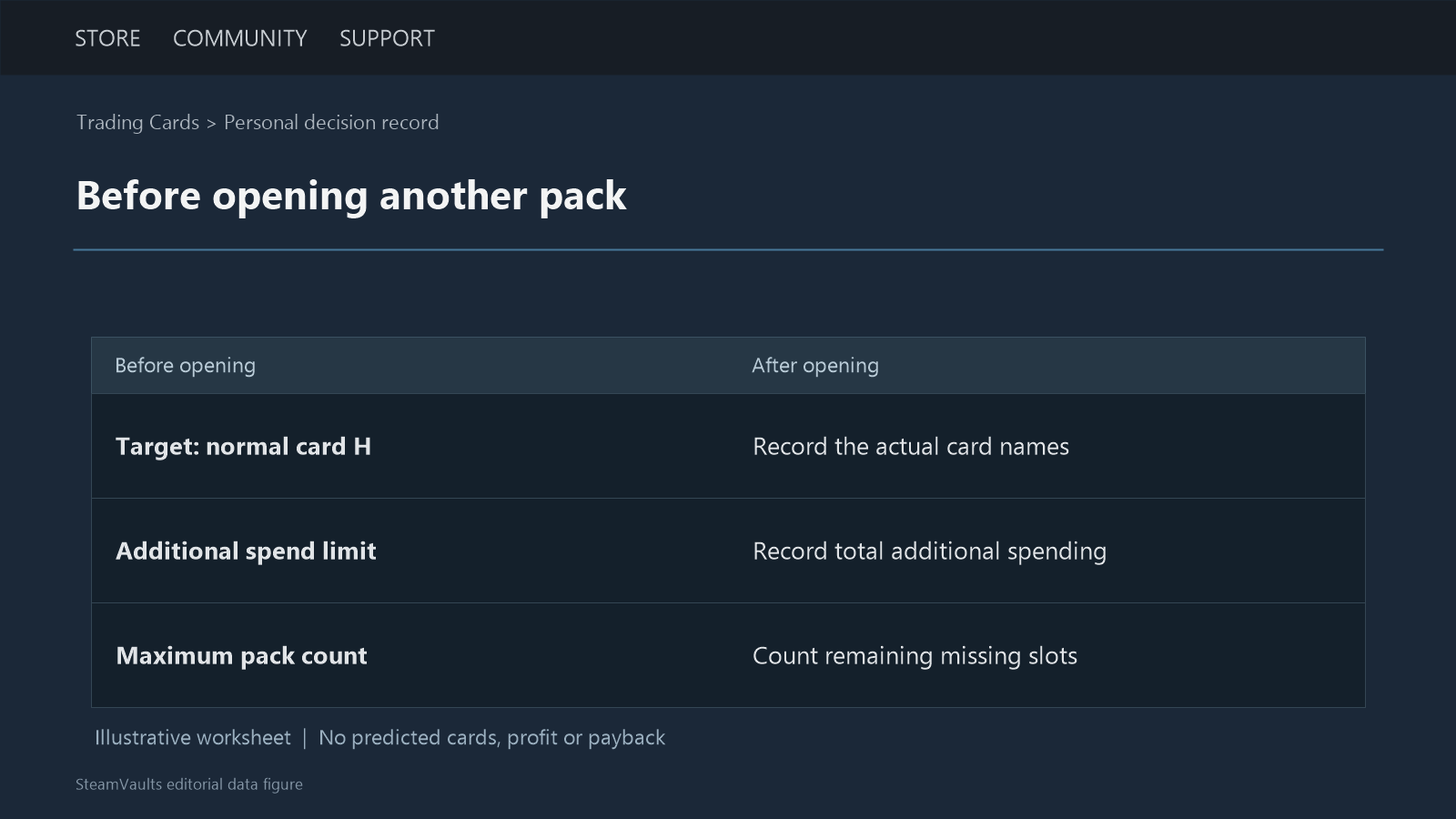
If you want to finish one badge promptly, the useful record is short. Put the missing names, their current direct-purchase total, the Gem requirement displayed on your account, and any extra material purchase in one place.
Leave an unverified crafting cost blank instead of using an online average. A confirmed direct-purchase price may already be enough to choose.
If you'd like to open packs, add a spending limit that still applies when the wanted card doesn't appear. Use a unit you can track: a quantity of Gems, for example, and whether any additional Wallet purchase is allowed. Continually raising the limit after looking at another pack defeats its purpose. If you decide to spend more because you're enjoying the openings, recognize that as extra entertainment spending rather than a reduction in the badge's cost.
Don't count every received card as the same kind of success. First record how many gaps in this badge were closed. Mark the spares as kept, intended for a trade, or intended for sale. Keep hoped-for sale amounts apart from money actually received. What earlier packs cost doesn't create a requirement to open the next one. Its contents are still unknown.
If you own few cards and enjoy collecting the different pictures, a pack may be spending you're happy with. If one empty slot is simply bothering you, buying the card itself may be more comfortable. Using up spare Gems can also be a goal, but continually buying new Sacks to eliminate leftovers moves away from clearing your inventory. Leaving some Gems alone is an available choice.
The four observed prices are a reference, not a recommendation to craft or buy any particular pack. Check your own currency's purchase screen and available materials before spending. If you still prefer opening a pack to buying the last card, decide now what you'll do if it doesn't appear—stop, buy the card or spend more within the limit you've already chosen.
Ready to sell supported Sacks of Gems?
After the bot confirms receipt, USDT is credited to your site balance. Polygon withdrawal is a separate request.