


Steam Wallet Funds Missing? Check the Transaction
A top-up looks complete, or a Market item has sold, but the money isn't available. Use receipts and transaction history to separate missing Wallet funds from pending sale proceeds.
Article languages
On this page
- Where was the money coming from?
- For a completed top up, check the account on the receipt
- A charge on your card is not a Wallet credit
- The item sold, but the proceeds are pending
- Include money spent since the transaction
- Avoid creating another transaction while checking this one
- Send Support the story of one transaction
Your card provider sends a payment notification, yet your Steam Wallet hasn't changed. Or an item has disappeared from your inventory and you've received a sale email, but Steam says you don't have enough funds for the game you wanted. Both feel like missing money. They start with different records: the Wallet purchase receipt for the top-up, and the Market transaction history and any hold notice for the sale.
There isn't one waiting period that covers top-ups, Market sales and refunds. Before waiting any longer, identify which transaction you're following. Otherwise you could be checking the wrong account—or waiting for a bank authorization to become a Wallet purchase that never completed.
Pause any additional top-up and look at the transaction that already happened. The records you have can help establish how far it progressed.
Where was the money coming from?
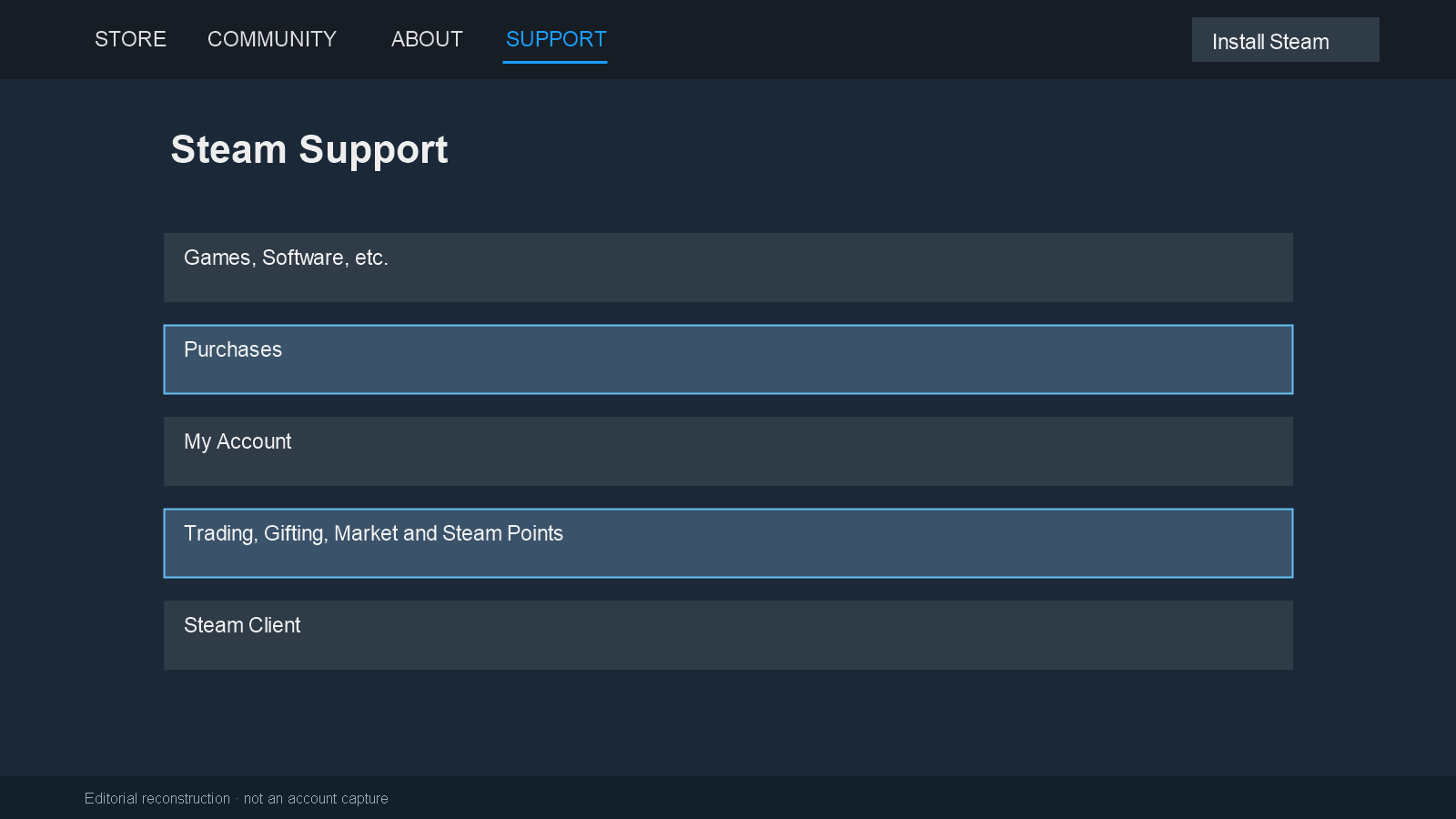
The balance alone can't tell you where the money has stalled. Even within the same account, a direct top-up, proceeds from an item sale and an approved refund begin as different transactions. Start by recording what you did and how much you expected to receive afterward. Did you use Add Funds, list an item on the Market, or receive a refund approval email?
For a direct top-up, find the purchase in your Steam receipt and purchase history. For a Market sale, check whether the transaction history actually records a sale. Confirmation that you created a listing is different from confirmation that another user bought the item. If you've only confirmed the listing, there may be no sale proceeds to receive yet. Refreshing your Wallet would mean watching the wrong part of the process.
Valve says your Community Market history is available from the Market homepage and from Account Details in the Store. It also emails a receipt for each transaction. Match the time and amount as well as the item name so that you don't pick a different sale of the same item. Steam Community Market FAQ
For a refund, check the destination in the approval notice. Money being returned to the original payment method won't appear in your Wallet. Our guide to whether Steam refunds return to your card or Wallet covers that process, including timing; those timings don't apply to a top-up or Market sale.
If you're unsure which transaction you have, read the notification again. Payment authorized, purchase completed, listing created, item sold and refund approved aren't interchangeable descriptions. If the title doesn't settle it, find the corresponding record while signed in to Steam. Rather than following a link because an email address looks familiar, use your usual Steam client or open the support site directly and compare the records there.
If you can't find a record, say that in your support request. “I couldn't find the receipt” leaves the outcome unconfirmed; “Steam shows that the purchase failed” reports a failure notice. Neither a missing receipt nor a bank notification establishes whether the Steam purchase completed.
For a completed top-up, check the account on the receipt
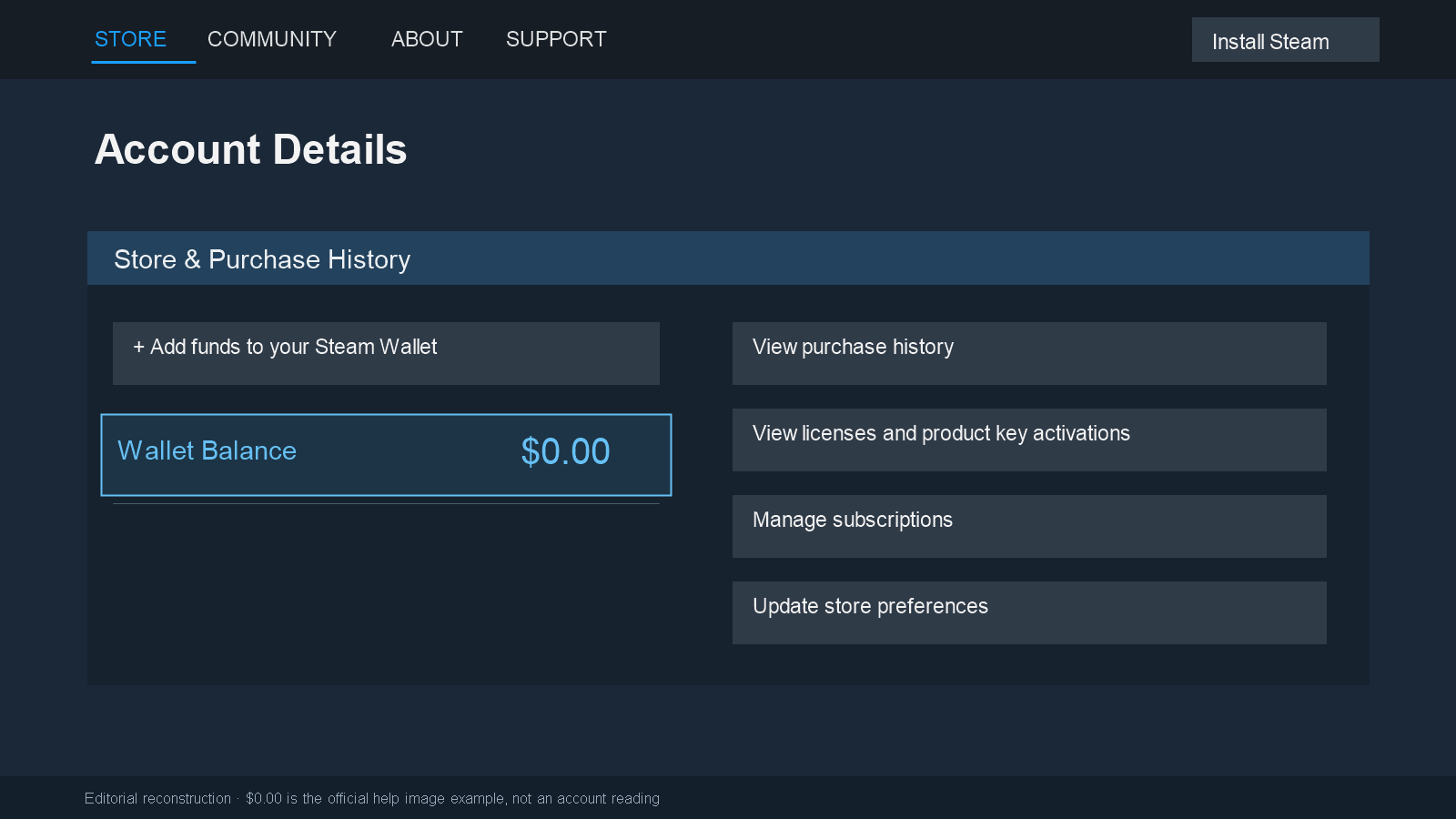
Steam's Wallet FAQ gives a practical sequence: check the emailed receipt to confirm that the purchase completed, check that you're signed in to the purchasing account named on that receipt, then restart the Steam client on your computer. If the balance is still incorrect more than 2 hours after the purchase completed, it directs you to Steam Support. Steam Wallet FAQ
This account check matters if, for example, you added funds in a browser but are checking the balance in the client. Compare the account information on the receipt with the account currently signed in. A familiar avatar or display name isn't enough, and the owner of the payment card doesn't determine which Steam account received the funds.
If the accounts differ, check the transaction and balance in the purchasing account first. Before reporting an incorrect balance display, establish where the purchase was recorded. Don't assume you can move the balance afterward. The purpose of matching accounts is to find the purchase, not to find a transfer workaround. The separate question of moving Steam Wallet funds to another account belongs in its own guide.
Once the receipt and account match, close and reopen the client. If the balance is still incorrect, include that result when you contact Support. If a restart fixes the display, it doesn't tell you which server or payment process caused the delay; this is a check Valve recommends, not a diagnosis.
Measure the 2 hours from purchase completion, not from the first press of the payment button. Restarting doesn't start the clock again. Keep the receipt's completion time and the current time, with their time zones if they differ. Around midnight, “I paid yesterday” can be much less useful than the actual timestamp.
Be careful not to turn this threshold into a promise that funds always arrive within 2 hours. The document gives a sequence of checks and a point for contacting Support. It does not guarantee settlement times for every payment method or say that a bank authorization hold must clear on the same schedule. If a completed Steam purchase hasn't been confirmed, examine the payment state in the next section first.
With a completed purchase, matching account and unchanged balance after restarting, you have enough to describe the discrepancy. Leave the diagnosis to Support; you don't need to decide whether it's a payment-network error or an account bug.
A charge on your card is not a Wallet credit
An amount appearing in your bank or card app doesn't establish that Steam completed a Wallet top-up. Check whether the provider describes it as a pending authorization or a finalized charge. Apps use different wording; a color or notification sound won't make the distinction for you. If Steam displayed a failure but an amount remains on the card side, investigate a possible authorization hold before deciding the records contradict each other.
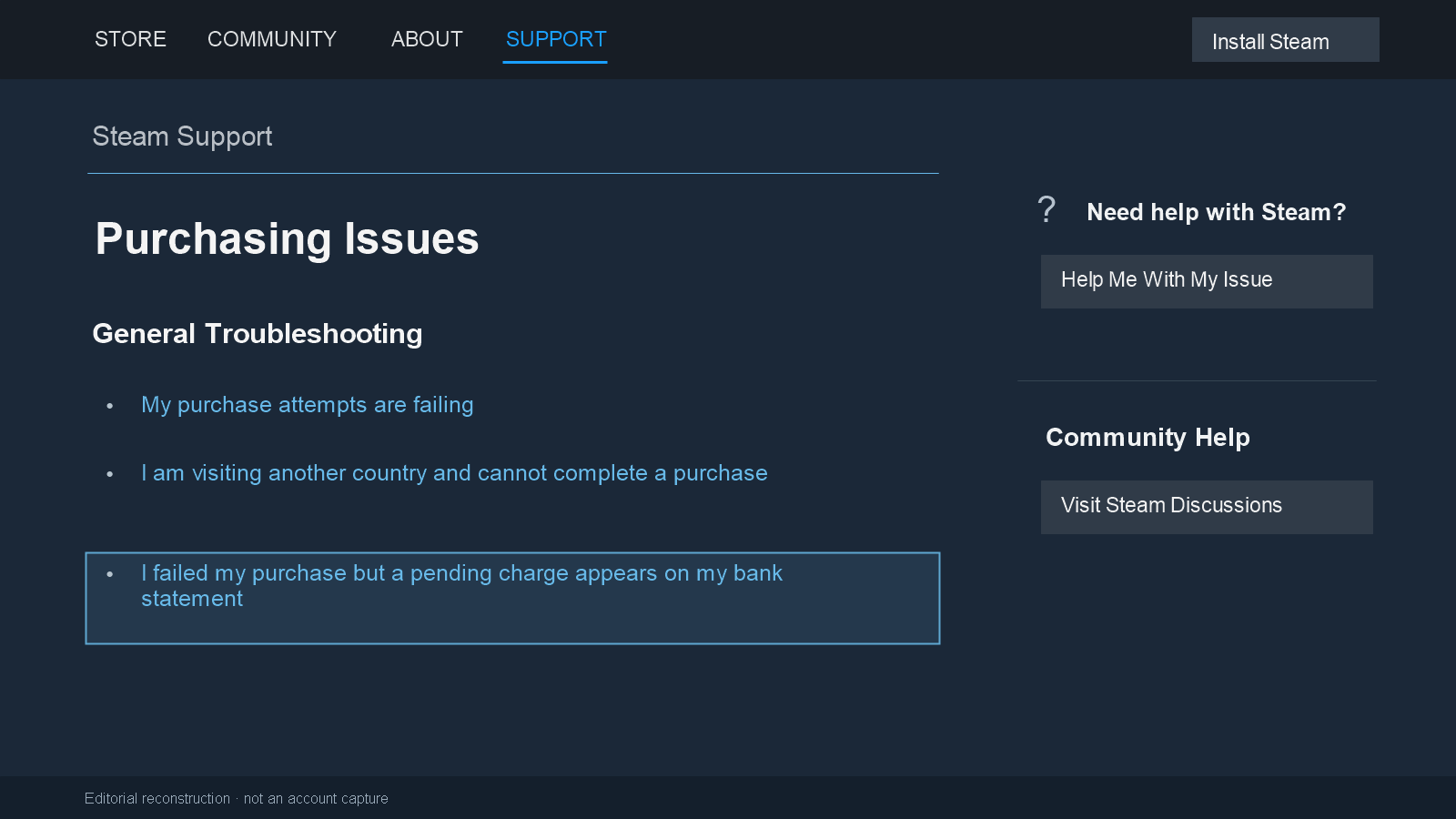
Valve's purchasing guidance explains that a bank can temporarily hold funds when an attempted purchase fails an address or card security-code check. Steam says it declines transactions that fail those checks and will not collect the money the bank has held. The page says release can take up to 30 days, depending on the bank's procedures. That explanation concerns those failed transactions. It isn't the normal arrival time for a successfully completed Wallet purchase. Steam Purchasing Issues
You can ask about the hold before those 30 days have passed.
Ask the bank what state the entry is in and how it handles authorization releases. The question for Steam is whether the purchase completed and which transaction a failure record refers to. Two organizations may be displaying different stages of the same payment. Telling both only that your money hasn't arrived can miss the distinction you need them to check.
An authorization can still reduce your available card balance or spending limit even though Steam hasn't collected it. Tell the bank if that's preventing another purchase. The held amount isn't available in your Steam Wallet, so you need the issuer to explain its status and release process rather than treating it as a completed top-up.
Record the currency with each amount. Your card statement may show a conversion or separate fees, so an amount calculated from an expected exchange rate could lead you to the wrong Steam transaction. Keep the original payment amount, currency and time beside the Steam record; add the card provider's converted amount separately. Check the statement before attributing a difference to an exchange rate or fee.
If you tried paying several times after a failure notice, count the entries individually. Identical amounts don't tell you whether one transaction is displayed twice or whether you made several attempts. List how many top-ups Steam shows as successful, how many attempts produced a failure notice, and how many entries remain with your card provider. Match transaction identifiers where available, then ask about whatever still doesn't reconcile. Until then, neither declare it a duplicate completed charge nor dismiss everything as a temporary hold.
If you find an error in the address or card details you entered, correct it only in the official checkout flow. Community replies and private messages are not places to send card details for verification. Don't put your full card number or security code in an initial support request either. Information that identifies a transaction serves a different purpose from information that could authorize a payment.
The item sold, but the proceeds are pending
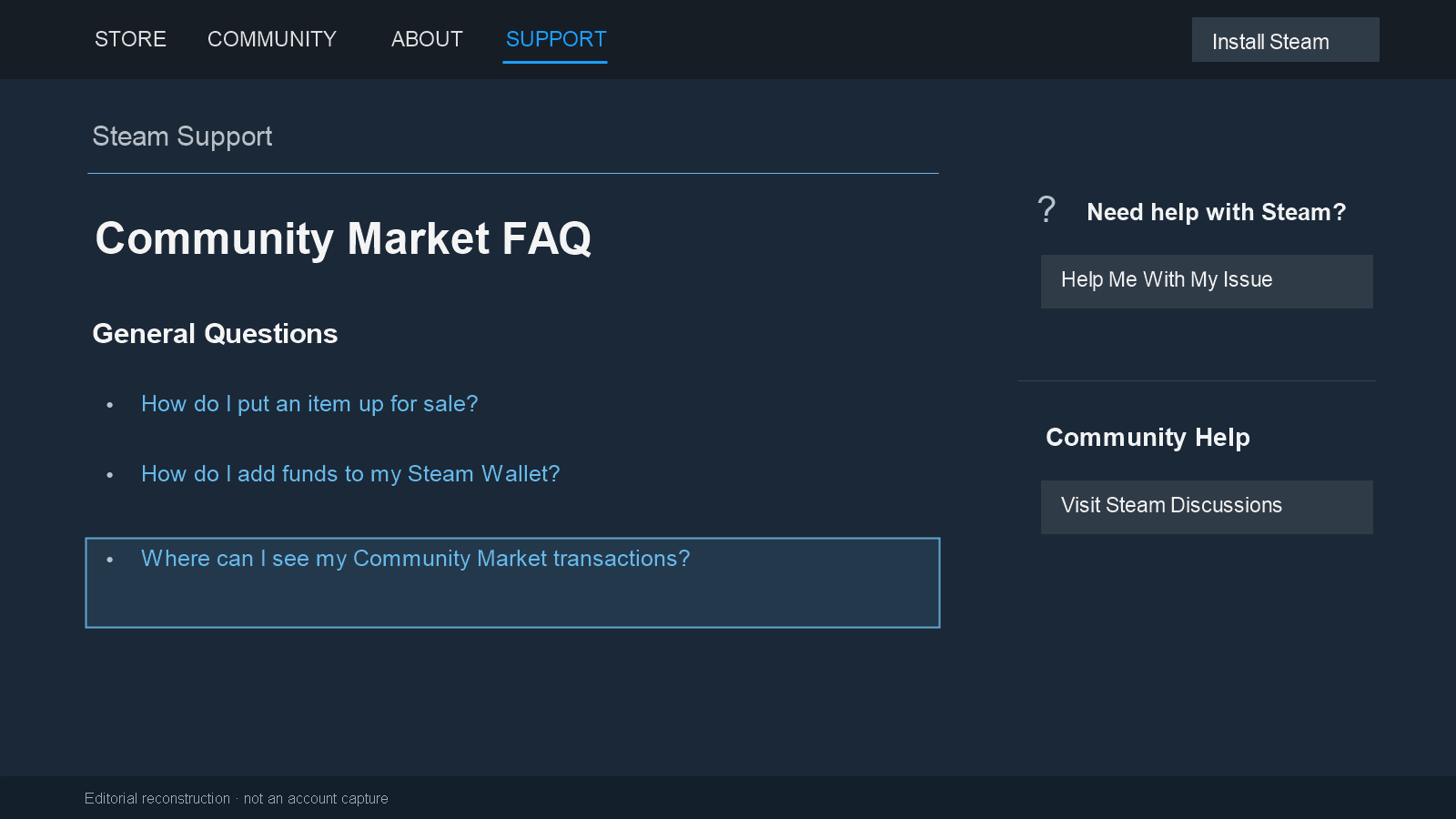
After a Market sale, don't rely only on the item disappearing from a list. Look for the sale in your transaction history. A listing that you removed, or one whose state changed for another reason, cannot simply be counted as sold. If you find a sale record, compare the amount you receive with its email receipt, then look for a pending notice in the Wallet or the information attached to that transaction. At this stage, you're tracing the money's status, not researching the item's price.
A recorded sale and immediately spendable proceeds need to be read separately. If your own screen labels an amount as pending, don't add it to the available balance when planning a purchase. Seeing a pending amount doesn't tell you every reason for the hold. It does let you describe something more specific than a sale with no trace of its proceeds.
Read the notice attached to your transaction first. I couldn't verify a universal release time for sale-proceeds holds in the public Market FAQ. A report that another user received funds after a day doesn't establish when yours will arrive. Search results for “Steam pending funds” also mix top-ups, refunds and item sales, so check which transaction each answer concerns.
There is a dated record worth distinguishing from policy. In a Steam discussion on September 14, 2024, a user reproduced an email describing an unusual sale price and a hold of up to 5 days. The reproduced text also mentioned a possible transaction reversal. This is a historical email transcribed by a user, not a Valve announcement covering all present-day transactions, and not data observed in this article. It illustrates why a sale-completion message can have a separate condition attached to its proceeds; it does not predict your release time. The dated Steam discussion
Keep the wording of any remaining-time or expected-release notice. If it changes, note when you saw each version. That documents the display, not Steam's internal review decision. The evidence here doesn't establish a percentage-price threshold or any other formula for Steam's undisclosed detection criteria.
If your current notice explicitly says Support cannot accelerate the process, don't assume repeated tickets will move you ahead. That doesn't mean a discrepancy in the records should go unreported. If you cannot locate the sale, the balance conflicts with the notice, or you identify a sale you did not make, those facts belong with official Support. Asking to hurry a release and asking someone to investigate a transaction mismatch serve different purposes.
If the item has not sold and the listing itself is on hold, this is not a sale-proceeds hold. Use the guide to trade holds and Market listing holds instead. Sharing the word “hold” doesn't make them one countdown. The sources checked for this article also do not establish that resetting your authenticator releases pending sale proceeds.
Include money spent since the transaction
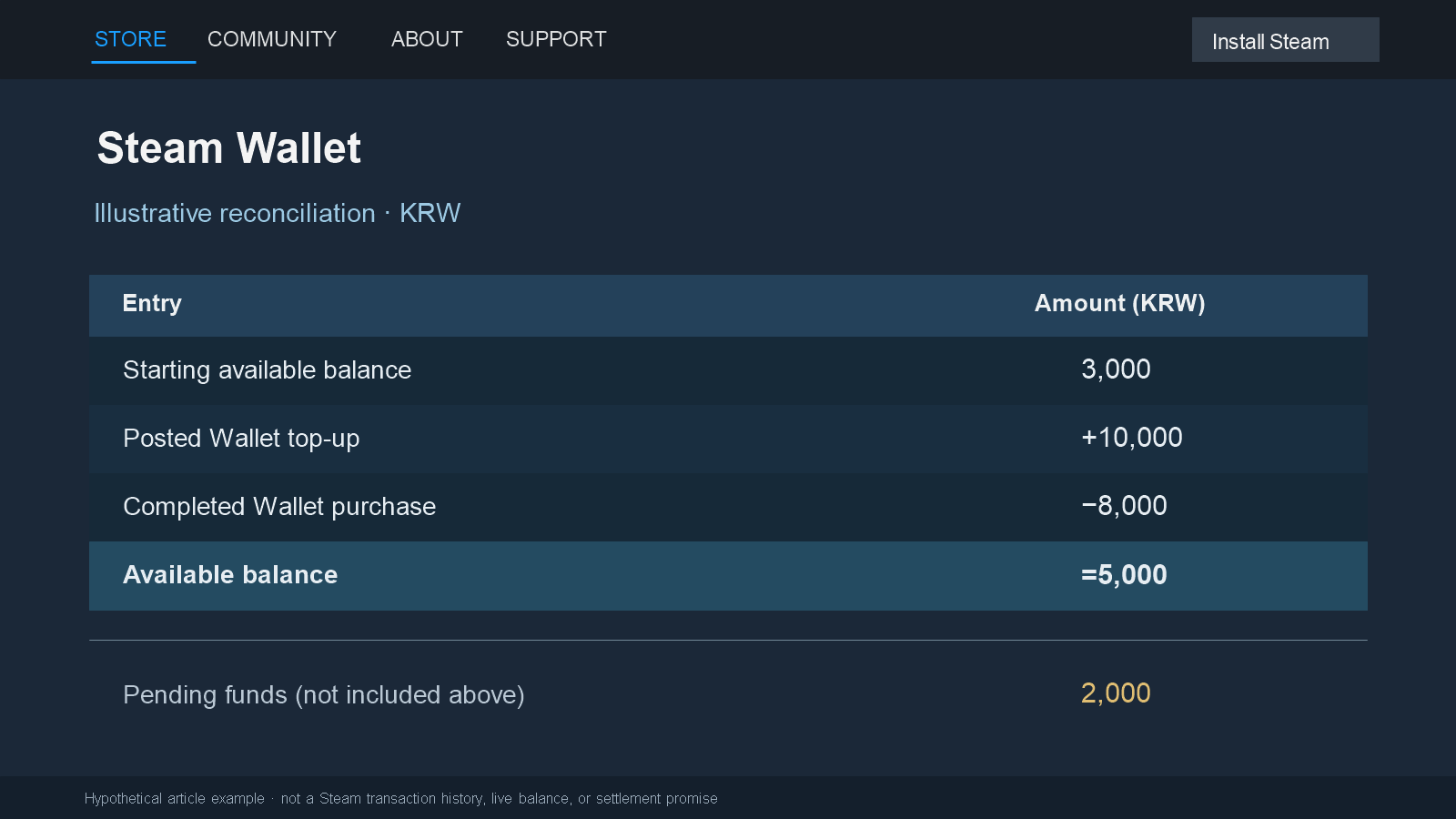
To establish whether money arrived, choose a starting point for the comparison rather than simply subtracting the expected amount from today's balance. If you know the available balance immediately before a top-up and there were no later transactions, the comparison is simple. If you bought a game and sold items in the meantime, include those records. An incorrectly remembered opening balance makes the calculation wrong from the start. Separate a balance confirmed by a record from one you only remember.
These amounts are hypothetical. They aren't observations from an account or the Market.
Suppose you started with KRW 3,000 available, a KRW 10,000 direct top-up became available, and a later game purchase used KRW 8,000 from the Wallet. Separately, KRW 2,000 in Market sale proceeds is still shown as pending. Under those conditions, your available balance is KRW 5,000. Expecting to spend KRW 7,000 immediately would create an apparent KRW 2,000 shortfall by including money that is still pending.
That KRW 5,000 balance still leaves the Market sale pending. A plausible total doesn't settle every transaction, especially if a top-up and a sale have the same amount. Even a later KRW 2,000 increase wouldn't, by itself, prove that this sale's hold ended. Check the sale record as well as the total.
For Market reconciliation, use the amount the seller receives rather than the buyer's total payment. Comparing a fee-inclusive price screen directly with a Wallet increase can make money appear missing when it wasn't due to you in the first place. Our guide to Steam Market fees and the amount you receive handles the fee calculation. Here, take the receipt's net amount and compare that. Don't combine different currencies into one total either.
Don't overlook purchases completed in the meantime. In addition to games you deliberately checked out, look for completed transactions in your Market purchase history. A buy order appearing in a list and a purchase actually completing are different events. For this calculation, use actual spending from completed transactions, not an expected purchase or an order's maximum price. Questions about order priority or a disappearing order are covered separately in why a Steam buy order hasn't filled.
If the reconciliation uncovers spending you didn't authorize, you have moved beyond a straightforward balance check. Tell official Support clearly that the transaction wasn't yours and raise it as an account issue. Don't accept a private offer to restore your balance if you first send somebody more money or items. Calling that payment part of a recovery process doesn't provide a reason to make it.
Avoid creating another transaction while checking this one
I wouldn't make a small second top-up to test whether the system is working. Success wouldn't explain the first purchase, and failure would leave you with another transaction to investigate. Reusing the same amount also makes receipts harder to match. Work from the original records before deciding to spend again.
Selling another item to see whether its proceeds arrive immediately has a similar weakness. It isn't a like-for-like experiment: the item, transaction and buyer have changed. An apparently normal second sale doesn't establish that the first hold is an error. Selling more items because you urgently want to buy a game is a separate spending decision. I wouldn't present it as a troubleshooting step for the original sale.
Be especially cautious with advice to change your Steam country or security settings to release pending money. The official top-up guidance checked here covers the receipt, account, client restart and contacting Support. It doesn't justify expanding that sequence into changes to your whole account setup. A restriction on using the Market and a wait to use sale proceeds involve different records. Applying restriction-removal steps indiscriminately can make the diagnosis harder.
Keep a short record of the checks: when you restarted, the original notice, and any changed wording. Use the original transaction, current state and unexplained difference to describe what you're seeing. Repeated screenshots of an unchanged page add little.
Separate material for a public post from material for a private support request. If you ask a community for help, don't post an unredacted receipt containing account names, email addresses, full transaction identifiers or payment information. Send materials requested by official Support through that private channel. If a Wallet code is involved, there is no reason to publish the full code in a discussion. An offer to check it for you is not a reason to hand over your login or an authentication code.
If the confusion also concerns what a Wallet balance can buy or where it can be withdrawn, read the distinction between Steam Wallet funds and cash withdrawals. This article traces transactions that should be recorded in the Wallet. It doesn't offer a route to turn pending money into external cash or move it through another wallet.
Send Support the story of one transaction
A support request should identify the transaction and explain the discrepancy. Say whether it's a direct top-up or a Market sale, provide the record that locates it, and describe what you see after the checks above.
For a direct top-up, the sequence can be simple. Give its completion time, currency and amount, then state whether the receipt's account matches the account signed in. If the balance remains incorrect after restarting and more than 2 hours have passed since completion, say so. Mention any subsequent Wallet spending that helps explain the difference. This is not a script to copy regardless of your circumstances. Use only the facts you've actually checked.
Without a completion receipt, use the card provider's time and amount, the success or failure notice in Steam, and whether you found the purchase in Steam history. Mark completion as unconfirmed instead of filling in a template that says it succeeded.
For a Market sale, don't stop at the item name. You may have sold that item more than once, so include the transaction time and the amount received. Separate a sale shown as completed in the history, funds shown as pending in the Wallet, and conditions contained in the email. If your current notice includes an expected time, pass on its wording and when you checked it. If it doesn't, say that. If actual spending since the sale still leaves an unexplained difference, show that difference.
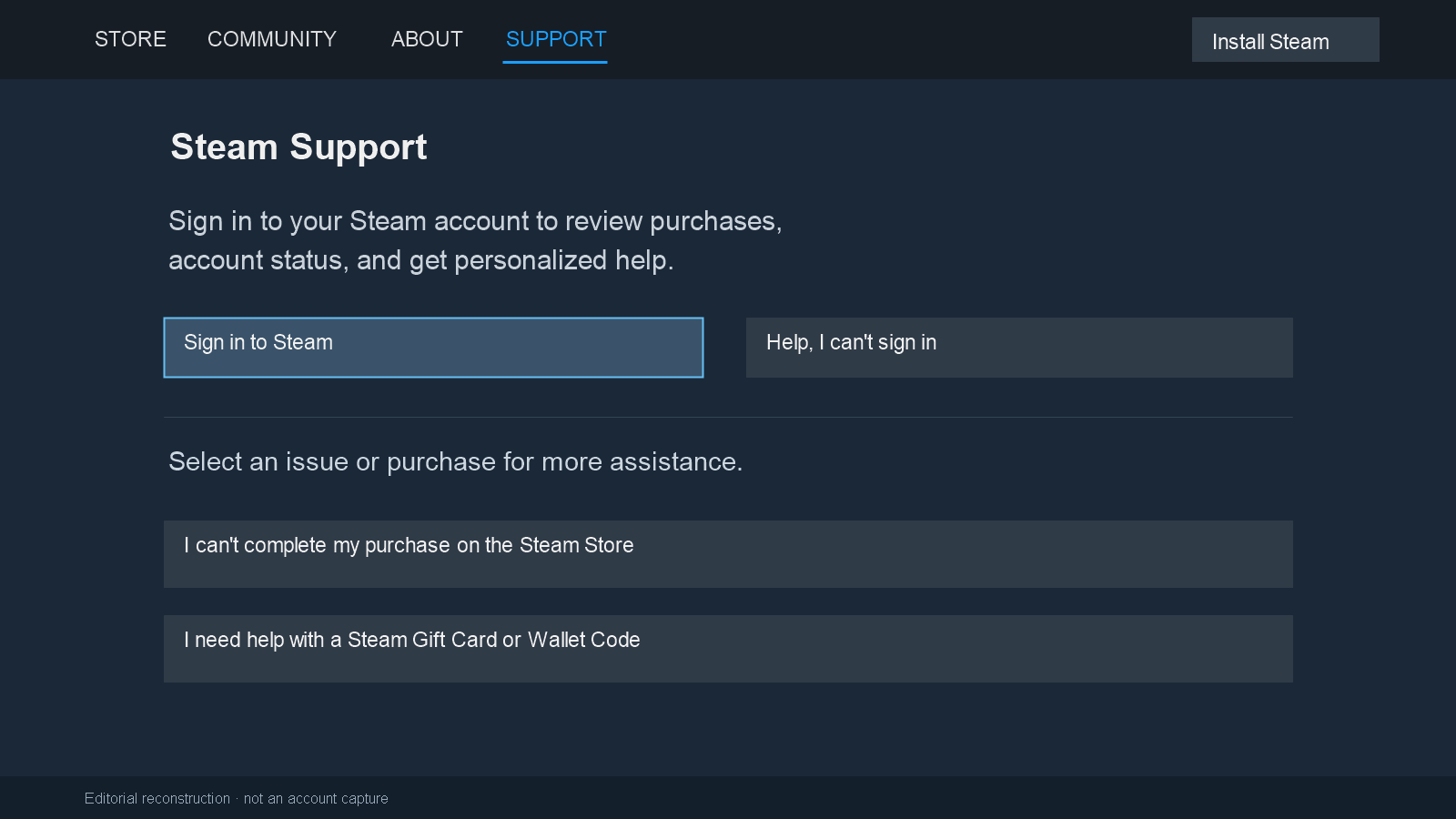
Sign in through Steam Support and follow the path appropriate to that purchase or problem. A user replying in a public discussion isn't a support agent with access to your payment records. When an email response arrives, it is sensible to open the support page directly and confirm that the same request and reply appear there rather than trusting a new message's link alone.
After submitting, add relevant changes: the balance appearing, an updated hold notice, or a new record that appears to show a cancellation. There's no response-time or resolution guarantee in this article.
Sources were checked on September 5, 2026. Valve documents the checks and support threshold for a direct top-up. The public evidence examined here doesn't establish a universal release time for pending Market sale proceeds; for those funds, retain the notice attached to your own transaction.
Ready to sell supported Sacks of Gems?
After the bot confirms receipt, USDT is credited to your site balance. Polygon withdrawal is a separate request.