


Steam's recent and overall reviews disagree. Which should you trust?
Recent and Korean-language reviews checked in three Steam store pages' public HTML, plus research, recent/overall calculations and what to read before buying.
Article languages
On this page
Good overall reviews and bad recent ones can make you hesitate at the buy button. Was this a good game that has since gone wrong? And if the overall reception is poor but recent reviews are better, does that mean it's safe to buy now?
I'd start with recent reviews when deciding what to buy. If you're about to play for the first time, today's problems matter.
But blaming every difference on an update is a mistake. The language may differ, or the review list and the score above it may cover different groups. For this article, we checked the recent and Korean-language summaries in three Steam store pages' public HTML. We'll look at whether those summaries can be compared on the same terms, with fictional calculations you can check yourself.
The same page can show different groups
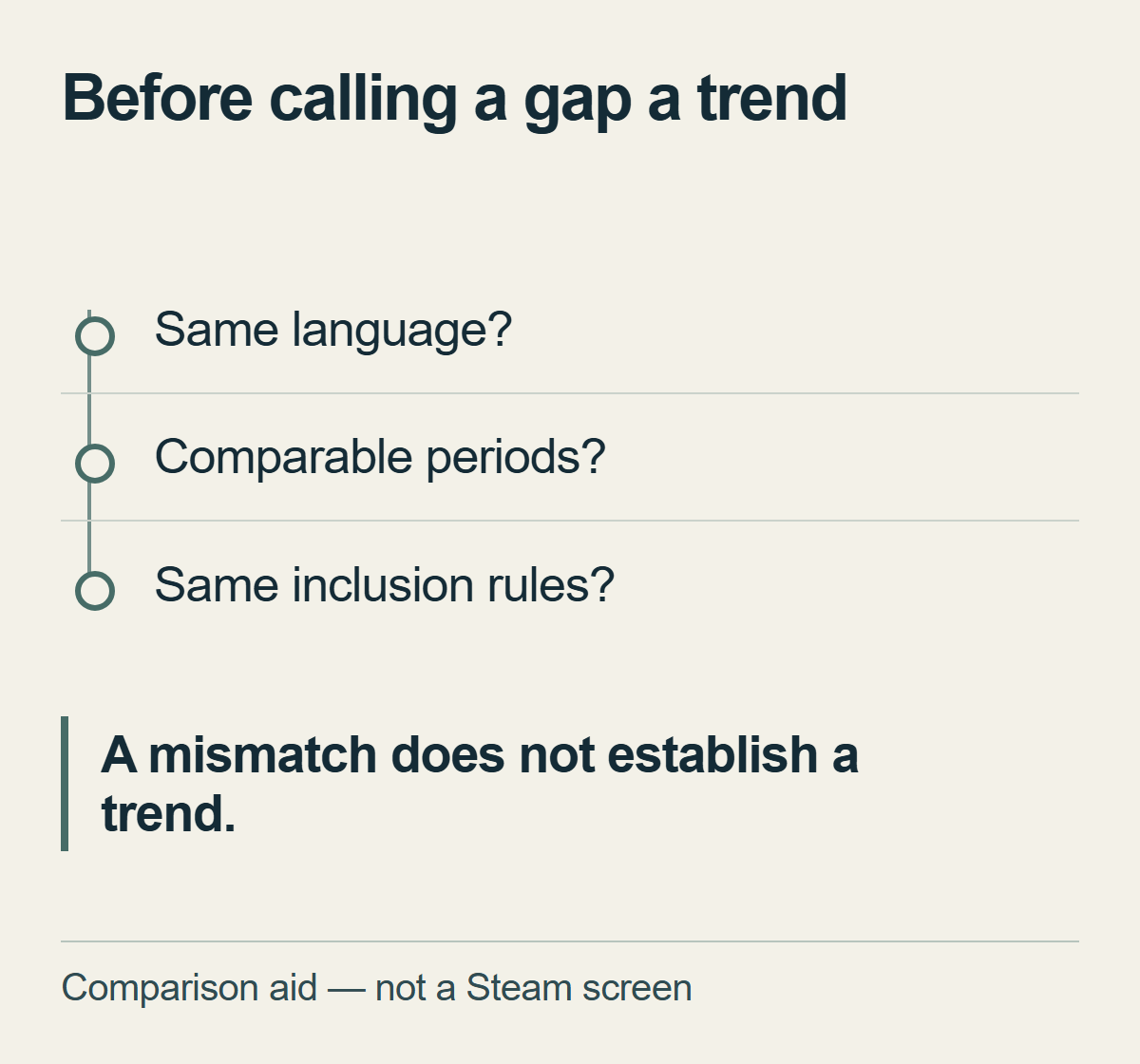
A comparison diagram. The actual figures and observation times are in the table below.
On September 12, 2026 in Korea, we sent HTTP requests to three Steam store pages without login credentials and saved the returned HTML. The times below are when each response finished arriving, in Korean Standard Time (KST, UTC+09:00). They aren't simultaneous observations or the times Steam calculated its summaries.
| Game · response received in full (KST) | Recent reviews · last 30 days | Korean-language reviews |
|---|---|---|
| Stardew Valley · 00:06:55.356 | 7,066 · Overwhelmingly Positive · 97% | 32,234 · Overwhelmingly Positive · 98% |
| No Man’s Sky · 00:06:56.014 | 2,476 · Very Positive · 92% | 2,657 · Mostly Positive · 75% |
| Balatro · 00:06:56.430 | 1,559 · Overwhelmingly Positive · 97% | 2,216 · Overwhelmingly Positive · 97% |
Sources: Stardew Valley, No Man’s Sky, Balatro. The percentages came from tooltip-description attributes in the saved HTML, not a browser capture of an open tooltip. These summaries didn't establish the language scope of recent reviews, the start date of the Korean-language group, or the count, percentage and category for overall reviews across all languages.
The two No Man’s Sky percentages differ by 17 percentage points. That doesn't show a 17-point improvement in Korean-language reviews. To investigate change, we'd need two periods with consistent language and inclusion rules. This table doesn't provide that comparison.
Before choosing a number to trust, decide what you want to know: the response over the game's life, the reaction lately, or the experience in the language you'll use. Those questions may sound similar, but answering them takes different information. A familiar label cannot supply a condition the data never stated.
Steamworks describes the store's review periods as the last 30 days and the product's lifetime. Steamworks user review documentation
We chose these three games to explain how to read the summaries, not to estimate how many games have good or bad recent reviews. All three recent summaries fell into positive categories; that doesn't establish that most Steam games are being received well. Nor did we run the games or measure their performance.
“Korean-language reviews” needs care, too. Steam's review data documentation defines language as the language the author specified for the review, not their country of residence. Calling the percentage a satisfaction rating for all Korean people would go beyond the data. Steam review data documentation
When introducing language-specific scores, Valve explained that translation, cultural context and network conditions can affect people's experience. There is a reason to narrow the language. But a Korean-language review needn't be about translation quality. Complaints about difficult combat and unnatural dialogue concern different problems, even in the same language. Language-specific review score announcement
If translation worries brought you to Korean-language reviews, look for comments that actually discuss dialogue or explanations. If difficult combat is what puts you off, a pile of translation complaints won't answer that question. Selecting a category is only the start of the reading.
What's inside that 90%?
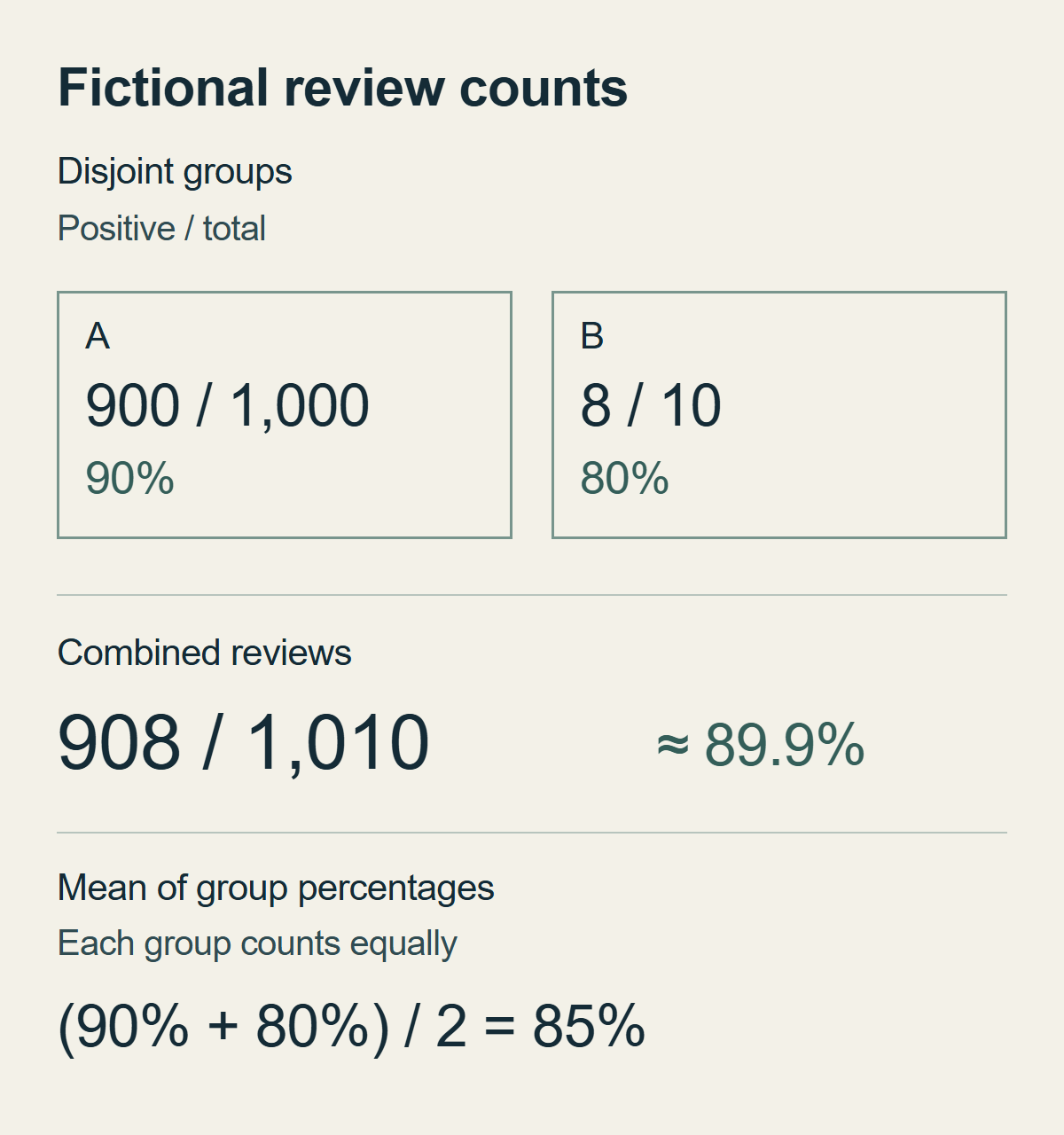
Hypothetical arithmetic, not actual Steam review figures.
Steam Support describes the score as a category based on the proportion of positive reviews. For games requiring purchase, reviews from Steam purchasers contribute to the score; games requiring no purchase have a separate exception. The percentage isn't an average of marks users awarded out of 100. Steam user review help
A recommendation doesn't mean the writer had no complaints. Someone might like enough of a game to recommend it while writing at length about a serious problem. Another person may enjoy playing but choose not to recommend it because of one requirement that matters to them. A percentage combining those choices cannot tell us all the reasons behind them.
An older study looked into this. Lin and colleagues collected 10,954,956 reviews of 6,224 games from a March 2016 store list, excluding games with fewer than 25 reviews. They did not manually read the entire collection. For content analysis, two researchers classified a separate sample of 472 English reviews. Among the positive reviews in that sample, 29% mentioned drawbacks and 7% mentioned bugs. Those are historical sample results, not rates for Korean-language reviews today. To me, that's a concrete reason to read past the recommendation badge. Lin and colleagues' Steam review study, Table 10
The numbers in the calculations that follow are invented for explanation. They aren't actual game reviews or survey findings. I'll give both the positive count and the denominator so you can do the arithmetic yourself.
Suppose group A has 1,000 reviews, of which 900 are positive. A separate, non-overlapping group B has 10 reviews, with 8 positive. Their percentages are 90% and 80%. Add the percentages and divide by 2, and you get 85%.
Combine the reviews, though, and there are 908 positive reviews out of 1,010: about 89.9%. Why the difference? The first calculation gave a group of 1,000 reviews the same weight as a group of 10. One calculation averages groups; the other combines individual reviews. They answer different questions.
The same issue arises when averaging language-specific percentages to make an overall score. You need each group's positive and total counts. Before combining them, check that they don't overlap, that no group is missing and that the inclusion rules match. If you've combined only part of what's available, the result describes only that part.
Giving a large group its proper mathematical weight doesn't mean dismissing a small group's problems. Something that barely affects a combined score may matter a great deal if you plan to play under the very conditions it concerns. The larger group doesn't get to decide your tastes.
The denominator also changes how steady a percentage looks. Four positive reviews out of 5 is 80%. Add one negative review and it becomes 4 out of 6, about 66.7%. Start with 800 positive reviews out of 1,000 and you have the same 80%, but one more negative brings it to about 79.9%. One added review, very different movement.
That doesn't make a small set of reviews worthless. You don't need a thousand reviews before looking into one account of being unable to get past the opening screen. Just separate how much that account moved the percentage from how serious the problem is. A sharp percentage drop alone doesn't tell you how many people are affected.
A large review count can mislead in the opposite direction. A new problem may be hard to see beneath years of accumulated reactions. An overall percentage that barely changed since yesterday is no reason to dismiss reports of a launch problem today. Read what happened and under which conditions.
It also helps to name the unit of change. In a fictional comparison with consistent conditions, a rise from 60% to 90% is 30 percentage points. Relative to the starting value of 60%, it's a 50% increase. Saying “30% better” leaves the calculation unclear. Neither percentage tells us how many positive reviews were added: we'd need the total count at each point.
Nor should we treat displayed numbers as exact raw data. In a hypothetical table rounded to one decimal place, 79.96% and 80.04% both appear as 80.0%. The underlying values differ; the display has hidden the difference. This isn't a claim about Steam's rounding method. It illustrates why a displayed percentage cannot reveal the exact integer counts behind it.
What if you add recent reviews to the overall total?
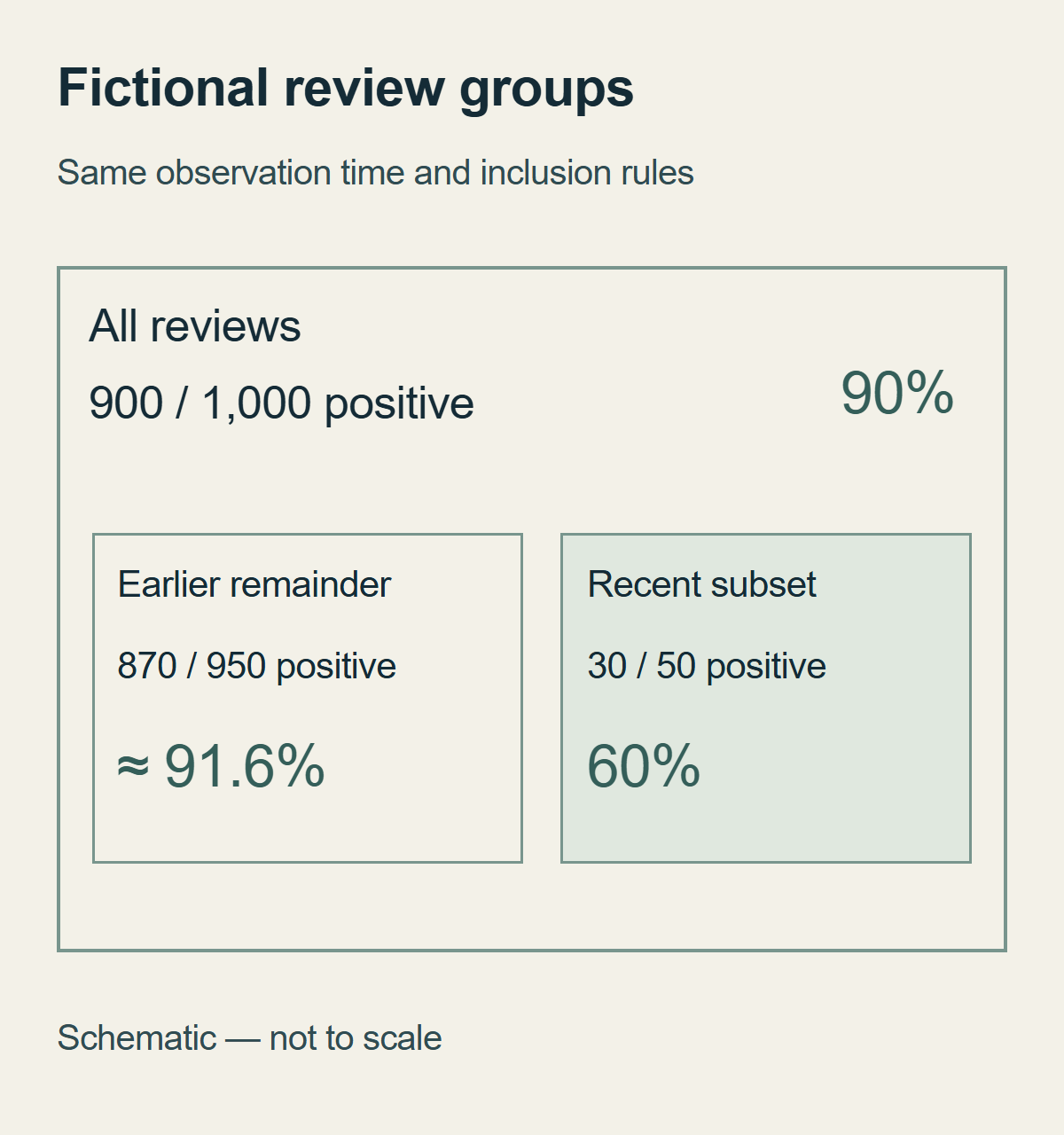
The example assumes exact counts and containment. These aren't values worked backwards from Steam's displayed percentages.
Assume the same inclusion rules and observation time, with every recent review already included in the overall group. There are 900 positive reviews out of 1,000 overall. Within that total, only 30 of the 50 recent reviews are positive. That's 90% overall and 60% recent. Neither number has to be wrong.
The recent group accounts for a small share of the whole. When a game has accumulated many older reviews, a new difference can have a modest effect on the overall figure. The gap gives you a reason to read the newer reviews, not a reason to discard one of the numbers.
Adding the two groups is the calculation to watch. Add 900 to 30 and 1,000 to 50, and the recent reviews enter twice. Overall and recent aren't two independent rounds of voting. Before trying to blend their percentages into one supposedly trustworthy score, check which group contains which.
Under the same assumptions, we can calculate the earlier remainder. Subtract 30 from 900 to get 870 positive reviews, and 50 from 1,000 to get 950 reviews in total: about 91.6%. That subtraction works because we already know the exact counts and containment. It doesn't transfer to groups with different languages or exclusions. Nor can we multiply the whole-number percentages in the HTML table by the displayed counts and claim to have recovered an exact earlier score.
A game changing over time and the mix of people reviewing it changing are also different possibilities. Here's another fictional example to show why that matters. A and B don't stand for actual countries or types of player.
At the first point in time, group A has 90 positive reviews out of 100, and B has 5 out of 10. Together that's 95 out of 110, about 86.4%. At the second point, let A have 9 out of 10 and B have 50 out of 100. The combined result is 59 out of 110, about 53.6%.
The overall proportion has fallen sharply, yet A is still 90% positive at both points and B is still 50%. Neither group's percentage changed. Their shares of the total changed places. Even the total number of reviews stayed at 110. Equal totals don't establish an unchanged mix.
This example doesn't explain an actual fall in Steam scores. Finding a real cause would take further evidence. It does show why a lower percentage, by itself, cannot establish that every part of a game has become worse. We still need to ask what changed.
A buyer's task is smaller than identifying every cause. Reading recent accounts under conditions that matter to you, and looking for specific changes, can still add useful information. You don't need to collect reviewers' personal details or account lists just because groups may differ. We haven't collected individual-level data or performed that analysis here.
The review list can leave a different impression from the score
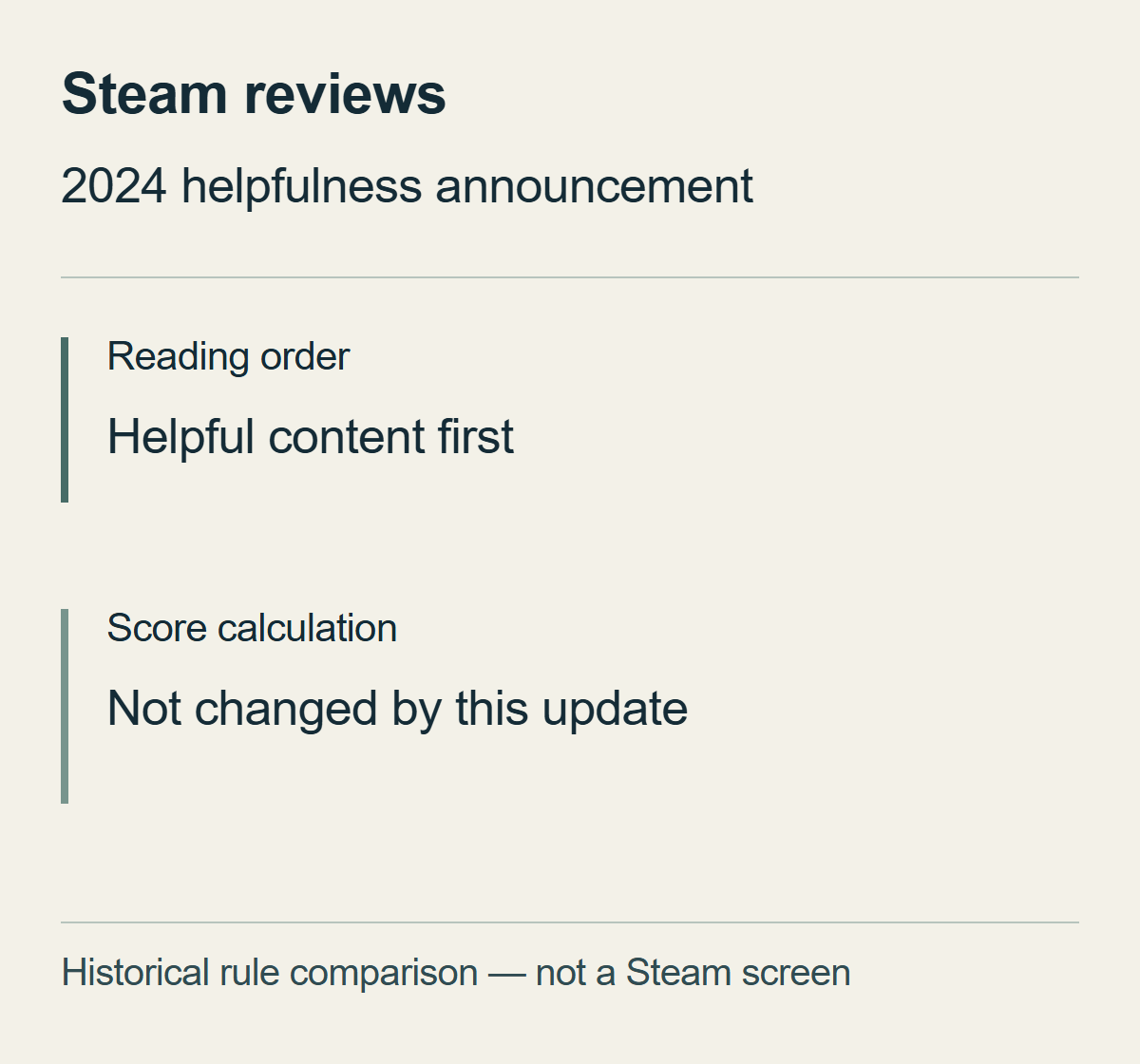
A diagram comparing what the announcement said at the time, not a screenshot of an actual review list.
Scroll down into a run of complaints and a high score at the top can seem odd. But were those first few reviews chosen at random? The impression left by a selected set of posts can differ from the overall tally.
In its 2024 helpfulness announcement, Valve described changing review order to place information useful for a purchase decision earlier in the list. One-word reviews, memes and similar content could appear later when classified as less informative. It said this update didn't change score calculation. What you read first and what counts towards a score are different things. Review helpfulness announcement
A funny one-line review can be enjoyable without answering your buying question. You don't have to rule on whether it was wrong to write it; you can simply move on if it doesn't have the information you need. A long, serious review has no stronger claim on your time if it's unrelated to your question.
People who played through external keys, free weekends, family sharing or similar routes can also write reviews. Not every review you can read contributes to a paid game's score.
There's also a difference between an individual review classified as off-topic and a whole period of off-topic activity excluded from the score. Current Steamworks documentation says the former still contributes despite reduced visibility. For the latter, Valve's announcement says all reviews in the identified period are excluded from the score by default, not deleted. Valve's announcement revisiting reviews
I wouldn't call every burst of criticism a review bomb just because a graph drops sharply. More people may genuinely have encountered a problem. Whether criticism is justified and how it enters the score are separate questions. We didn't check excluded periods or account settings in this collection.
Your reading order can follow your purpose. If you're concerned about something after a particular change, start with accounts written since then. If you're interested in problems that emerge over longer play, look for descriptions of that experience. Either way, the few reviews you selected aren't a measure of how all players feel.
Several posts appearing to report the same problem may actually be quoting one original account. Check whether someone describes a separate experience under different conditions or is passing on the first claim. Finding five quotations isn't the same as finding five independent confirmations.
Try underlining what can be checked rather than concentrating on a review's mood. What did the player do, and what happened next? What did the writer expect, and what are they guessing? The angriest post doesn't necessarily describe the biggest problem, and a calm tone doesn't make an account verified.
A patch announcement isn't proof of a fix
Evidence that an announcement was made, not a measurement of the patch's effects.
Hello Games described update 7.0 in its COSMOS announcement on September 9, 2026. Official COSMOS announcement
Even if a score changes after an announcement, that doesn't identify the cause. We haven't collected and classified individual reviews from before and after this update. We haven't run launch tests or compared performance under controlled conditions either.
If a complaint is holding you back from buying, you can read its date alongside a relevant announcement. What the announcement actually says matters: new content, acknowledgement of a problem and a claimed fix give you different answers. The word “update” in a title doesn't make those three interchangeable.
Similar error descriptions may concern different scenes. A freeze after combat and a freeze when opening the save list are hard to match against a fix if you combine them into one “freezing problem.” Read the conditions attached to the developer's claim. Having read that claim is also different from testing whether the problem is fixed on your system.
Steam's review data records creation time, last-update time, total playtime and playtime when the review was written separately. An old review may have been edited recently; its author may have played more after writing it. A high total doesn't show that every hour was spent with the problem now described.
Short playtime isn't a reason to dismiss a launch problem, either. Being blocked at the start and disliking the late-game structure require different amounts of experience. Someone with many hours may still never have tried the particular mode or scene you care about. Hours give context; they don't settle whether every claim is true.
The absence of a follow-up makes things less clear. It's tempting to think silence means a fix, but finding no new posts in the places you looked isn't the same as finding that a problem has gone away. People may have stopped writing for other reasons. If you haven't found evidence of resolution, you can leave the question open.
Read reports of improvement with the same care. An explanation of which problem eased tells you more than “it's fine now.” If praise gets a free pass while criticism faces every possible challenge, you can end up reading only to confirm that you wanted the game all along.
Which complaints matter to you?
A fictional reading example, not a reproduction of any real review, author or game.
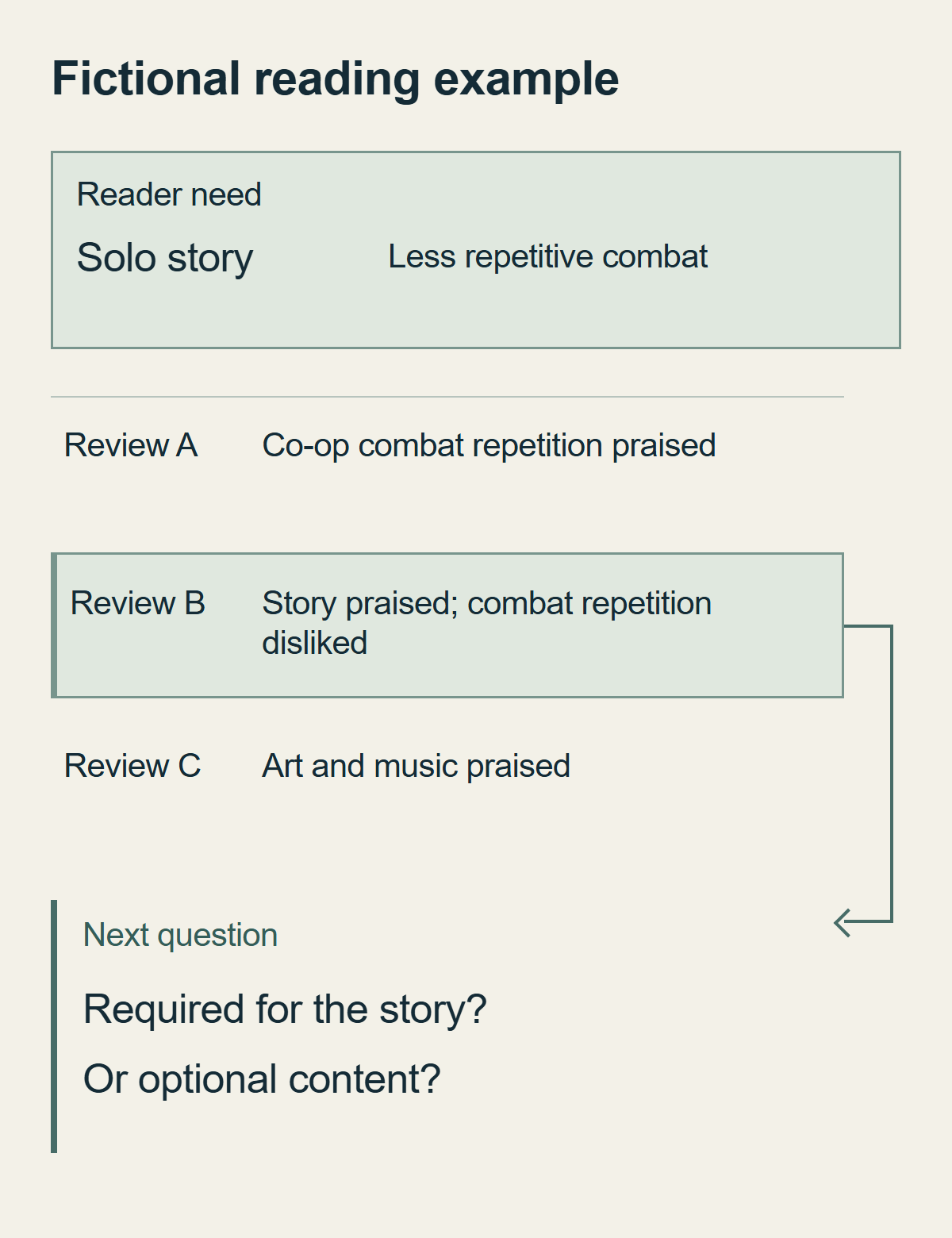
Let's imagine a buying decision. This isn't an account of a real game or player. Someone wants a story to enjoy alone, dislikes long stretches of repetitive combat and needs to stop playing frequently. They know the game has a good overall reception. What they don't know is whether it suits them.
They come across three fictional reviews. The first praises the repetitive combat enjoyed with friends. The second likes the story but doesn't recommend the game because the same fights must be repeated. The third likes the visuals and wants to listen to the music again. None of these descriptions quotes an actual post.
Count recommendations alone and the impression may be positive. For this buyer, though, the second review's description of repeated combat deserves attention first. Playing with friends and enjoying the music aren't bad things; they simply answer a different question from the one this person brought. Choosing a useful review isn't the same as passing judgment on the game.
One negative review needn't make you give up on buying the game. We still don't know whether the repetition is necessary to progress through the story or comes from trying to complete every piece of optional content. If the review doesn't answer that, the next thing to read should address the distinction. Another repetition complaint is less useful here than knowing where that complaint applies.
People willing to tolerate the repetition may choose differently from those who aren't. A player might be happy to skip repetitive optional content, but choose another game if it regularly forms part of the main story. If the scope is still unclear, waiting remains an option. A high percentage needn't erase the question, and one negative review needn't erase everything appealing about the game.
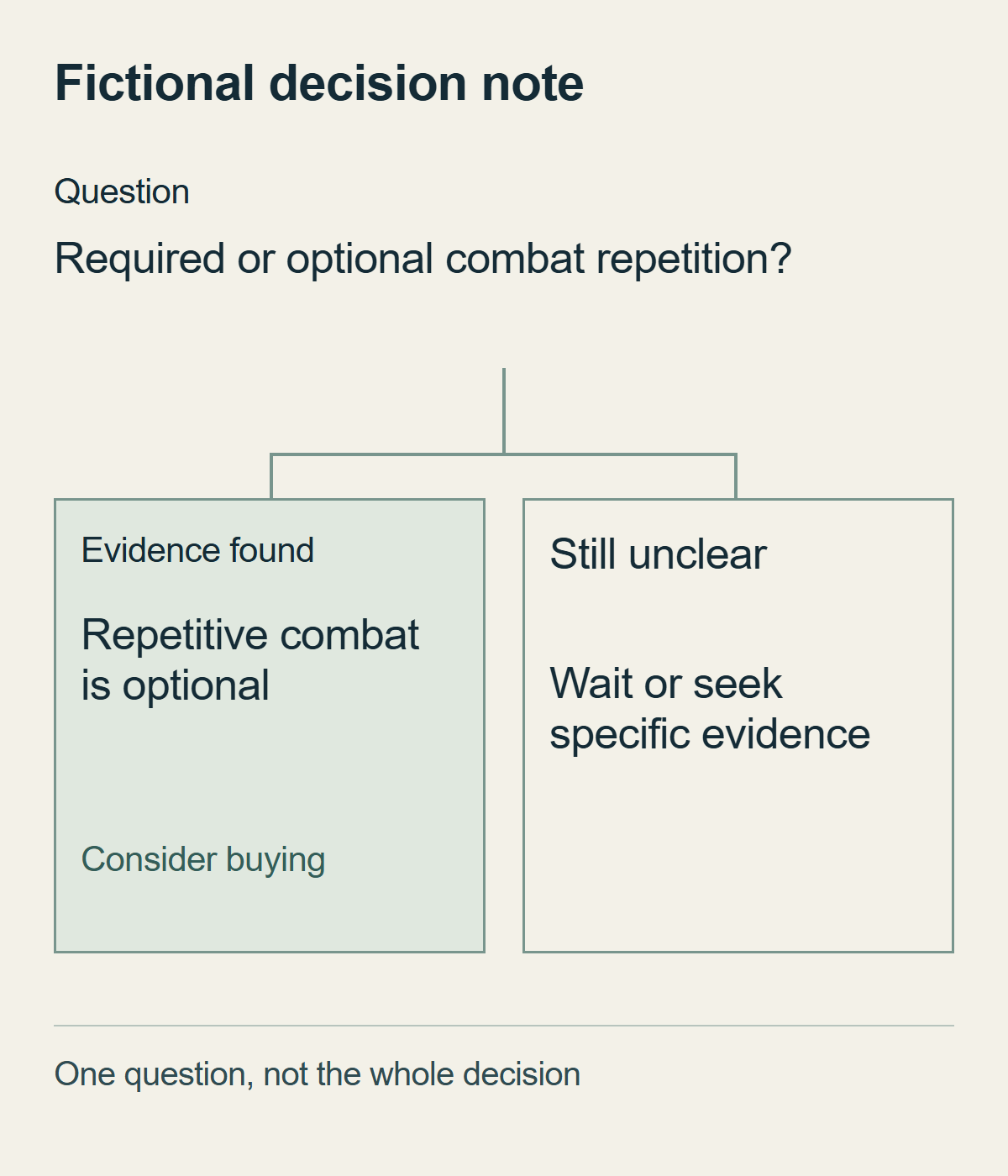
Suppose they find that repeated combat is optional. One original requirement remains: they need to stop playing frequently. Being able to skip those fights doesn't establish that they can quit whenever they need to. I'd next look for accounts of short sessions and stopping, or official guidance. Without that evidence, you can note that repetition is less of a concern, but stopping remains unknown. Answering one question hasn't satisfied every buying condition. Equally, there's no need to start reading the already-answered repetition issue from scratch. Keeping what you know separate from what you still need lets you move on to the remaining question instead of circling the same reviews.
A problem's frequency and its consequences are different questions. Rare doesn't necessarily mean minor. A brief visual glitch and lost progress can carry very different costs even if they happen equally often. We haven't measured any such rates here. The question is what else you'd need to know when judging a reported problem against your requirements.
Also ask whether a common complaint concerns something you dislike. Long dialogue may be a warning to someone who wants to move quickly through the story, yet barely trouble someone who hoped to take their time reading it. You needn't force every popular complaint into a personal advantage. But numbers won't resolve a difference in taste.
Looking for detail doesn't mean requiring other players to submit a full evidence file. Reviews are also a place for personal reactions. Someone is free to write a brief “not fun,” and you're free to need more information before buying. You can leave an insufficiently detailed review out of your decision without interrogating its author or investigating their account.
When reviews contradict one another, look for facts they agree on. One writer may find repeated combat boring, while another enjoys mastering the same fights. They could agree about the repetition itself. Opposite recommendations can still help you understand what kind of game you're considering.
That reading isn't quite a vote on who's right. You're asking whether the difference comes from taste, experiences at different times, or different playing conditions. People can disagree even under the same conditions, so there's no need to assign one cause to every disagreement.
I think writing down a few buying conditions before opening the reviews helps. You don't need an elaborate scorecard. “How repetitive is solo progress?” or “Can I stop after a short session?” is enough to keep the question in view. If your enthusiasm rises and falls as you read, you have something to return to: what you came to find out.
When more reading stops adding answers
An example of a conditional decision, not a guarantee about buying or a demonstration of a Steam notification feature.
After enough similar reviews, it can get hard to tell whether you're gathering information or asking for permission to click Buy. Ten more posts won't strengthen a decision if you're only looking for the conclusion you already like. Ask yourself what you could read that would actually change your choice.
Suppose you've decided to consider buying if the problem that worries you occurs only in optional content. Evidence about that condition is what you need next. But if even a small possibility of disappointment is what troubles you, collecting more praise may never resolve it. I'd put the purchase aside for a while.
In your notes, the conditions tell you more than a number on its own. Briefly record when you looked, which summary you read, what question you answered and what remains unclear. Keep that old note when new evidence arrives, and you can see why your judgment changed.
If you adjust something to compare the results, record what you changed. Change the period, language and purchase type all at once, and it becomes difficult to tell which produced a difference. If you couldn't verify the settings, don't describe the comparison as controlled for them.
Our store-page evidence is HTML received without sending login credentials. We reproduced only its explicit recent and Korean-language summaries. We didn't match the preferred language, purchase filters or exclusion settings across the comparison, and we didn't obtain a public review-aggregation API response. We didn't obtain exact raw counts of positive and negative reviews or calculate differences between purchase routes.
There is no requirement to read every review before you're allowed to buy. Check whether you've answered the questions you started with. If you understand the trade-offs in taste and can live with them, you can consider the game. If a problem that could prevent you from playing is still unclear, you can wait. You don't have to make either the high score or the low score disappear to reach a decision.
Once you've looked for what someone starting today needs to know, you should have a clearer sense of why you're hesitating than the badge at the top could give you on its own.