


A game catches your eye, then you notice the Early Access label. Will there be enough to enjoy if you start now? Would you have a better time waiting? You scroll through announcements about new regions, modes, and storylines. Gradually, features missing from the version on sale become part of the game you're imagining—and part of your reason to buy.
I wouldn't rule out a game just because it's in Early Access. I wouldn't add its promising plans to its current content when deciding whether it's worth the money, either. Looking forward to its future is a reasonable part of buying it. I'd still want the game I receive today to justify the purchase if the changes I'm hoping for never arrive.
Here, I compare two games' official release records with research on Steam Early Access. Hades II has already left Early Access. Project Zomboid shows why a Stable release and version 1.0 need to be read separately. The aim is to clarify a buying decision, rather than rank the games. The documents were checked on October 3, 2026. This article doesn't include firsthand testing of features or performance.
Is the game you want to play available now?
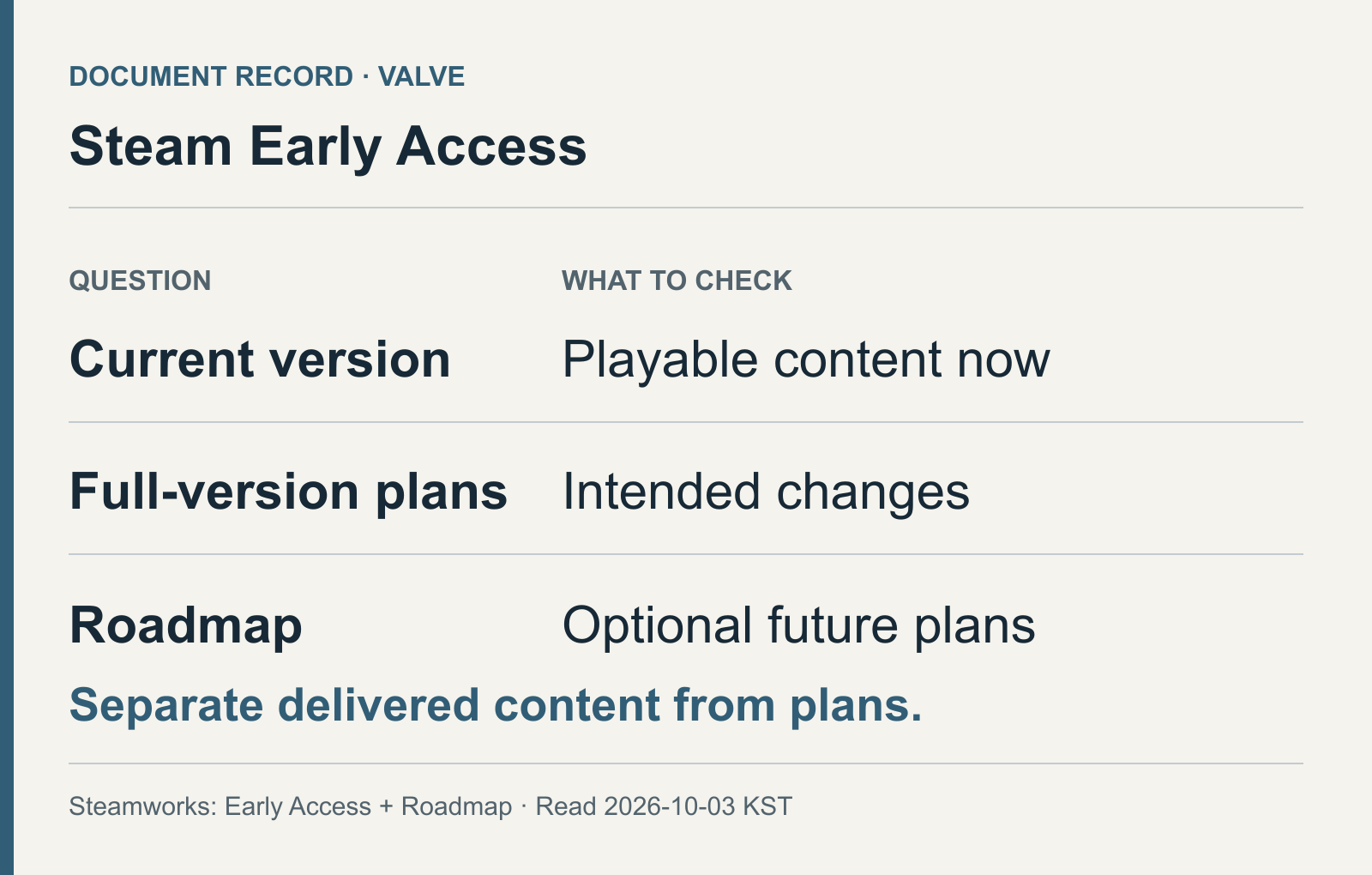
The Steamworks questions are organized from a buyer's perspective. This is a reference chart, not a screenshot of the store interface.
Valve describes Early Access as selling an unfinished game that people can play now. Its rules also tell developers to avoid promises about specific future outcomes and to make clear that purchases should be based on the game's current state. Steamworks Early Access documentation
That can feel like a strict standard. Part of the appeal of a game in development is looking forward to what it might become. You might want to support a team whose direction you like. I don't think either motive is wrong. But it helps to distinguish what you hope will change from what you can play today, so you know what you're paying for.
Before reading more of the store page, write your reason to buy in one sentence. Go a little further than “It looks fun.” Do you want to explore a large map on your own, build a home in a shared world with friends, or follow a story all the way to its ending? The same game can attract people who need different things from it.
If you're planning to play together, mention the version you'll use when asking about a feature. Multiplayer might be available on a test branch, or it might be described as a later addition. Confirm that its conditions fit your plans. A feature can exist and still be unsuitable for the way you want to play.
You don't have to treat every missing feature as a reason to avoid buying. Someone who spends most of their time building may barely notice that the later story is unfinished. Someone who cares most about the ending may wait for the same game. Those are different preferences about how to enjoy it.
A list of current content won't settle the question on its own. If the description mentions exploration, crafting, and combat, ask which of those you'd enjoy repeating. Liking a picture of a finished structure is different from wanting to collect materials and choose what to build and where. The picture doesn't tell you whether the process suits you.
Look for information that answers your particular question. Footage from the opening of the current version can help you understand the controls. If you only need to know whether the story has an ending, a spoiler-free official description may do. You don't have to watch a whole video and learn the plot to make a good purchase decision. Once you've found the condition you needed to check, you can stop looking.
A roadmap helps you understand the direction of development. Valve describes it as an optional way for developers to share future plans, with flexibility over its format and the period it covers. Steamworks roadmap documentation I wouldn't compare progress indicators between games as though they measured the same thing. Teams may count tasks differently, and the size of the work left to do can vary. The documentation doesn't say that Steam certifies completion percentages against a common standard.
When you find a feature you really want on a roadmap, check whether it's also available in the current game. If it isn't, leave it marked as planned in your purchase notes. You can welcome the prospect without counting it as something you've already received.
What does Project Zomboid's Stable label tell you?
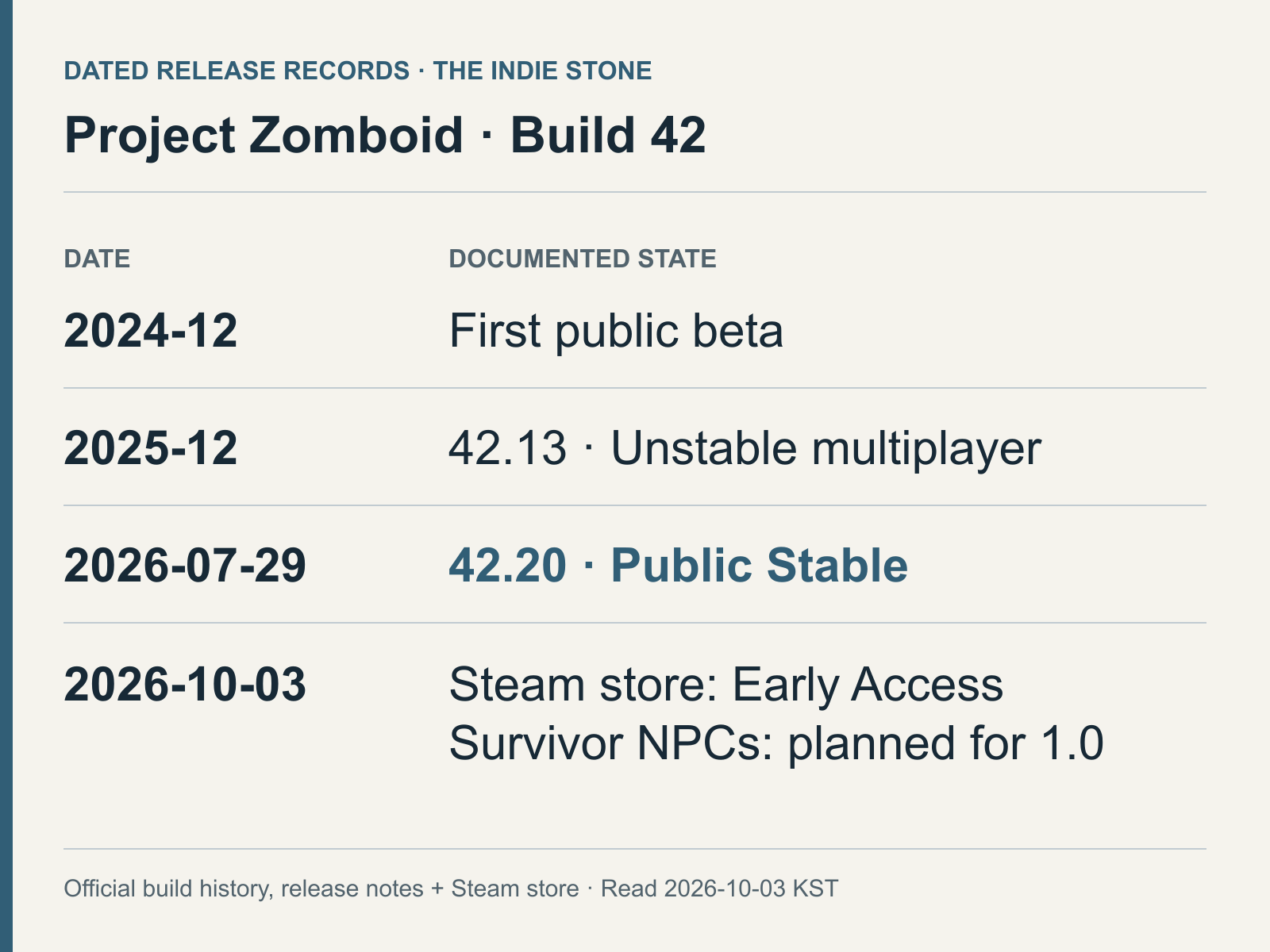
The timeline separates the release stages in each announcement. A site-wide latest-version label on an older post wasn't used as evidence of that post's historical version.
Project Zomboid offers a useful example of how to read update news. A single label doesn't tell you how much of the game is finished.
The official build history distinguishes Build 42's first public beta in December 2024 from its Stable release in July 2026. The page says it records major changes. Its entries therefore wouldn't give me a count of every patch or an average update interval. Official Status and Build History
In December 2025, between those releases, version 42.13 introduced multiplayer. The headline includes “Released,” while the body describes a stress test of work in progress and an Unstable beta. A release at that point doesn't, on its own, establish that the conditions needed for ordinary play were in place. Unstable 42 multiplayer release announcement
On July 29, 2026, the developer announced that version 42.20 had been released to the public Stable branch. That identifies a change in the branch receiving the release. Build 42.20 release announcement
Did Early Access end too? The Steam store page read on October 3, 2026 still contains the Early Access explanation. The developer hasn't committed to a full-release date and describes survivor NPCs, among other features, as plans for version 1.0. Project Zomboid's Steam store description
Stable describes the release stage of a particular build. Full release describes the stage the developer assigns to the game as a whole. The records confirm that 42.20 reached Stable; they don't establish that the planned NPCs have been implemented. Those statements can both be true.
The distinction matters if your purchase depends on a particular feature. If I wanted a current version to play with friends, I'd compare the release branches first. If building relationships with survivor NPCs were what interested me, I'd first check whether that feature was still a plan. A Stable release doesn't answer both questions.
Read the audience and version named in an announcement's body. Is it announcing a plan or reporting a release? Does it cover a test channel or the version offered by default? Is the feature you care about listed among the additions? One long post can discuss the current update near the top and future plans further down. That doesn't put everything on the same release date.
Also keep the date described in a page separate from the date you're reading it. A developer's site may show its latest version above many older posts. Using today's header to identify the version released months earlier muddles the history. If an older announcement informs your purchase, note the build and date stated in the body.
None of this establishes how reliably the game runs. It establishes what the developer's Stable label refers to. Whether the game is free of errors, runs well on a particular setup, or suits your taste remains to be checked.
Will an update let you keep playing where you left off?
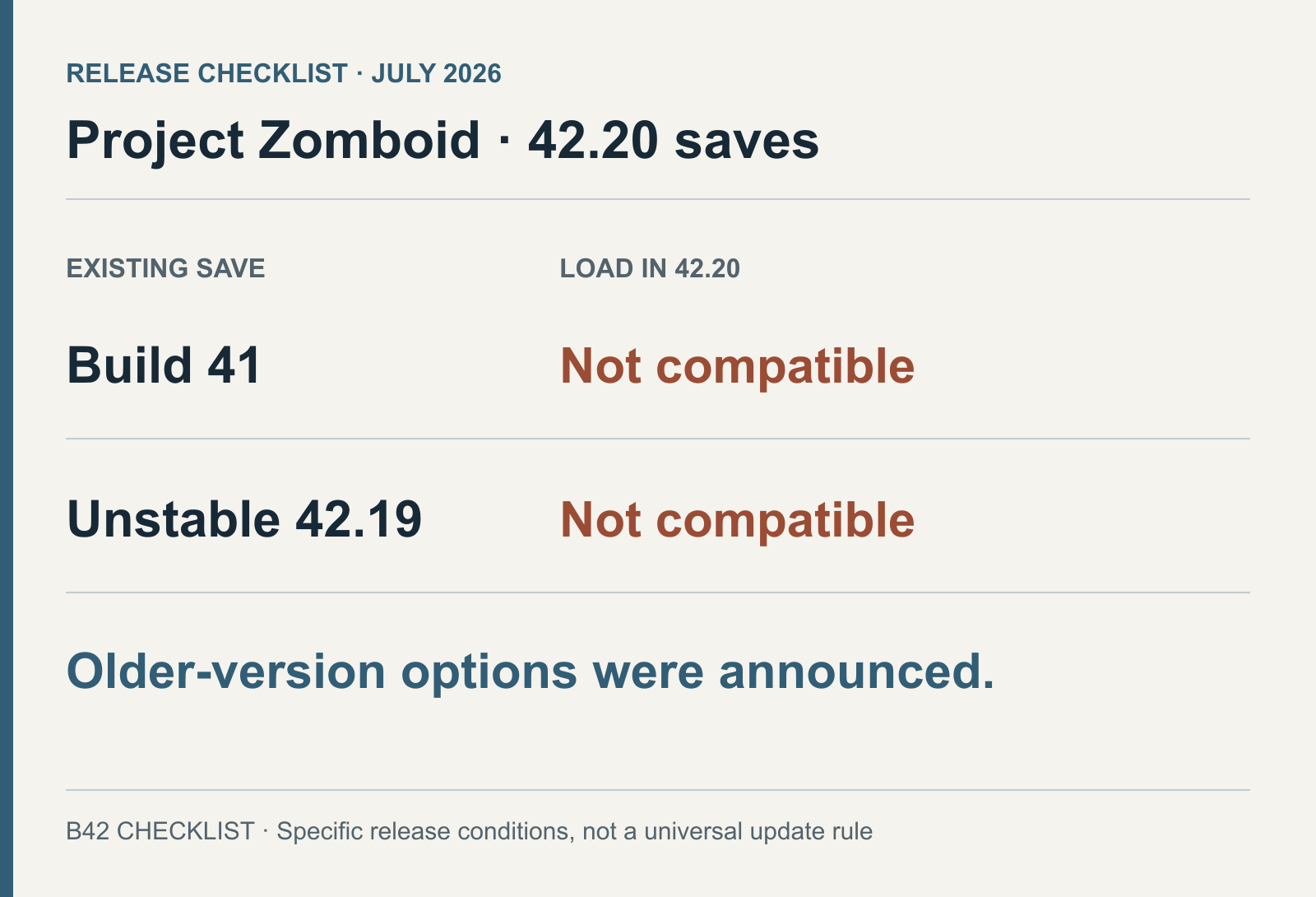
This save guidance accompanied the July 2026 release. It applies to that change, rather than every Early Access game or every update.
An update naturally draws attention to what's been added. If you want to spend a long time building up one game, what happens to your existing progress matters too.
Project Zomboid's checklist before the 42.20 release says saves from Build 41 and Unstable 42.19 are incompatible with the new version. It also explains options for continuing on an earlier version. Build 42 pre-release checklist
That isn't a claim that every update erases all progress. Read the conditions for this particular change. The option to stay on an older version doesn't remove the choice: enjoying the new features and preserving the world you've been playing may lead you in different directions.
I'd factor in the time that choice could take. Starting again may be welcome if trying different rules in each new world is part of your enjoyment. Someone who wants to keep what they've built in one world may find the same notice much more consequential. The difference has more to do with how you want to spend your free time than how well you understand the game.
With friends, it takes more than deciding for yourself. You may need to agree to start together on the new version, keep the existing progress, or accommodate someone who isn't ready to change. This article hasn't measured how often players face that problem or how often they resolve it. It's a consideration that follows from needing to agree on a version. When finding time together is difficult, the cost of a restart isn't easily expressed in money.
A save notice lets you narrow the questions. Which versions does this incompatibility affect? Does the way you plan to play require a fresh start? Would the people joining you accept staying on an older version? Before buying, checking those conditions is more useful than memorizing a recovery procedure.
Be specific about accepting bugs as well. Would you be happy to spend time looking for troubleshooting information? Do you want to relearn controls or rules as they change? You can like the idea of participating in development and still want a familiar, unchanged environment when you sit down to play.
I wouldn't make confidence in writing bug reports a qualification for buying. You might become interested enough to give feedback, but a game can still be what you want in return for your money today. If you have little time to follow changes, it makes sense to judge the current version more strictly.
Waiting for the ending: the Hades II example
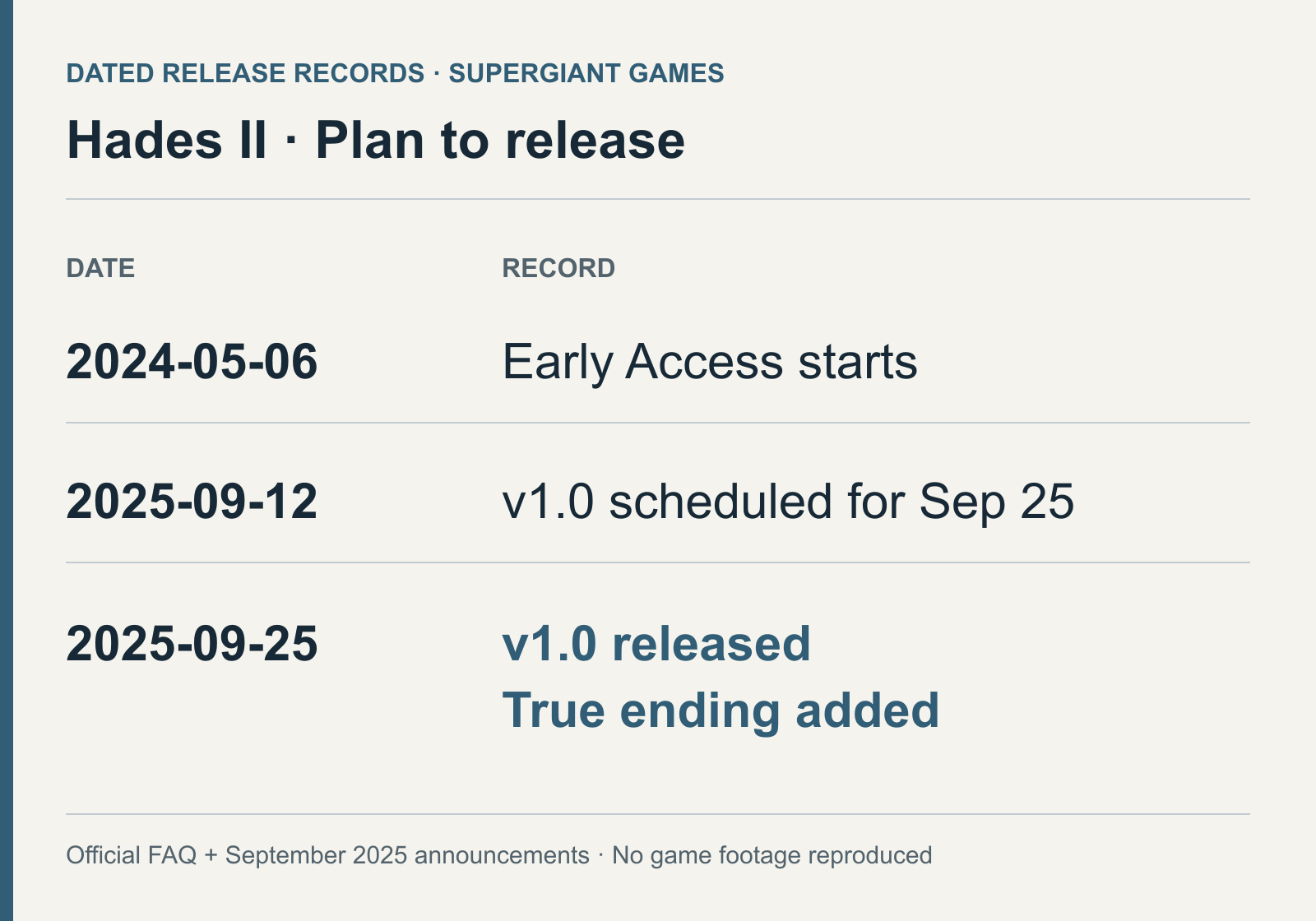
The official FAQ, planned-release announcement, and actual release announcement were compared. These records don't predict whether other games will meet their planned dates.
Hades II has completed Early Access. Its official FAQ records an Early Access launch on May 6, 2024 and the version 1.0 release on September 25, 2025. Hades II official FAQ
The September 12, 2025 announcement set September 25 as the version 1.0 release date. For a reader on that day, it was still a plan. Version 1.0 release-date announcement The actual release announcement on September 25 confirmed that Early Access had ended and named the true ending among the additions. Hades II version 1.0 release announcement
Someone waiting specifically for the ending would likely care more about what was available for their first playthrough than how long development took. If you want to follow the story through to its conclusion, even a large amount of released content can leave a reason to wait. The release announcement identifies the ending that reader wanted.
Someone who started earlier could have equally good reasons. They might enjoy learning the available content and returning when something changes. Following changes to the rules during development can be part of the appeal. The question is whether that's the experience you wanted.
I don't think updates can fully reset a first impression. New content and an entirely new first encounter are different experiences. You can choose to wait because you expect to like a game and care about how you first play it. That preference doesn't require a verdict that the current game is inadequate.
Hades II doesn't give us a general reason to trust development plans. Here, we can compare an announcement with the release that followed, including a record that the ending was added. An unfinished game elsewhere doesn't yet have that next record. This game's completed history doesn't predict another game's future.
If you wait, choose a specific reason to return. I'd write “when the ending I want has actually been released” rather than “when it's finished.” A developer calling the game version 1.0 and the arrival of what you want aren't guaranteed to coincide. Check the experience you've been waiting for as well as the label.
Which games make up the “70% finished within a year” figure?
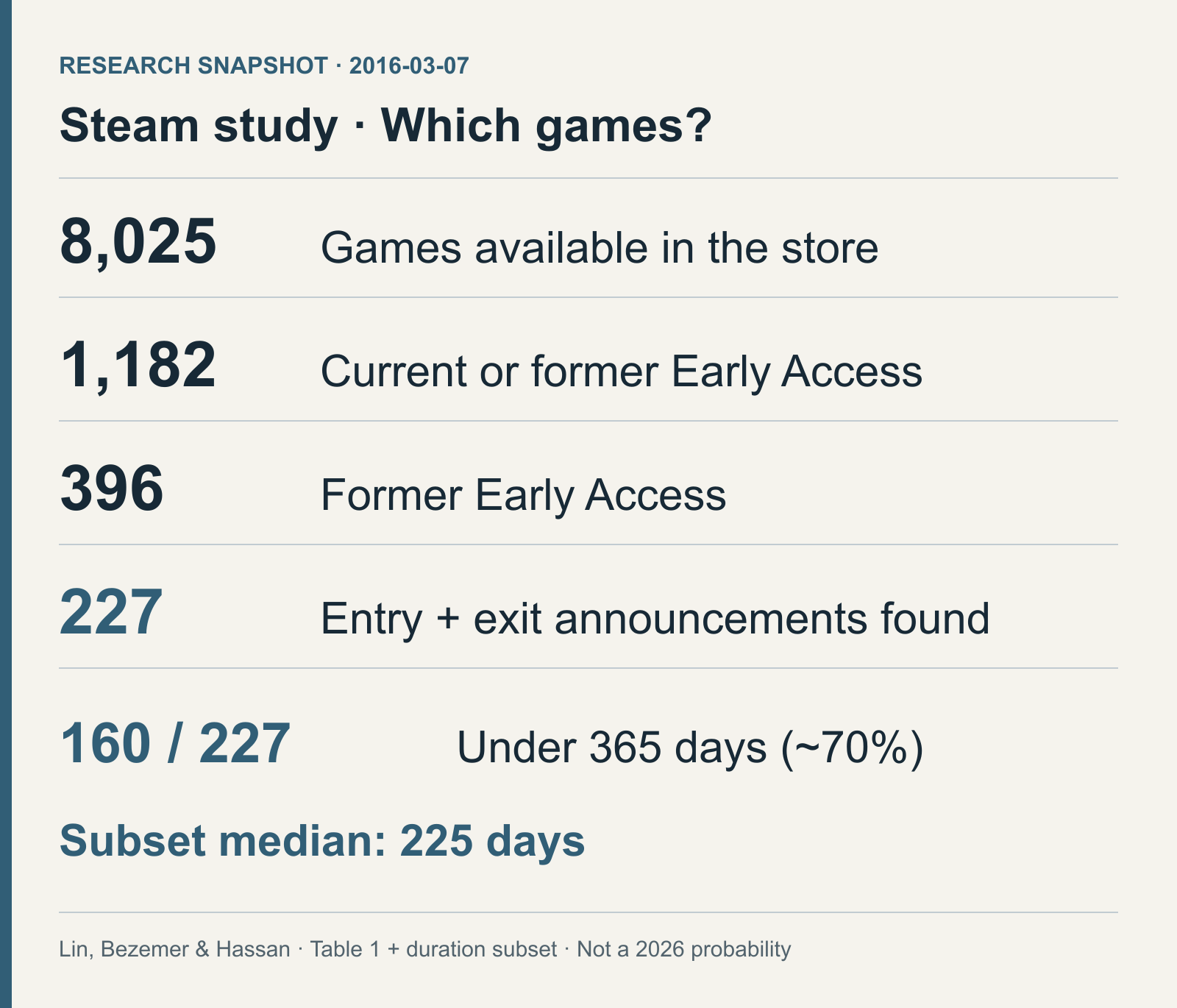
Historical 2016 duration data, not a current completion probability.
It's understandable to want data on when Early Access ends. But a number can be accurate while answering a different question from the one you have.
Lin, Bezemer, and Hassan studied 8,025 games for sale on Steam on March 7, 2016. Of those, 1,182 were in Early Access at the time or had been in it previously; 396 had left Early Access. For the duration analysis, the researchers used 227 of those completed games that had both start and end announcements. In that subset, 160 games, about 70%, spent less than 365 days in Early Access. The median was 225 days. Original empirical study, Table 1 and duration analysis
The 70% covers only already-completed games with both announcements. It doesn't tell us later outcomes for unfinished games, predict a 2026 completion probability, or provide a developer trust score.
How much should years in development influence your decision?
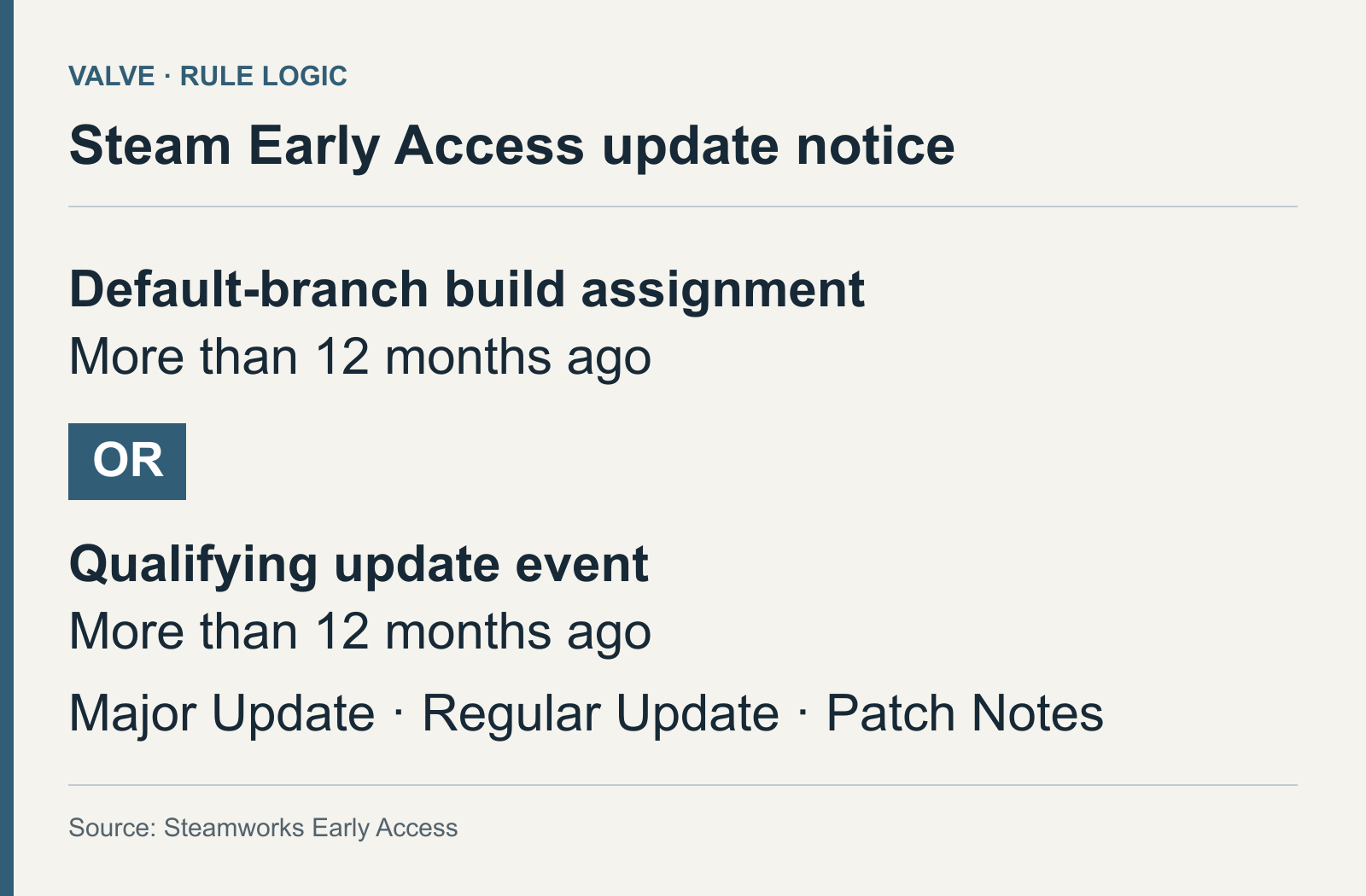
The diagram summarizes Valve's documented conditions. It doesn't record the notice appearing on any particular game.
A long stay in Early Access can understandably make you wary. If a feature you need has been planned for years, that wait becomes part of your decision. I'd still consider more than development time when judging the game's value. Whether it has what you need today and when you might receive what's missing are separate questions.
Read Steam's update notice carefully too. Valve's documentation says the notice condition applies when it has been more than 12 months since a build was set on the default branch, or more than 12 months since an update event of the Major Update, Regular Update, or Patch Notes type was posted. Either condition is enough; both aren't required. Steamworks explanation of the last-update notice
Frequent general news posts aren't interchangeable with events of those specified types. The other condition still matters as well. The notice alone wouldn't establish that development has been abandoned, and its absence wouldn't guarantee completion.
I'd look for the change I need instead of counting announcements. A game can have plenty of news while the feature you want remains planned. When an announcement includes both new content and save guidance, read both. A requirement to start again could alter your decision.
If you don't find an answer, don't immediately treat a feature as absent. A developer saying it isn't available differs from you being unable to establish its status. In the first case, leave it out of your reasons to buy the current game. In the second, leave a question to check. A gap in the information also isn't a reason to assume a feature is available just because it seems likely to work.
When accounts disagree, compare dates and versions first. An older player's experience may differ from the current release. A developer's own post may discuss a test version and the default release separately. If descriptions of the same version at the same time still conflict, I'd leave the answer unverified. If the condition matters to you, waiting until you know is a reasonable choice.
If you've read enough and still can't decide, return to your reason to buy. After removing planned features, is there something you want to do? Do you have time to learn again or start over as things change? Do you want your first playthrough to include a finished story? You can answer those questions now, without spending longer trying to predict the developer's future.
A reason to buy now can be quite specific. You like the gameplay available today and can accept the conditions of the version you checked. The development direction gives you something to look forward to. You don't have to believe every planned feature will succeed to justify buying.
If you wait, set a condition for checking again: the mode you want reaches the branch you'll use, the ending you want appears in an actual release, or the announced change that conflicted with keeping a long-running game has been addressed. Start with that condition when you return. It gives you more to work with than checking whether the Early Access label has disappeared.
Wanting to support a developer may remain part of the decision. I wouldn't try to reduce that feeling entirely to a calculation. I'd just keep the plans you want to support distinct from the game you want to play in your free time today. You can buy for the current game, or because following its development also has value to you. If a feature that hasn't arrived is essential, you can wait to buy.