


Is a Steam Badge Worth Using Up Your Cards?
Decide whether to use a completed Steam card set for a badge: what gets consumed, what 100 XP buys, regular versus Foil badges, and alternatives for your profile.
Article languages
On this page
- A complete set isn't a crafted badge
- You know the badge; the extra artwork is random
- A craft gives 100 XP, not necessarily a full level
- A Foil badge doesn't unlock a better set of features
- The profile item you want might not require a badge
- Already owning the cards doesn't make the craft cost nothing
- Check the badge page once more before crafting
- Keeping the set is a valid use of your inventory
A complete set unlocks the crafting button, but you may still want to keep the cards. Before pressing it, check what disappears, what the badge gives you and whether you'll use the result.
If Steam is simply where you launch games, a badge may do little for you. If you like keeping reminders of favorite games on your profile, it can be a hobby in its own right. You don't have to take up that hobby to make proper use of Steam.
Crafting consumes the set in exchange for an account-bound badge and rewards. This article is about deciding whether you want that exchange—not acquiring more cards or finding a better selling price.
A complete set isn't a crafted badge
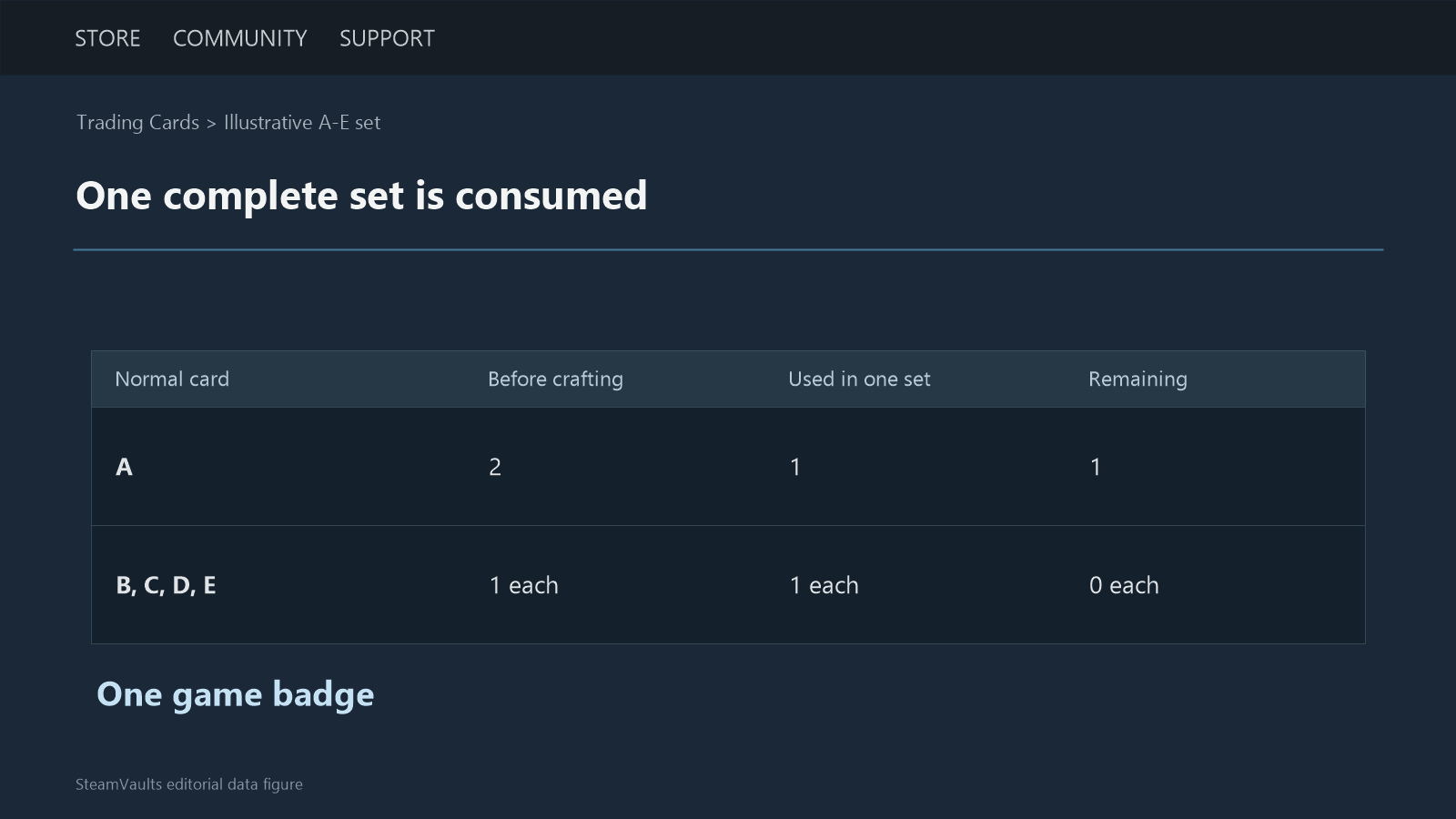
Collecting a complete set doesn't craft it automatically. Steam's Trading Cards introduction describes a separate action that turns the set into a badge and Community items. The badge is tied to your account; you don't receive it on top of an untouched set.
A set also isn't simply a total number of cards. Imagine a fictional game with five regular card types: A, B, C, D, and E. Five copies of A don't complete its set. Two copies of A plus one each of B, C, D, and E give you one complete set. Using that set for one craft leaves one copy of A. Those letters and quantities are an illustration of types versus copies, not observations of a particular game's inventory.
The game's name isn't the only detail that matters. When you're completing its regular set, check which regular card is missing. Owning a Foil card doesn't mean you've filled the corresponding regular-card slot. The card names and set category on the badge details page are more useful than an overall inventory count.
If you collect the cards for their artwork, owning the set may already be the result you wanted. Leave it in your inventory. If you'd prefer the badge, use the set knowing that the original cards will go. Crafting doesn't retain copies of those inventory items for you.
Cards you already own still count in this decision. Not needing another payment isn't the same as using nothing. Your existing set goes into the craft. If you later want those cards back in your inventory, make the decision on the assumption that you'll need to obtain them separately. Don't plan to dismantle the badge if you dislike it: the official crafting instructions checked for this article don't provide that reversal procedure.
If holding cards or buying and selling them is unfamiliar, the Steam Community Market guide explains that part of the system. From here, the question is what you want to use a set for, not how two prices for the same item compare.
You know the badge; the extra artwork is random
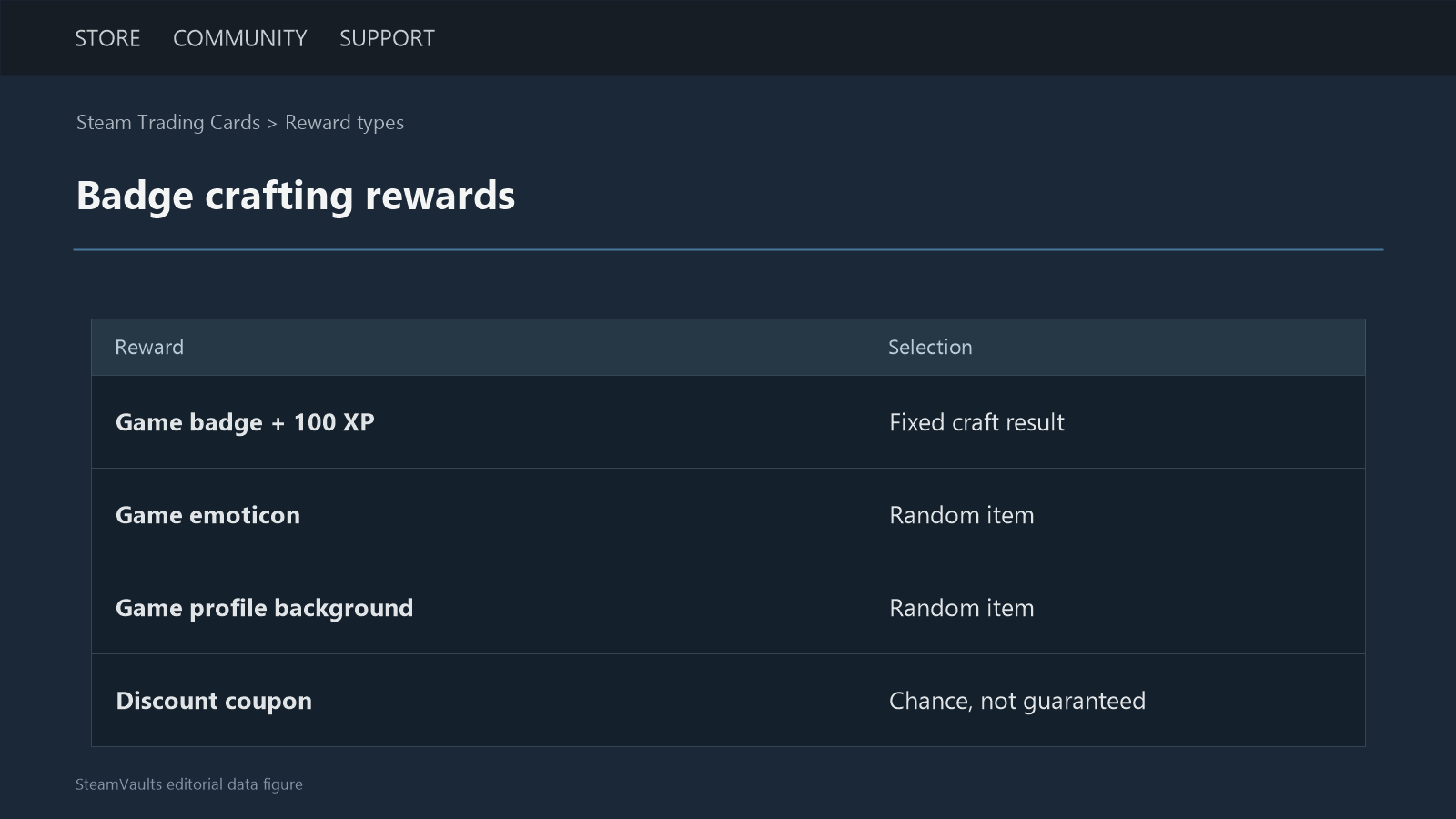
An ordinary game-badge craft gives you the badge and 100 XP. Steam also lists a random emoticon and random profile background from that game, plus a chance of a discount coupon for a different game or DLC. Treating a coupon as guaranteed, or expecting to choose the background, would promise more than Valve's crafting-reward explanation does.
For the badge itself, you can check the result you're working toward. For a particular character's background, “random background” is much less helpful: the reward list doesn't promise the picture you chose.
You might enjoy collecting through further upgrades within the game's crafting limit. But if you planned one craft, pause before buying another set just because the background disappointed you. Decide whether you still want the next badge; the disappointing result gives you no evidence that the next reward will be better.
Valve's description of random rewards doesn't establish equal probabilities or a guarantee that repeated crafts will produce every background. Those missing probabilities also prevent a supported forecast of when rewards will pay back the cards. I would decide whether I want the craft even with artwork that isn't my first choice.
A coupon has value to you if it helps buy a game you already wanted. Before crafting, you don't know whether you'll receive one, which title it might cover or whether you'd use it. A large discount percentage doesn't recover the badge's cost by itself. Buying an unplanned game to use it may increase your total spending.
Keep account rewards separate from inventory items in any cost calculation. The badge and XP aren't cards you can sell. Check backgrounds and emoticons individually for what you can do with them. I wouldn't force the enjoyment of a profile badge into the same break-even figure as possible sale proceeds.
A craft gives 100 XP, not necessarily a full level
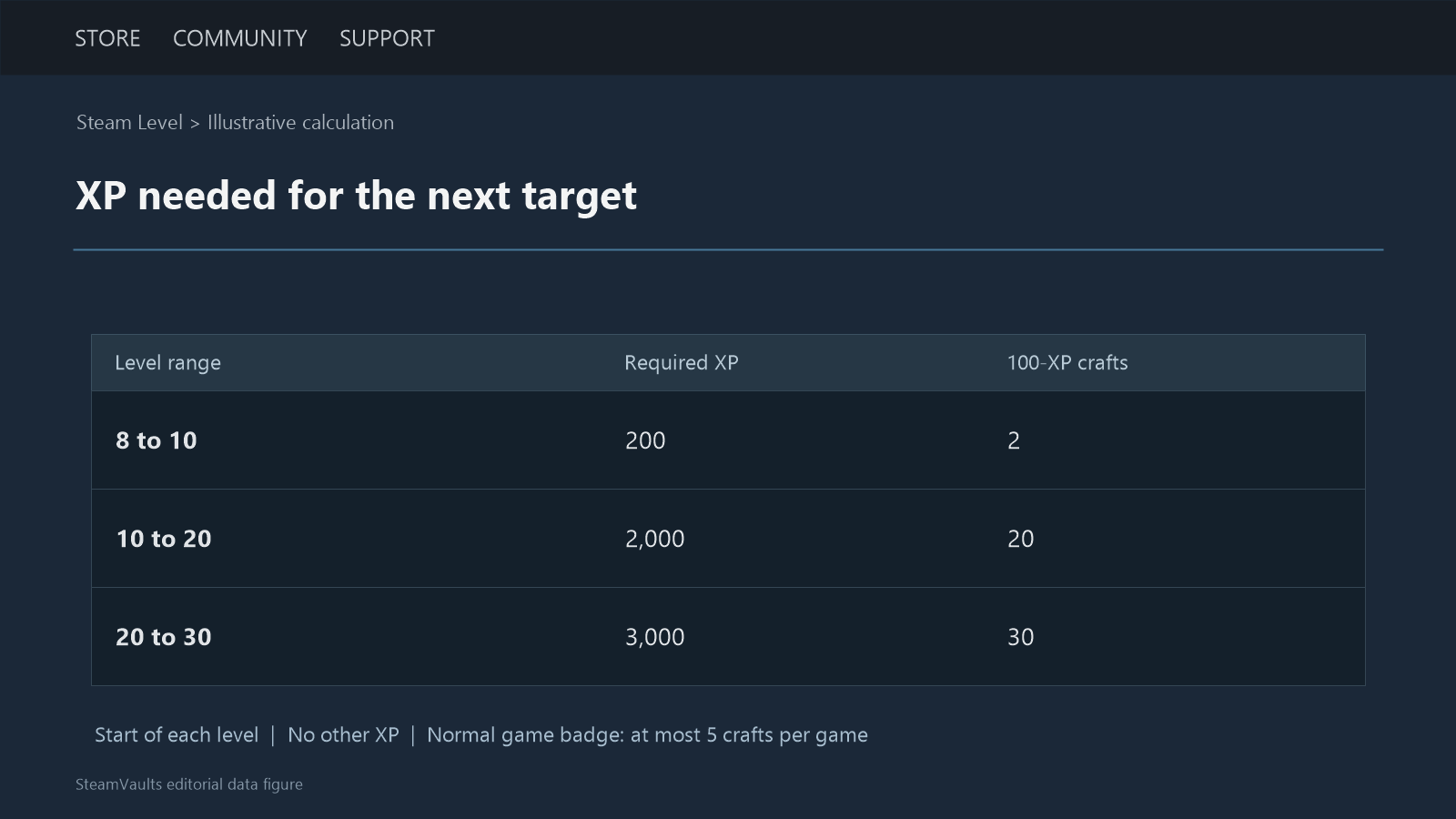
If you're crafting to level up, write down the target. Steam explains that early levels require 100 XP each, then 200 XP per level after level 10, 300 after level 20, and so on. The badge still contributes 100 XP. The visible change depends on where your account is in that progression.
The following examples are calculated from those official rules. Each assumes an account at the very start of its current level, no XP arriving from other sources, and only eligible ordinary game-badge crafts. They are not account measurements or a ranking of the cheapest crafting routes.
| Assumed starting point | Target | Additional XP needed | Crafts awarding 100 XP each |
|---|---|---|---|
| Level 8, no progress within the level | Level 10 | 200 | 2 |
| Level 10, no progress within the level | Level 20 | 2,000 | 20 |
| Level 20, no progress within the level | Level 30 | 3,000 | 30 |
The level band matters, not just the distance to your target. Also, the row calling for 20 crafts doesn't allow 20 ordinary crafts for a single game; the per-game limit still applies.
An account with XP already earned needs a smaller calculation. Suppose your screen shows that the target is 180 XP away. Two 100-XP crafts add 200 XP and take you beyond that target. The 180 is an illustrative figure, not a number to substitute for your own account's progress. Divide the remaining XP by 100 and round up to find the required number of those crafts. Recalculate if other badges or activities award XP before you've finished.
I'd choose a target before shopping: more room for friends, a screenshot showcase or simply a level number I'd enjoy reaching. Any can be a hobby goal. “As high as possible” gives me no clear point to stop, especially when comparing my profile with someone else's.
Steam Support names concrete benefits in the friends list and profile showcases. The friends limit starts at 250, gains five places per level, and reaches a maximum of 2,000. Level-derived showcase slots arrive every ten levels, with a currently documented maximum of 20. The support page separately notes that an extra showcase purchased from the Points Shop adds a slot on top of that maximum. The current details are in Steam Levels and XP.
If your friends list has plenty of room and you never use showcases, a larger allowance may change very little. Someone already at their friends limit has a much clearer use for five more places. Open your own profile before deciding how much XP you need.
If a limited account is keeping you at level 0, check that status before buying cards. The same support page says limited users can't increase their Steam level, and Support cannot change levels or grant XP or badges.
A Foil badge doesn't unlock a better set of features
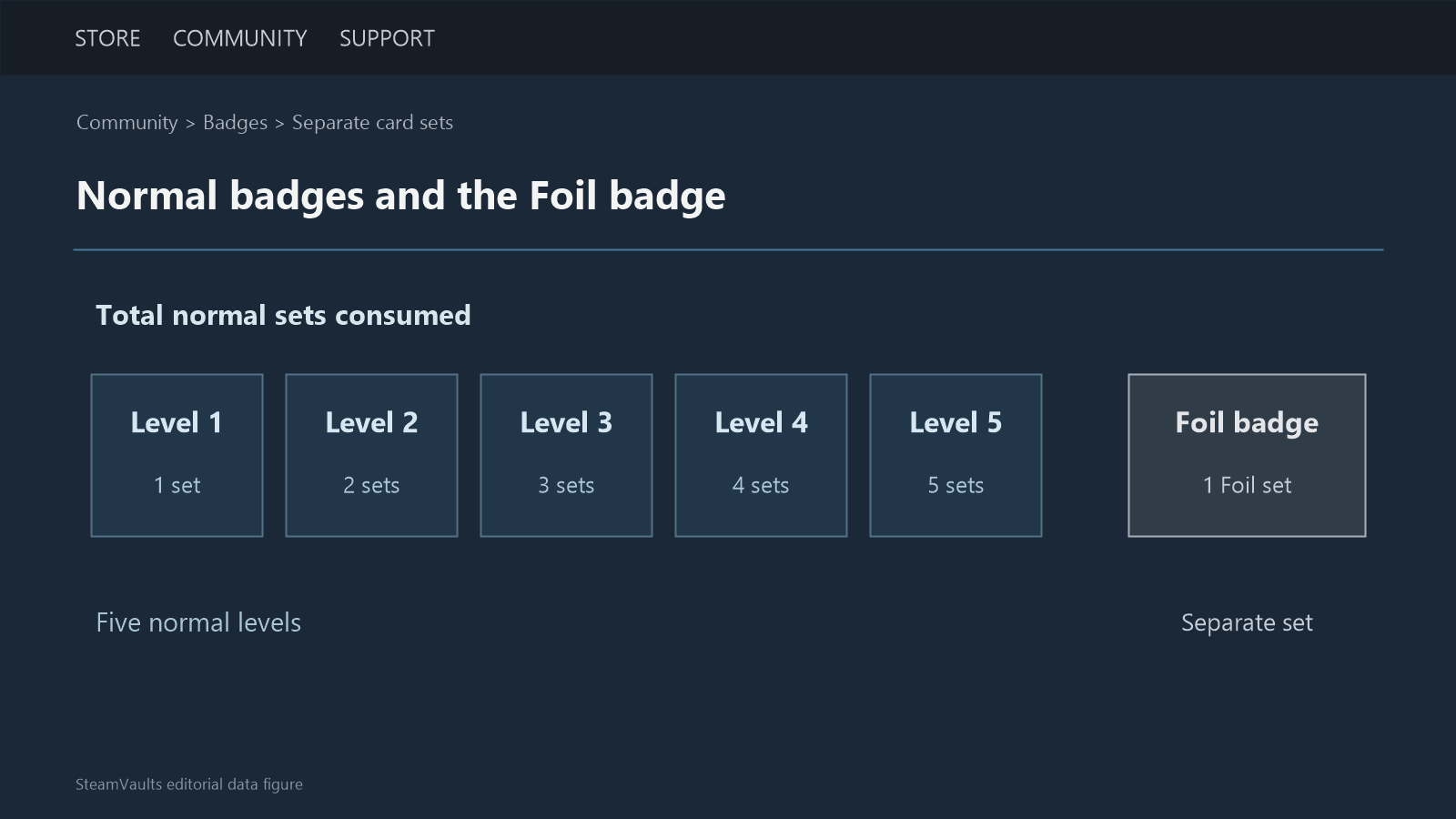
You upgrade an ordinary game badge by collecting another complete set for the same game. The maximum is five crafts including the first one. If the first badge is level 1, another four sets take it to level 5. Don't read “five upgrades” as an initial craft followed by five more, making six in total.
The Steamworks badge-asset instructions distinguish five regular levels from one Foil badge. The regular levels have their own images and names. A Foil badge comes from the Foil set; it isn't a final stage automatically awarded for finishing all the regular levels.
Check the next stage's artwork and name before upgrading for its appearance. You may prefer the colors of an earlier stage; reaching level 5 needn't produce your favorite design. If you're only collecting XP, the artwork may matter less.
Look at the game's badge page and published game material for the actual design you're considering. Check whether an image you've found shows regular level 1, regular level 5, or the Foil badge. A picture on someone else's profile isn't enough to tell you which set and stage will produce it.
Valve explicitly says Foil cards and badges have no additional benefit apart from rarity. A higher asking price, if you encounter one, doesn't buy extra friends-list benefits or special Market permissions. Collecting the rare version can be enjoyable without those extras.
For a functional goal, compare ordinary badges and the XP needed. If you want a Foil design or its rarity, choose a budget for that preference without expecting extra account features.
The profile item you want might not require a badge
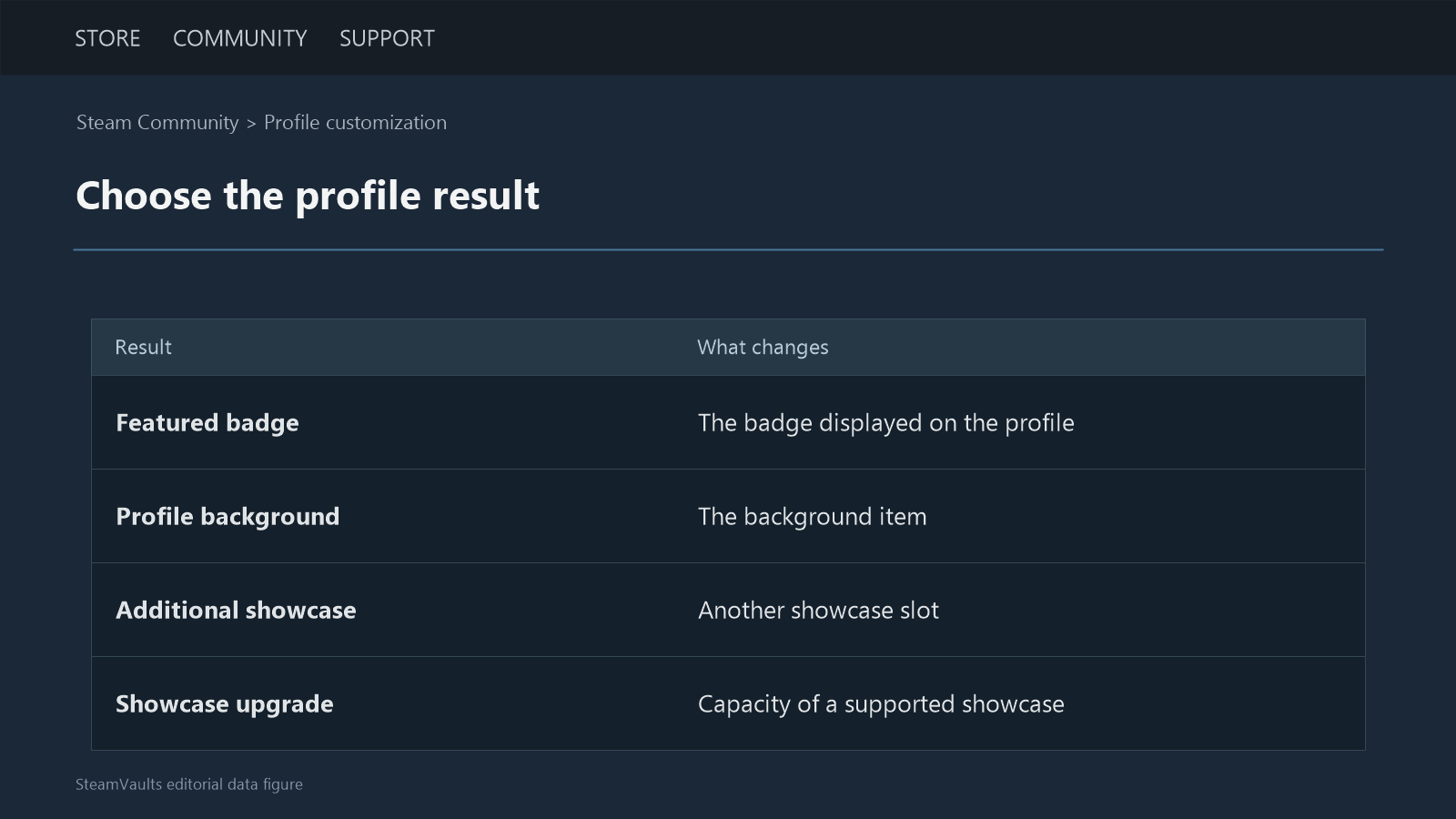
Suppose a background on a friend's profile makes you start collecting cards. The first question isn't “what level do I need?” It's “what is that item called?” A regular profile background, an animated mini-profile background, an avatar frame, and an image placed in a showcase send you to different places. A good-looking profile doesn't mean every effect on it came from a badge.
Valve describes several ways to obtain Community items: crafting, user trades, the Community Market, and the Points Shop. For redeeming a game's emoticons and static profile backgrounds with Points, its developer documentation specifies owning the game and having at least two hours of playtime. Keep that scope intact. It is a condition for those redemptions, not a rule to apply indiscriminately to every Points Shop product.
Once you've identified a background by name, see whether it is actually offered in the Market or Points Shop. Games have different items and may have purchase conditions, so don't assume the picture will be available. If there's a way to choose the exact one, you have less reason to keep trying random crafts.
Valve's Points Shop Items documentation covers separately prepared animated avatars, avatar frames, mini-profile backgrounds and game-profile bundles. If you want an animated frame, look for that item instead of searching an ordinary badge's reward list. These profile decorations aren't all in the same reward pool.
Read showcase names carefully, too. Getting another place to position a showcase and upgrading how much an existing showcase can display are different desired outcomes. Don't assume more XP automatically expands the contents of the particular showcase you want. Compare the product description on the Points Shop showcase page with the options in your own profile editor. I can't see which options each reader's account has already purchased, so this isn't a promise that a particular purchase immediately enables the same layout on every account.
For example, someone who wants to show another screenshot should first describe the result plainly. Do they want more pictures inside one showcase, or another showcase elsewhere on the profile? Buying XP before settling that question can leave them with a higher level and a page that still doesn't match the plan. Knowing the desired result tells you which product description to read.
Check your existing backgrounds and editing options before buying more. An unused showcase slot or a background you already own may fit the plan. You can still choose a new design, but then you're paying for a different appearance rather than a missing feature.
Already owning the cards doesn't make the craft cost nothing
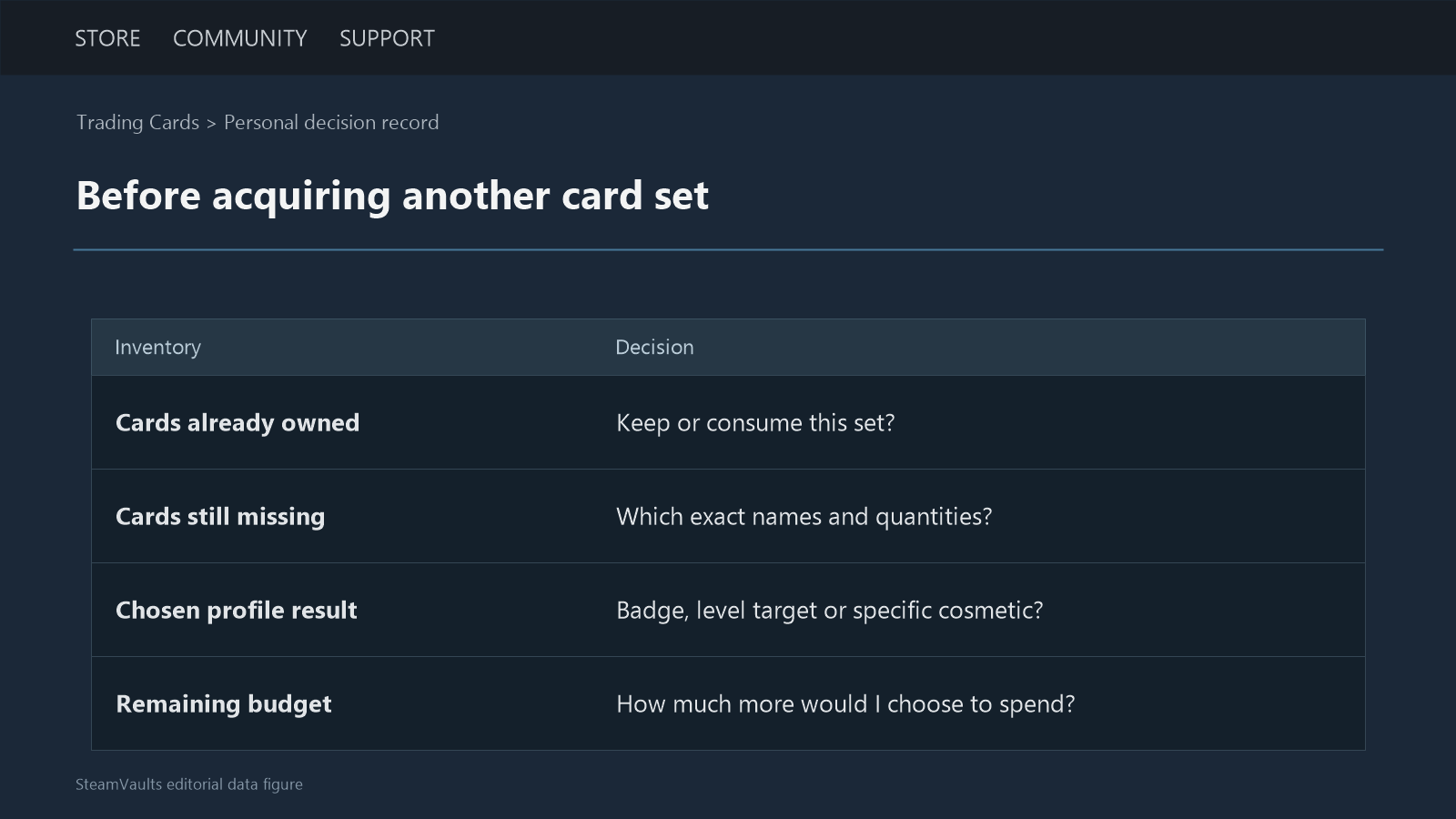
A single missing card can make completion tempting even if you never wanted the badge. Ask what you'd use the finished result for. You don't need a long attachment to the game—an accidentally collected set can become a badge you enjoy—but having most of its cards doesn't oblige you to buy the rest. You may prefer another game's half-finished set.
Note three things separately: the new payment, the owned cards you'll consume and the result you plan to use. A small payment doesn't make the existing cards irrelevant. Once you've accounted for them, though, you can choose to use them without treating preservation as the only sensible option.
This article doesn't provide a live-price table. Each game has different cards and prices, and your inventory changes the missing quantity. Use the names, quantities and current purchase total for your set rather than an old “price per badge.” The Market guide covers price comparison; keep the resulting amount beside your crafting purpose and budget.
If you want one favorite game's badge on your profile and its cost fits the budget, you needn't hunt for a cheaper unrelated badge. That other badge might supply XP without giving you the result you wanted.
For several games at once, look at the whole total before starting. Small payments can add up to more than expected. If one set needs one card and another needs several, simply counting how many games can be completed doesn't tell you enough. Choose the intended crafting list, check all the missing cards, then remove some entries if the total doesn't suit you.
Mark sets you won't craft, too. You might prefer one game's card artwork, another game's badge and neither for a third. Managing the inventory doesn't require the same decision for every set.
If you're still deciding how to get the missing cards, the comparison of booster crafting and buying identified cards deals with that choice. The decision here comes afterward. Completing a set doesn't oblige you to craft it. If you clearly want the badge, then you can concentrate on how to obtain its set.
If future earnings are the only reason left, I wouldn't rush. Check the separate rules in the card-drop and booster-eligibility guide. Uncertain rewards don't automatically offset the cards used now, and enjoying a profile purchase doesn't require an earnings plan.
Check the badge page once more before crafting
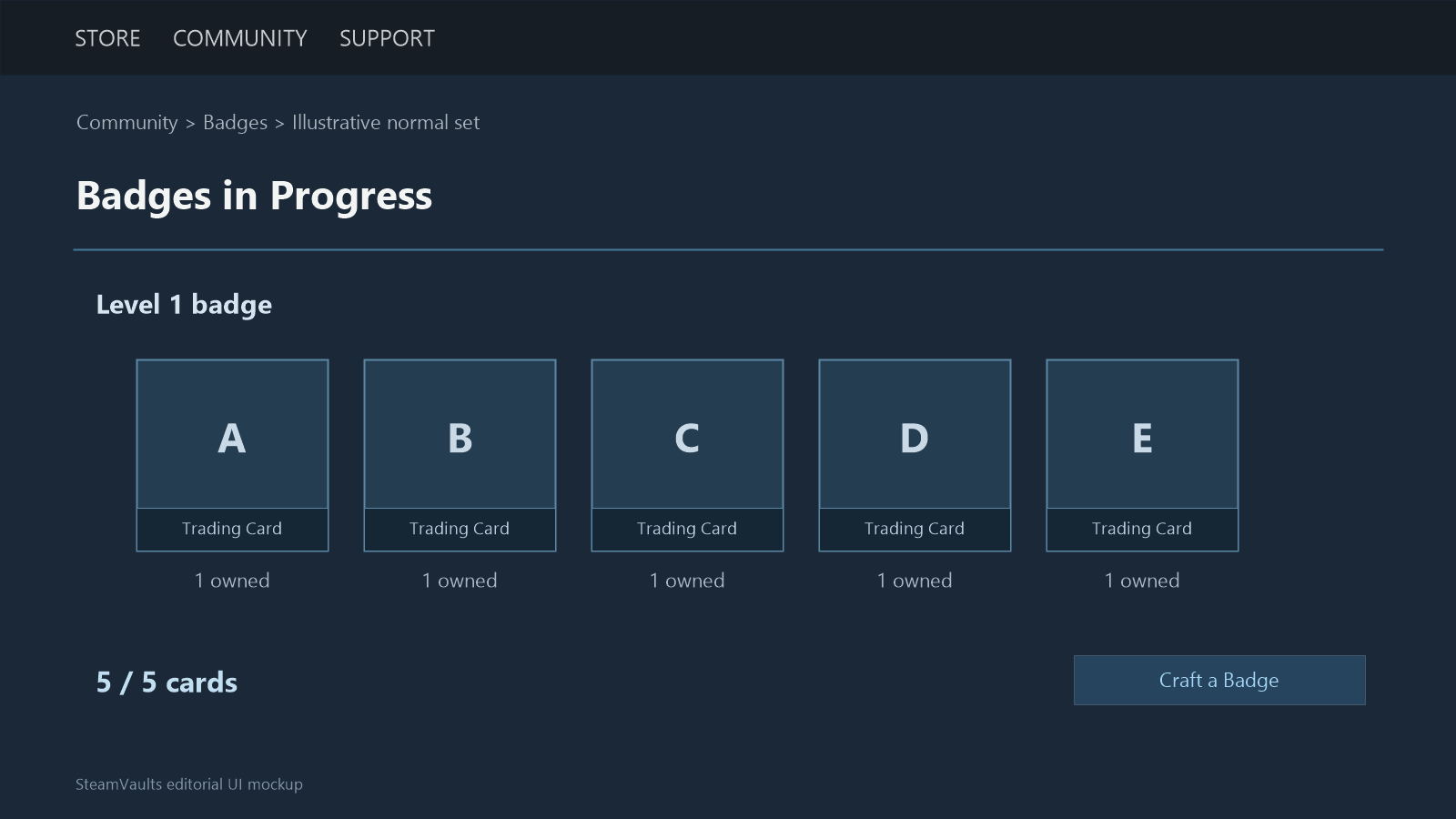
Once you've decided to craft, open the Badges page from your own Steam profile. The official route is to choose the game's badge in Badges in Progress, inspect the owned and missing cards, and use Craft a Badge when the set is ready. Menu translations and layout can vary. What matters first is that you're on your account's set for the right game, not a page you've reached from someone else's profile.
Check the game and the regular-versus-Foil category. Then check the current badge stage and the one you intend to craft. Having several spare sets doesn't change a plan to craft once. There's no reason to make “use everything ready” a habit. You can see the result and decide separately whether to use another set.
Craft on your own Steam account. The process doesn't require another service's login or sending your cards to someone else. A stranger promising cheap levels gives you no reason to entrust them with cards or account access.
Afterward, check the game's badge, the XP change, and which rewards arrived in your inventory. If you had several sets, check how many spare cards remain. Confirm that you've crafted the number of times you intended.
If the page appears to freeze during crafting, avoid immediately pressing the button over and over. Check your badge list and inventory to see whether the result has already been applied. Repeating an action before distinguishing an unrefreshed page from an unsuccessful craft can make it harder to track how many times you've proceeded. This article can't establish the cause or recovery time of a particular error. If a problem continues, use the displayed message and current account state when seeking Steam support.
If you crafted it to display, select it as your featured badge and check the profile. You don't need to redesign the page; see whether the badge looks as you hoped.
For a level-based goal, open the profile editor and check the feature you were working toward before shopping for another level.
Keeping the set is a valid use of your inventory
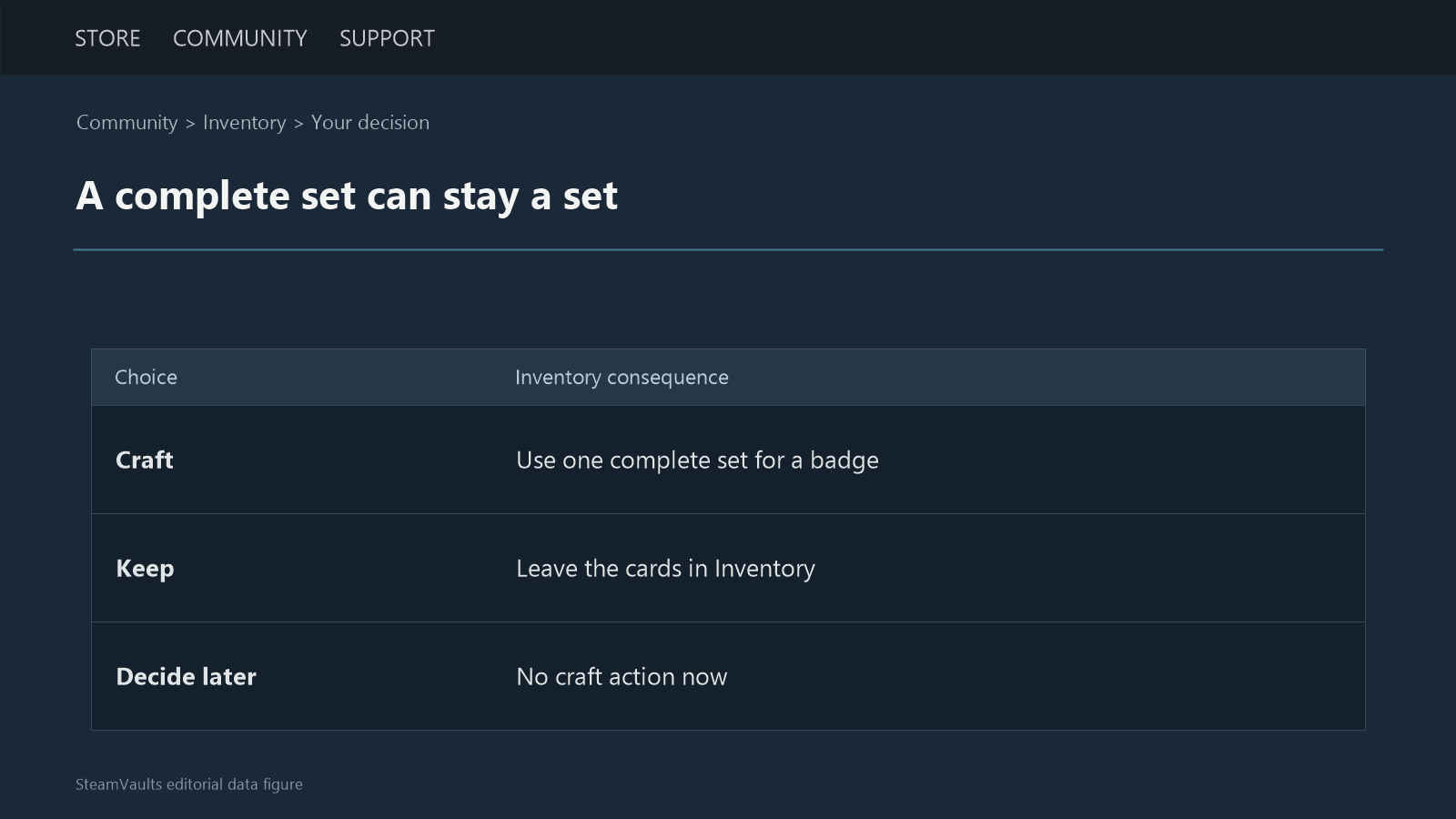
Cards lead to badges, badges add XP, and levels unlock showcases. It's easy to keep following those connections without deciding whether you want the next feature. I don't think understanding Steam requires using every option it offers.
If a badge is a reminder of a game you love and you accept the cost, that's enough reason to make it. It needn't earn a return or prove gaming skill.
If its artwork, levels and showcases don't interest you, leave the set ready to craft. You can reconsider later. Keeping cards deliberately isn't unfinished inventory tidying.
There's no need to debate it endlessly if you like the badge and don't mind losing the cards. A collector who prefers their artwork may choose the opposite at exactly the same price. Cost alone won't settle that preference.
One easy test is to say the reason in a sentence before pressing the button. “I want this game's badge as my featured badge.” “I need this much more XP for a screenshot showcase.” “I like the Foil design, so I'm collecting its set.” If you have a reason like that and accept the budget, crafting is your choice. If all that's left is “the set is complete, so I suppose I should” or “boosters will eventually pay for it,” you can stop for now.
A badge you've already made might feel less exciting than expected. That doesn't require an immediate upgrade to make up for it. Try placing the reward background, feature the badge, and if you don't like the result, choose not to craft more for a while. Using more sets in an attempt to recover the one you've already spent doesn't resolve the original disappointment.
For me, knowing an inventory's value includes knowing what I'd keep as cards, what I'd use for a badge and what I'd leave undecided. The level number only captures part of that choice.
Sources checked on September 5, 2026: Valve's Trading Cards FAQ, Steam Levels help page, and Steamworks Community Items and Points Shop documentation. The table is XP arithmetic under stated assumptions, not a record of prices, crafting returns, or tests on a personal account. Images are explanatory mockups.
Ready to sell supported Sacks of Gems?
After the bot confirms receipt, USDT is credited to your site balance. Polygon withdrawal is a separate request.